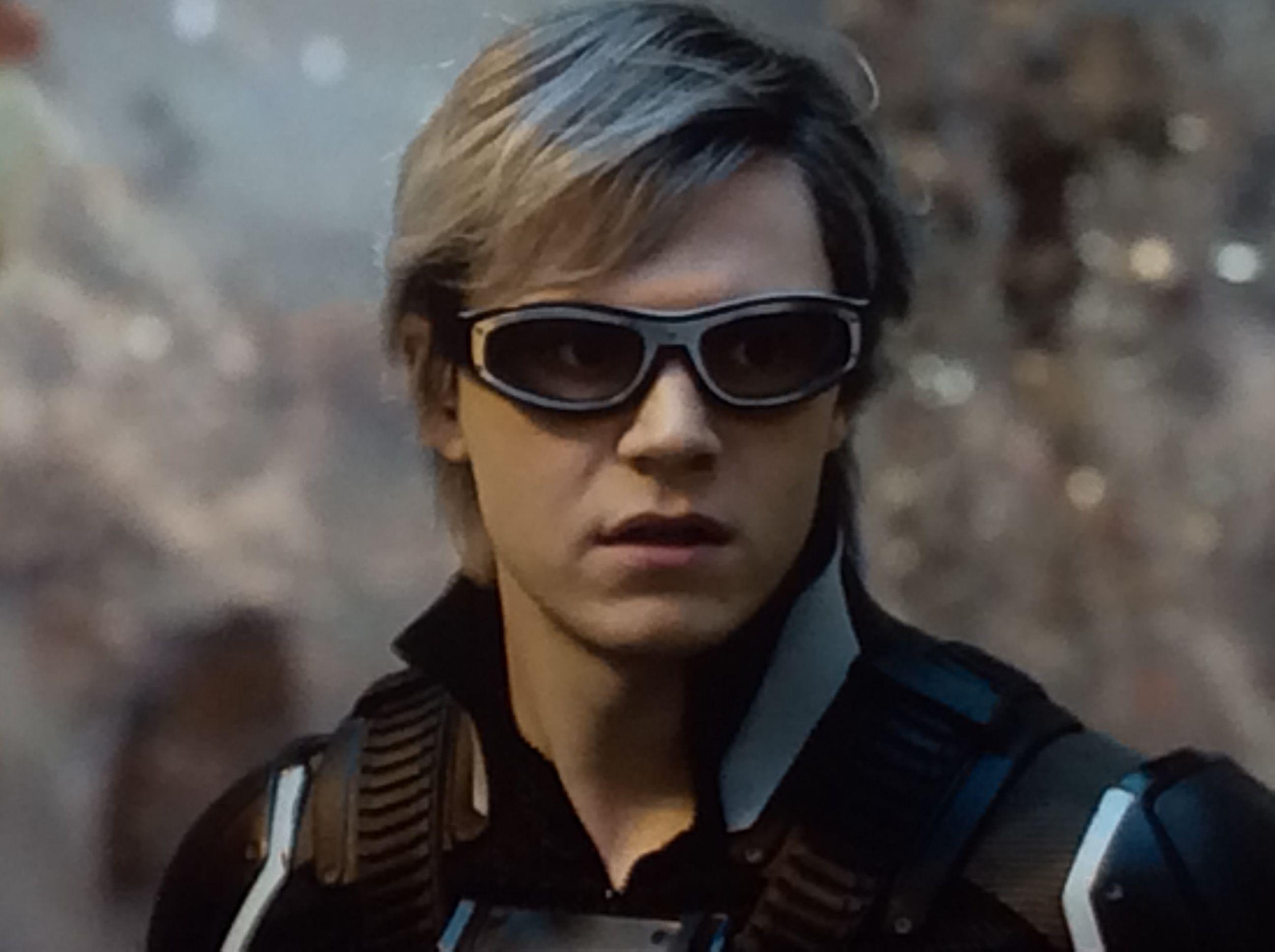
Honestly, if you ask any Marvel fan about the moment the Fox franchise finally "got it," they aren't going to talk about Wolverine's claws or Magneto's cape. They’re going to talk about a kitchen. Specifically, the Pentagon kitchen. That’s where the X-Men movies with Quicksilver shifted from being just another superhero series into something genuinely experimental and, frankly, way more fun than what the competition was doing at the time.
Evan Peters didn't just play Peter Maximoff; he hijacked the entire franchise. When he first showed up in Days of Future Past, people were skeptical. I remember the first look photos—the silver jacket, the goggles, the "mom's basement" vibe. It looked kinda cheap. Then the movie hit theaters and he became the only thing anyone wanted to talk about.
Why the X-Men Movies With Quicksilver Changed the Game
The brilliance of these films wasn't just in the speed. It was in the perspective. Most speedsters in movies are just a blur. You see them run, things blow up, and they're standing at the finish line. Boring.
In the X-Men movies with Quicksilver, director Bryan Singer and the VFX team at Rising Sun Pictures decided to flip the script. They showed us the world through Quicksilver's eyes. Time doesn't just move fast for him; the rest of the world basically stops.
Take that 2014 kitchen scene. To get those shots, they used high-speed Phantom cameras filming at 3,600 frames per second. For context, a normal movie is 24 frames per second. If you blink, you miss several seconds of real-time action, but in Peter's world, that blink lasts an eternity. They had Evan Peters running on treadmills against green screens while 70 artists spent seven months rendering CGI soup, floating carrots, and slow-motion bullets.
It wasn't just a technical flex. It was a character beat. While Magneto and Xavier are having a high-stakes heart-to-heart about the fate of mutantkind, Peter is just vibing to "Time in a Bottle" by Jim Croce. He’s tasting the soup. He’s flipping hats. He’s poking guards in the face. It’s hilarious because it’s exactly what a teenager with god-like speed would actually do.
The Evolution from Days of Future Past to Dark Phoenix
The franchise knew they had a hit, so they kept raising the stakes. By the time X-Men: Apocalypse rolled around in 2016, they went bigger. Much bigger.
The "Extraction" scene—where the X-Mansion is literally exploding—is a masterclass in superhero filmmaking. Peter arrives just as the explosion begins. Most movies would have everyone die. Instead, we get a three-minute sequence of Quicksilver saving everyone (including a dog eating pizza) to the tune of "Sweet Dreams (Are Made of This)."
- Days of Future Past (2014): The breakout. We meet him as a kleptomaniac living with his mom.
- X-Men: Apocalypse (2016): The emotional core. He joins the team officially and looks for his dad (Magneto).
- Deadpool 2 (2018): A blink-and-you'll-miss-it cameo where he shuts a door on Wade Wilson.
- Dark Phoenix (2019): A bit of a letdown for Quicksilver fans, as he gets sidelined early after Jean Grey tosses him aside.
It’s sorta heartbreaking how his arc ended in Dark Phoenix. He was the heart of the "New Class" cast, yet the script didn't give him much to do after the space mission. But even in a lackluster movie, his presence felt essential.
The Magneto Connection: The Story We Almost Got
One of the biggest missed opportunities in the X-Men movies with Quicksilver was the unresolved father-son dynamic. Throughout Apocalypse, Peter is carrying this heavy secret. He knows Erik Lehnsherr is his father. He goes to the mansion to find him. He follows him to Cairo.
But he never actually says it.
There’s a scene where he’s talking to Mystique, and he admits he’s there for his dad. It’s a rare moment of vulnerability for a character who usually hides behind jokes and high-speed pranks. Fans spent years waiting for the big reveal. We wanted that awkward family dinner. Instead, the Fox era ended before they could ever truly bridge that gap.
Nuance matters here. Unlike the MCU version (Pietro Maximoff), Peter had a home life. He had a sister (seen briefly in a deleted scene and hinted at in the house). He had a personality that wasn't just "angry guy with an accent." He felt like a real person who just happened to be able to break the sound barrier.
Comparing the Two Quicksilvers
It’s impossible to talk about this without mentioning Aaron Taylor-Johnson's Quicksilver in Avengers: Age of Ultron. Look, Aaron is a great actor. But the MCU version felt... stiff. He was a "miracle" created by an Infinity Stone. He was brooding. And then, well, he died.
Evan Peters' Quicksilver was a mutant. That distinction is huge. It meant his powers were part of his DNA, not a lab accident. It gave him a history. In the X-Men movies with Quicksilver, the speed felt like a lifestyle, not just a tactical advantage.
The MCU tried to play with this later in WandaVision by bringing Evan Peters in as "Pietro." Fans went wild. Was this the multiverse? Was the Fox universe merging?
Nope. Ralph Bohner.
That "Bonner" joke in 2021 remains one of the most divisive moments in Marvel history. Evan Peters recently mentioned in interviews that he didn't even know his character's last name until he filmed the scene where Monica Rambeau reveals it. He thought it was hilarious; most fans thought it was a slap in the face.
Technical Mastery: How They Made Him Fast
If you’re wondering why those scenes look so much better than other speedster effects, it's the "wash."
When Peter moves, he leaves a wake. In the kitchen scene, you see the water droplets from the sprinklers being pushed aside by his movement. The VFX team simulated fluid dynamics to show how air and water would react to a human moving at Mach 10.
- Cameras: Phantom 65 and Stereo Phantom.
- Lighting: Massive arrays of heat-producing lights to compensate for the high frame rate.
- Set Design: The kitchen was built specifically to be destroyed and interacted with at a "frozen" pace.
It’s expensive. It’s time-consuming. But it’s the reason those movies stay in your brain long after you've forgotten the plot of Apocalypse.
Actionable Insights for Fans and Rewatchers
If you're planning a rewatch of the X-Men movies with Quicksilver, don't just watch the action. Look at the background.
- Check the Shirts: Peter is always wearing band shirts (Pink Floyd, etc.) that aren't quite "right" for the year the movie is set. It’s a nod to him being "ahead of his time."
- Watch the Hands: In Days of Future Past, he vibrates his hands to shatter the glass in Magneto's cell. This is a classic comic book power that often gets ignored in movies.
- The Food Motif: Speedsters need calories. Notice how he's almost always eating or holding a snack (Tab soda, pizza, Twinkies) right before or after a big run.
The legacy of these films is complicated, but Quicksilver is the undisputed highlight. He proved that you could make a "god-level" hero feel relatable by giving them a sense of humor and a slightly annoying personality.
If you want to dive deeper, I'd suggest looking for the "Quicksilver Power Piece" featurettes on the Blu-rays. They show the literal blood, sweat, and tears that went into making a three-minute scene. It makes you appreciate the character way more when you see Evan Peters sweating under 100-degree lights just to get that perfect "slow" look.
For those holding out hope for a real return, keep an eye on the Avengers: Secret Wars rumors for 2027. With the multiverse now wide open, the chance of seeing the "real" Peter Maximoff one last time is higher than it’s been in years. Until then, we’ve always got the Jim Croce scene.
To get the full experience of how these scenes were built from the ground up, go back and watch the behind-the-scenes "Extraction" featurette from Apocalypse. It breaks down the 90-mph camera rigs used to track his movement through the mansion. Reading about the physics of how they kept the actors safe while simulating an explosion in slow motion gives you a whole new perspective on the technical craft behind the Fox era.