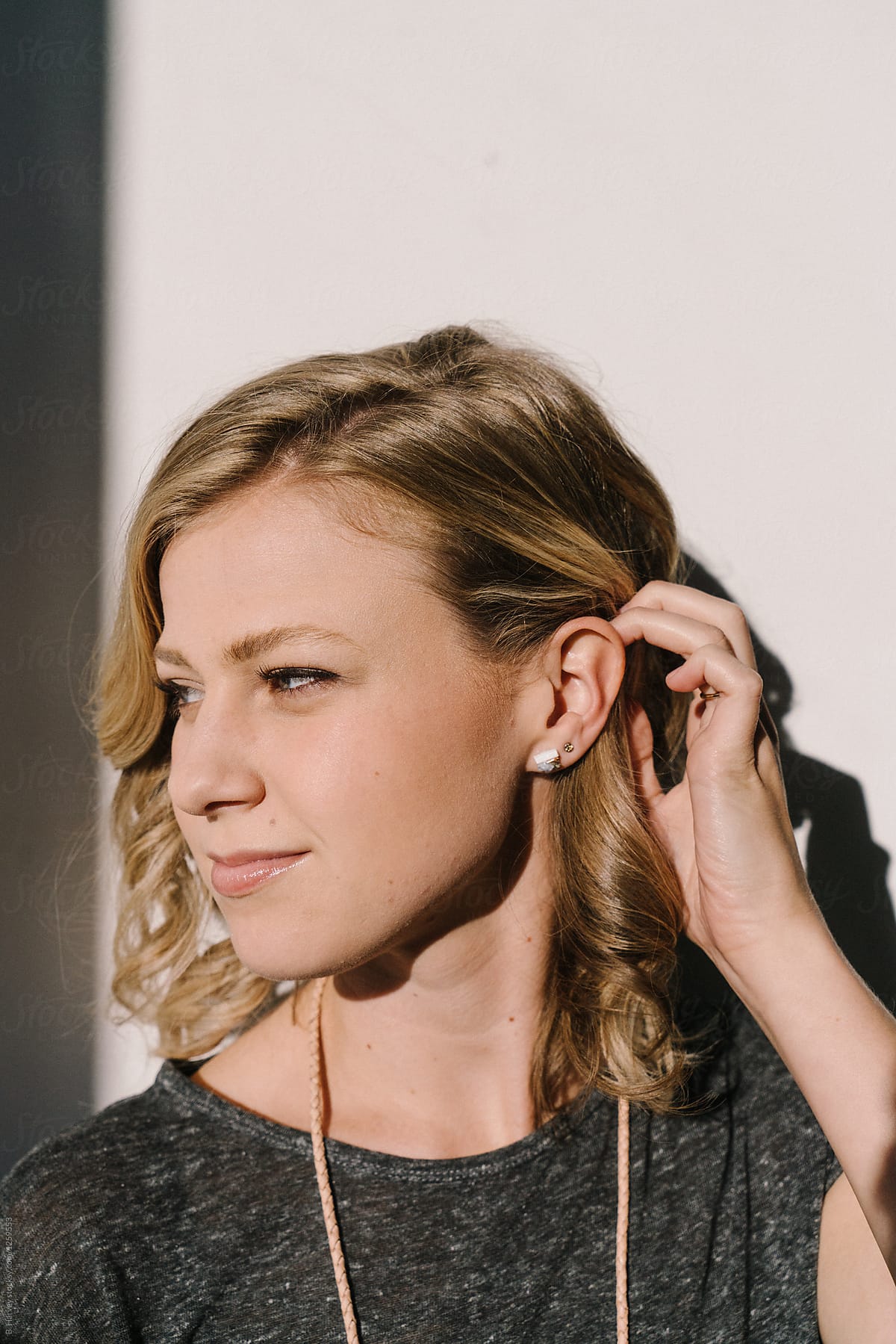
It’s a reflex. You’re leaning over a desk, or maybe the wind picks up on a Tuesday afternoon, and you just do it. Your hand goes up, the strands move, and suddenly you’ve tucked hair behind ears without even thinking. We do it thousands of times a year.
But have you ever noticed how different you look in the mirror the second you pull those strands back? It’s not just about getting hair out of your eyes. Honestly, it’s one of the most underrated "micro-adjustments" in the world of beauty and body language. It changes your jawline. It highlights your cheekbones. Sometimes, it even signals to the person across from you that you’re actually listening.
The Psychology of the Tuck
Body language experts have been obsessed with this for decades. When you see someone tucking hair behind ears during a conversation, it’s rarely just a grooming habit. Vanessa Van Edwards, a behavioral researcher and author of Captivate, often discusses how clearing the face is a sign of openness. You’re literally removing a barrier between yourself and the world.
Think about it.
When we’re nervous or hiding, we use our hair as a shield. We let it fall forward. We hide behind the "curtain." By tucking it back, you’re signaling vulnerability or confidence, depending on the context. In dating, it’s often cited as a "preening" gesture—a subconscious way to show off the neck, which is a high-sensory zone. It’s subtle. It’s effective. It’s basically human nature caught in a loop.
How Tucking Changes Your Face Shape
Let’s get into the aesthetics because that’s why most of us care. If you have a round face, tucking hair behind ears on both sides can sometimes make the face appear wider. That’s just geometry. However, the "single-side tuck" is a classic styling trick used by red-carpet hairstylists like Chris Appleton or Jen Atkin.
By tucking just one side, you create asymmetry. Asymmetry is interesting to the eye. It draws attention to the ear—hello, statement earrings—and creates a diagonal line that can actually elongate the look of your neck. If you’ve got a sharp jawline, this is your best friend. If you feel like your face is too "soft," leaving a few wispy strands (the "tendrils" we all loved in the 90s) in front of the tuck can soften the whole vibe.
The Struggle With "Slippage"
We’ve all been there. You tuck the hair, you walk ten steps, and whoosh, it’s back in your face. It’s incredibly annoying. This usually happens because the hair is too clean or too healthy. Smooth, silky hair has no "grip."
To make the tuck stay, you need friction.
Professionals usually reach for a dry texture spray or a bit of sea salt spray. You don’t need much. Just a quick spritz behind the ear before you move the hair. Some people swear by the "hidden bobby pin" trick. You take a small section of hair underneath the top layer, pin it flat against your scalp behind the ear, and then let the top layer fall over it. It’s invisible. It’s genius. It works even if you’re dancing or running for a bus.
Is Tucking Bad for Your Hair?
You might have heard rumors that constant tucking causes "traction alopecia" or thinning around the temples. Let’s clear that up.
Unless you are pulling your hair back with the force of a thousand suns, you aren’t going to go bald from tucking. However, there is a real thing called mechanical damage. If you tuck the exact same clump of hair 50 times a day, the friction against your skin and the constant bending can weaken the hair shaft.
Over time, you might notice shorter, fuzzier hairs around your ears. That’s breakage. To avoid this, try not to "tighten" the tuck too much. Keep it loose. Also, if you’re using glasses, the friction between the hair, the ear, and the frames can accelerate that wear and tear.
The Role of Ear Jewelry
You can't talk about tucking hair behind ears without talking about earrings. The "tuck" is the stage; the earring is the lead actor.
When your hair is down and covering your ears, expensive jewelry is basically pointless. Why wear those gold hoops if nobody knows they’re there? The "tuck" became especially popular again with the rise of the "ear party" trend—multiple piercings, cuffs, and stacks. If you’ve spent a few hundred dollars on a curated ear, you’re going to tuck. It’s the only way to show off the investment.
Cultural Context and the "Cool Girl" Aesthetic
In the mid-2010s, the "tucked hair" look became synonymous with the "Off-Duty Model" aesthetic. It was meant to look effortless. Like you just woke up, threw on a trench coat, and pushed your hair back because you were too busy being chic to care.
In reality, it’s often highly calculated.
Fashion photographers often demand the tuck because it defines the profile. If you look at high-fashion editorials in Vogue or Harper’s Bazaar, you’ll see the tuck used to create a "clean" look that doesn't distract from the clothes. It’s a tool for minimalism. It strips away the "mess" and leaves the structure.
Practical Steps for the Perfect Tuck
If you want to master this without looking like you’re trying too hard, follow these steps.
First, consider your part. A deep side part almost always looks better with a tuck on the "shallow" side (the side with less hair). It balances the weight of the style.
Second, use product strategically. A tiny bit of pomade or wax on your fingertips can help "glue" the hair behind the ear without making it look greasy. Just a touch.
Third, don’t be afraid of the "double tuck" for a sporty, sleek look, but make sure you have some volume at the crown of your head. If the top is too flat and the sides are tucked, it can look a bit "helmet-ish." A little dry shampoo at the roots solves this instantly.
Finally, check your posture. Tucking your hair back highlights your neck and shoulders. If you’re slouching, the tuck just emphasizes the slouch. Stand up straight, tuck that hair, and suddenly you look like you’ve got your life together, even if you’re just going to the grocery store.
Actionable Insights for Your Daily Routine:
- For Grip: Use a matte texture powder behind the ears to prevent hair from sliding forward every five minutes.
- For Face Framing: Leave a 1-inch section of hair out in front of the ear to "slim" the face while tucking the rest for a clean look.
- For Hair Health: Give your hair a break at night. If you tuck all day, don't sleep with your hair pinned or tucked; let it fall naturally to avoid stress on the follicles.
- For Styling: Match your tuck style to your outfit. A sleek, tight tuck works for formal events, while a loose, messy tuck is better for casual weekends.