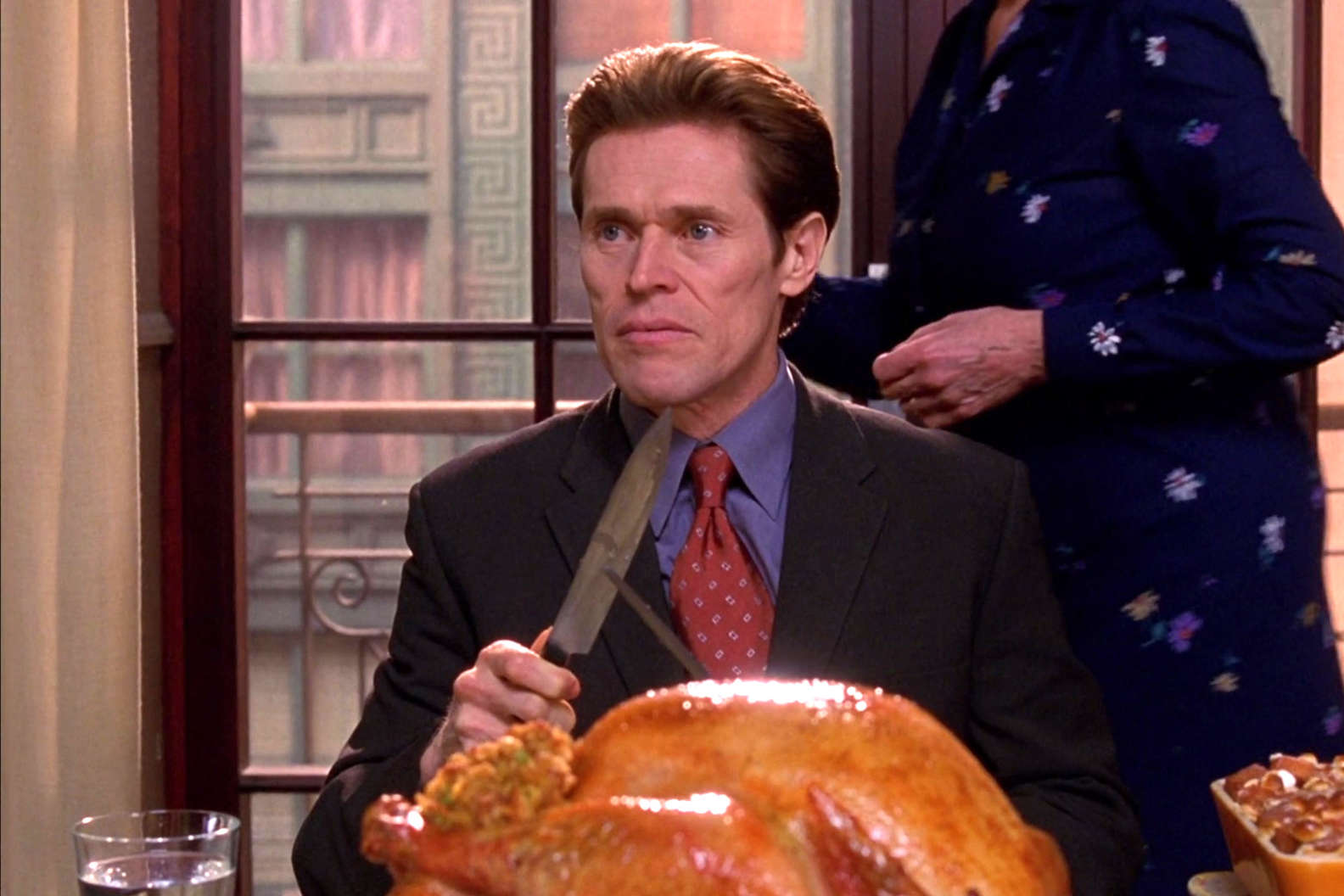
It is the tension. That's what sticks with you. You have a roasted turkey, some mashed potatoes, Aunt May’s nervous energy, and a room full of people who are essentially a ticking time bomb. When Sam Raimi sat down to film the Spider Man thanksgiving scene for the 2002 original film, he wasn't just making a superhero movie. He was making a horror-tinged family drama.
Think about the stakes. Peter Parker is literally bleeding under his clothes. Norman Osborn is slowly losing his mind. It is a masterpiece of subtext.
The Knife, the Green Blood, and the Moment Everything Changed
Most people remember the 2002 Spider-Man for the upside-down kiss or the final battle at the bridge. But the real turning point happens over dinner. This isn't just a meme. It is the narrative pivot point of the entire trilogy. Up until this dinner, Norman Osborn—played with terrifying oscillation by Willem Dafoe—mostly views Peter as a surrogate son. He likes the kid. He thinks Peter is "brilliant but lazy," or at least brilliant enough to be worth his time.
Then comes the cut.
Peter has a wound on his arm from a run-in with the Green Goblin earlier that day. As Aunt May tries to serve the bird, Norman notices the blood. It isn't just red; in the context of the film’s color palette and the way Sam Raimi shoots it, that wound represents the death of Norman's respect for Peter. He realizes the "brat" behind the mask is the boy sitting across from him.
The acting here is subtle but heavy. Dafoe doesn't scream. He doesn't transform into a monster right there at the table. Instead, he just stares. He looks at the wound, then at Peter, then back at the wound. You can see the gears shifting from "mentor" to "predator." It is chilling because it happens in such a mundane, safe setting. Thanksgiving is supposed to be the ultimate safe space, and Raimi violates that.
Why Sam Raimi Used Horror Techniques for a Family Dinner
Sam Raimi started in horror with Evil Dead. He knows how to make a room feel small. In the Spider Man thanksgiving scene, he uses those same tricks to make the audience feel physically uncomfortable.
Look at the camera angles. They get tighter and tighter. We see extreme close-ups of Norman’s eyes. We see Aunt May’s hands trembling. The sound design even changes; the clinking of silverware starts to sound like sharpened blades. Most superhero movies today rely on massive CGI explosions to create tension, but this scene does it with a carving knife and a Cranberry sauce dish.
Honestly, the chemistry between the cast makes it work. You have Rosemary Harris as the moral compass, Kirsten Dunst as Mary Jane trying to navigate a failing relationship with Harry, and James Franco playing the neglected son. It’s a mess. It’s a classic American holiday mess, just with a dash of supervillainy.
The Power of the "Great Power" Irony
There’s a specific irony that often goes overlooked. Throughout the film, Peter is told that with great power comes great responsibility. During this dinner, his "power" is exactly what puts his family in danger. If he hadn't been Spider-Man, Norman wouldn't have been looking for a reason to hate him. By being a hero, Peter has effectively invited a murderer to his aunt's table.
It’s heavy stuff for a movie that came out in 2002.
Misconceptions About the Green Goblin's Motivation
A common thing people get wrong about this scene is thinking Norman leaves because he's "scared" or overwhelmed. He isn't. He leaves because the Goblin persona has completely taken over his rational mind. When he stands up and abruptly exits, insulting Mary Jane on the way out, he isn't just being a jerk. He’s severing his last ties to humanity.
He tells Harry that Mary Jane is only after his money. It’s a cruel, tactical move. He wants to isolate Harry so that the only thing Harry has left is the Osborn legacy—and the Goblin. This dinner wasn't just a discovery phase; it was a demolition of Harry’s social life.
The Enduring Legacy of the Dinner Table Confrontation
Why are we still talking about this twenty-plus years later? Well, for one, the memes. "Work was murder" is a line that has lived on in internet history forever. But beyond the jokes, it represents a type of filmmaking we don't see much of anymore in the MCU or the DCEU.
Modern superhero movies often feel like they're rushing to the next fight. Raimi let the Spider Man thanksgiving scene breathe. He let the silence do the talking. You feel the grease on the turkey. You feel the heat in the room. It feels lived-in.
Breaking Down the Visual Cues
If you rewatch it today, pay attention to the colors.
- Peter/May: Warm tones, browns, oranges. They represent the "hearth."
- Norman: Sharp greens and deep shadows.
- The Transition: As Norman realizes the truth, the lighting on his face shifts to become more harsh, mimicking the mask he wears.
It’s visual storytelling 101, but executed by a master. Even the way he handles the carving knife is purposeful. He holds it like a weapon, not a tool.
How to Apply These Storytelling Lessons Today
If you’re a writer or a filmmaker, there is a lot to learn from how this scene was constructed. It teaches us that stakes don't have to be global to be massive. The stakes of this scene are simply: Will Aunt May find out? and Will Norman kill them right now? That is more compelling than a giant blue beam in the sky. It’s personal.
To really appreciate the craft here, you have to look at the "No Way Home" callbacks too. When Willem Dafoe returned to the role in 2021, the writers knew they had to reference the tension of the original. They understood that the most dangerous version of Norman Osborn isn't the one on the glider—it’s the one standing in your kitchen.
Actionable Insights for Fans and Creators
If you want to dive deeper into the history of this scene or use its techniques for your own projects, consider these steps:
1. Study the Edit
Watch the scene on mute. Notice how the pacing of the cuts increases as Norman gets closer to the truth. The visual rhythm tells the story even without the dialogue.
2. Explore the "Raimi-Cam"
Sam Raimi uses "push-ins" (rapidly zooming or moving the camera toward a character's face) to signal a psychological shift. Note where he uses this on Norman versus Peter.
3. Analyze the Dialogue Subtext
Read the script for this scene. Almost every line has a double meaning. When Norman says he has to go because of "an adventurous soul," he’s talking about the Goblin. Look for ways to give your own dialogue that second layer of meaning.
4. Contextualize the Era
Remember that in 2002, the "Secret Identity" trope was treated with much more gravity than it is now. In a world where every Avenger has a public PR firm, the tension of a secret identity feels like a relic of a different time. Appreciate the scene for its commitment to that high-stakes secrecy.
The Spider Man thanksgiving scene remains a high-water mark for the genre because it respects the characters' domestic lives as much as their super-powered ones. It reminds us that the scariest villains aren't the ones we fight in the streets, but the ones we accidentally invite to dinner.