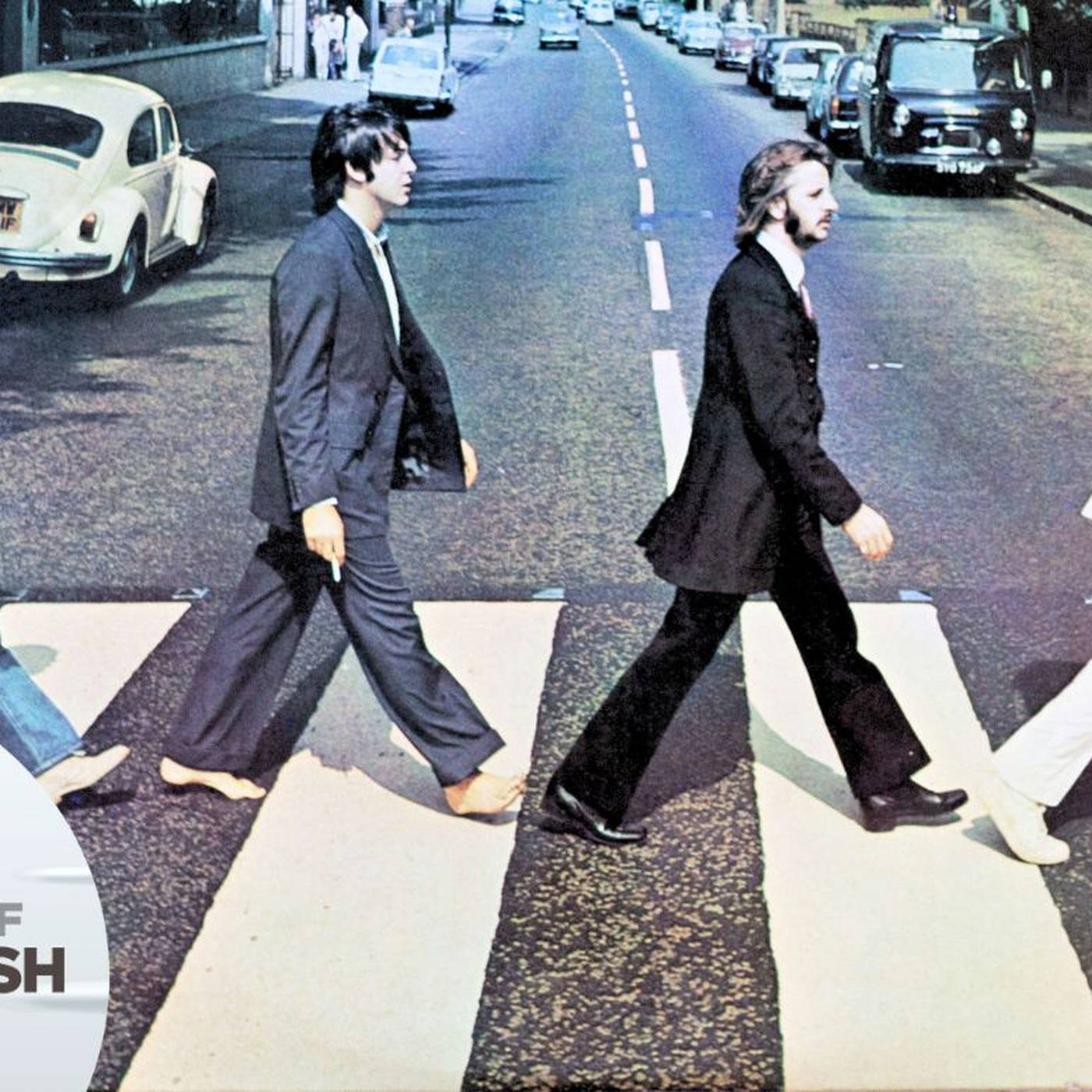
It happened on a Friday morning. Specifically, August 8, 1969, at around 11:35 AM. Iain Macmillan, a photographer standing on a stepladder in the middle of a leafy North London street, had exactly ten minutes to change pop culture forever. A policeman held up traffic. John, Ringo, Paul, and George walked across those white stripes six times. That's it. No big production. No CGI. Just four guys in suits (and one in denim) walking away from the studio where they had spent the better part of a decade redefining sound.
The result? The Beatles Abbey Road CD cover—well, it was an LP cover first, obviously—became a Rorschach test for an entire generation.
People don't just look at this image. They interrogate it. They look for clues about death, rebirth, and the end of the 1960s. Even now, decades later, if you go to that specific spot in St. John’s Wood, you will see a line of tourists blocking traffic to recreate the shot. It’s honestly a bit of a nightmare for local delivery drivers, but it speaks to the gravity of that single frame.
The day the music walked
Let's talk about the heat. It was a sweltering London summer. You can almost feel the humidity coming off the asphalt in the photo. This is why Paul McCartney is barefoot. It wasn't some grand symbolic gesture about being a "corpse" in a funeral procession, despite what the "Paul is Dead" theorists will tell you. He just lived nearby, showed up in sandals, and decided to kick them off because it was hot.
That’s the thing about the Beatles Abbey Road CD cover. Much of what we call "iconic" was actually just a series of happy accidents and last-minute pivots. The album wasn't even supposed to be called Abbey Road. The working title was Everest, named after the brand of cigarettes the engineer Geoff Emerick smoked. There were grand plans to fly the band to the Himalayas for a photoshoot.
But the Beatles were tired. They were falling apart. The friction during the Get Back sessions had left them drained. The idea of flying to Nepal seemed like a chore. Someone—legend says it was Paul—basically said, "Why don't we just go outside and name it after the street?"
So they did.
Macmillan took six photos. In the first, they were out of step. In the second, they walked the other way. It was the fifth shot that worked. The symmetry was almost perfect. Their legs formed a series of inverted "V" shapes. John Lennon led the pack in white, looking like a priest or a messiah figure. Ringo followed in a black frock coat, the undertaker. Then Paul, out of step and barefoot, the "deceased." Finally, George Harrison in denim, the grave digger.
The "Paul is Dead" madness and the Volkswagen Beetle
If you look at the Beatles Abbey Road CD cover on your phone or your old jewel case, look at the white car in the background. It’s a Volkswagen Beetle. Its license plate reads "LMW 28IF."
In 1969, conspiracy theorists lost their minds over this. They claimed "LMW" stood for "Linda McCartney Weeps" and "28IF" meant Paul would have been 28 if he had survived his supposed car crash in 1966.
Facts check: McCartney was 27 when the photo was taken.
The car actually belonged to a guy who lived in the flats across from the studio. After the album came out, his license plate was stolen so many times he eventually sold the car. It ended up in a museum in Germany. That’s the level of mania we’re dealing with. Even the man standing on the sidewalk in the distance—Paul Cole, an American tourist—didn’t realize he was in the most famous photo in the world until he saw the album in a record shop months later. He was just waiting for his wife to finish looking at a museum.
Why the CD version changed the way we see the art
When the music industry shifted to digital and the Beatles Abbey Road CD cover hit the shelves in the late 80s, something changed. The scale was gone. On a 12-inch vinyl sleeve, you can see the detail in the trees. You can see the cigarette Paul is holding in his right hand (another "clue," since he’s a lefty).
On a small plastic CD case, the image becomes more about the graphic lines. It becomes a logo. The four silhouettes are so recognizable that you don't even need the band's name. In fact, Abbey Road was the first Beatles album that didn't have the band's name or the album title on the front cover.
EMI executives were terrified. They thought people wouldn't know what it was. But John Kosh, the art director, famously said that the Beatles were the biggest band in the world and didn't need to say who they were. He was right. The cover is a masterpiece of minimalism, even if it was born out of laziness and a heatwave.
The back cover mystery
The back of the Beatles Abbey Road CD cover is often ignored, but it’s just as eerie. It’s a photo of a street sign on the corner of Abbey Road and Alexandra Road. During the shoot, a girl in a blue dress walked through the frame. Macmillan was annoyed, but he kept the shot.
People spent years trying to find out who she was. Some thought it was a fan; others thought it was a "spirit." In reality, she was just a pedestrian caught in the orbit of history. The wall where that sign was fixed was demolished in the 1970s, but the mystery of that blue dress remains one of the smaller, quieter enigmas of the Beatles' lore.
Technical details most people miss
The lighting in the photo is actually quite harsh. Because it was midday, the shadows are short and vertical. This usually makes for a bad photograph, but here, it adds to the clinical, almost staged feeling of the walk.
- Camera: Leica M3 with a 50mm lens.
- Film: Kodak Ektachrome.
- The "Fifth Beatle": The man in the brown suit on the right is Paul Cole (as mentioned).
- The Van: A black police van is parked on the right, which was there to help with the traffic block.
There is a strange loneliness to the image. Even though there are four of them, they aren't looking at each other. They aren't touching. They are moving in one direction, away from the place where they made their magic. It feels like a funeral because, in a way, it was. They would never record together as a foursome again after these sessions.
The cultural afterlife of the zebra crossing
The Beatles Abbey Road CD cover has been parodied by everyone from The Simpsons to Sesame Street. Red Hot Chili Peppers did it (wearing only socks), and even Paul McCartney himself went back to parody the "Paul is Dead" rumors for his 1993 live album, Paul Is Live.
But why does this specific image hold such a grip on us?
It represents a transition. It’s the bridge between the psychedelic 60s and the more grounded, cynical 70s. It’s a photo of four men who changed the world, caught in the most mundane act possible: crossing the street. There is no stage, no screaming fans, no studio equipment. Just four humans on a public road.
If you look closely at the Beatles Abbey Road CD cover, you’ll notice that George Harrison is the only one not wearing a suit tailored by Tommy Nutter. He stayed true to his denim. That little bit of rebellion, that refusal to match the "uniform" of the others, is a tiny crack in the facade that shows the individual personalities breaking away from the collective "Beatles" identity.
Actionable insights for fans and collectors
If you are looking to buy a version of this album today, the Beatles Abbey Road CD cover comes in several iterations. The 2019 Anniversary Edition (remixed by Giles Martin) is arguably the best-sounding version. It provides a clarity that the original 1987 CD release lacked.
When inspecting a physical copy, look at the "drain" in the bottom right corner of the front cover. In original pressings and high-quality reissues, you can see the texture of the metal. If it's a blurry mess, you're likely looking at a low-quality bootleg.
For those wanting to visit the site:
- Timing is everything: Go at 6:00 AM on a Sunday if you want a photo without 500 other people in it.
- The Webcam: There is a 24/7 live stream of the crossing on the Abbey Road Studios website. You can wave to your friends at home while you're there.
- Respect the locals: It is a functioning road. Don't be the person who causes a fender bender because you wanted to take your shoes off.
The Beatles Abbey Road CD cover isn't just art. It's a map of a moment in time when four guys from Liverpool decided they had done enough, walked across a street, and into eternity. The fact that we are still talking about the license plate of a random Volkswagen 50-plus years later is proof enough that some images never truly fade.
To appreciate the cover fully, listen to the "Medley" on side two while looking at the transition from the sunny street to the dark, shadowy back cover. It perfectly mirrors the shift in the music from "Sun King" to the heavy, crashing finale of "The End."
Check the back of your CD case for the Apple Records logo. On the original 1969 vinyl, the apple was aligned with the tracklist, but on various CD reissues, the positioning has shifted. Authentic 2009 remasters will feature the enhanced CD-ROM content, which includes a mini-documentary about the making of the album—essential viewing for anyone who thinks the cover was just a lucky snap.