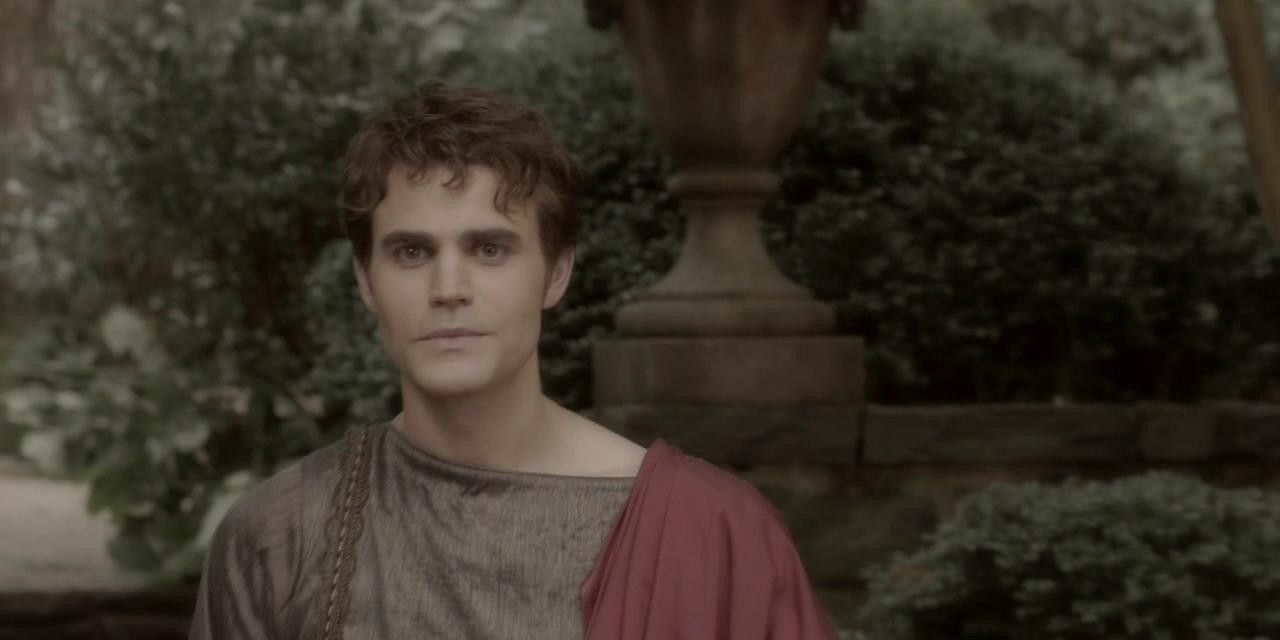
Honestly, the first time we heard the name Silas from The Vampire Diaries, it felt like the show was finally growing up. No more petty high school drama. No more "who is dating who" at the Mystic Grill. We were dealing with a literal immortal who had been chilling in a cave for two thousand years.
He was scary.
Then he actually showed up and he was... funny?
That is the weird thing about Silas. We spent all of Season 4 terrified of what was behind that mask, thinking we were getting some kind of Lovecraftian monster. Instead, we got Paul Wesley having the absolute time of his life playing a snarky, psychic jerk with serious relationship baggage. It changed the vibe of the show completely.
The Origins of the First Immortal
Let's get the facts straight because the lore in The Vampire Diaries gets messy fast. Silas wasn't a vampire. Not really. He was a witch—one of the most powerful to ever exist in Ancient Greece. Along with his fiancée, Qetsiyah, he wanted to live forever.
Greed? Maybe.
Love? That's what he told Qetsiyah.
But Silas was a liar. He didn't want to spend eternity with Qetsiyah; he wanted to spend it with her handmaiden, Amara. He tricked Qetsiyah into creating the immortality elixir, drank it with Amara, and basically kickstarted the entire supernatural mess that Elena Gilbert would have to deal with centuries later.
Qetsiyah didn't take it well. She was the original "scorned woman" archetype, but with world-ending magical powers. She created a "Cure" for immortality, killed Amara (or so she thought), and trapped Silas in a cave on a remote island with the Cure, hoping he’d take it, die, and join her on the "Other Side."
He refused. For 2,000 years, he just sat there. Starving. Desiccating. Waiting.
That is some serious dedication to a grudge.
Why the Doppelgänger Twist Actually Worked
When we finally saw Silas’s face at the end of Season 4, it was a genuine "shut the front door" moment for the fandom. Seeing Stefan’s face reflected back in that quarry water changed everything. It wasn't just a twist for the sake of a cliffhanger; it grounded the entire mythology of the series.
Suddenly, Stefan wasn't just a random brooding guy with hero hair. He was a shadow-self. A cosmic mistake.
The concept of the doppelgängers—the Petrova line and the Salvatore line—was explained as the universe's way of finding a "balance" to Silas and Amara’s immortality. Since they couldn't die, Nature created versions of them that could. It’s a bit of a stretch, sure, but in the context of the TVD universe, it made perfect sense.
It also gave Paul Wesley a chance to breathe.
Playing "Hero Stefan" for four years must have been exhausting. As Silas, he got to be flamboyant. He got to be mean. He got to talk about how much he hated modern technology and how "unimpressive" the current crop of vampires was compared to him.
He was the original. The blueprint.
The Power Scale Problem
One thing people often get wrong about Silas from The Vampire Diaries is his power level. People call him a vampire, but he’s an Immortal.
There’s a difference.
- He didn't have fangs.
- He didn't burn in the sun.
- Wooden stakes didn't do anything to him.
- He could walk into any house without an invite.
His real power was his mind. Silas was a world-class psychic. He could make you see your worst fears, your dead loved ones, or absolutely nothing at all. He got inside Klaus Mikaelson’s head. Think about that. Klaus, the "Original Hybrid" who spent a thousand years terrorizing the world, was reduced to a shivering mess because Silas made him feel like a white oak stake was buried in his heart.
He was playing chess while everyone else was playing checkers.
However, every villain has a weakness. For Silas, it was his obsession. Everything he did—every person he killed, every bridge he burned—was to get back to Amara. He didn't want to rule the world. He didn't want to be king of the vampires.
He just wanted to die.
That’s a weirdly relatable motivation for a guy who spent the first half of his arc being a terrifying boogeyman. He just wanted the peace of death with the woman he loved.
Silas vs. Klaus: Who Was Better?
This is the debate that still rages on Reddit and in fan circles.
Klaus was a better "villain" in terms of longevity and threat. He had a family, a history, and a vulnerability that made us root for him eventually. Klaus felt like a person.
Silas felt like a force of nature.
But honestly? Silas was funnier. His dialogue in Season 5 is some of the best writing in the show’s middle years. Whether he was complaining about the bus or mocking Damon Salvatore's love life, he brought a levity that the show desperately needed after the heavy tone of the search for the Cure.
"I'm a self-obsessed sociopath," he once said. "I don't have many friends."
Relatable.
The Downfall and the Legacy
Season 5 is where things got a little shaky. The introduction of the Travelers and the heavy focus on the "Doppelgänger Prophecy" started to weigh the story down. When Silas finally reunited with Amara, it wasn't the romantic tragedy he expected.
She was crazy. Two thousand years of being a "living anchor" to the supernatural purgatory will do that to a person.
Their story ended in a messy, bloody way that felt fitting for a couple that broke the laws of nature. Silas was killed by Stefan, his own doppelgänger, which is a poetic bit of irony that the writers actually pulled off well.
He didn't get his "Happily Ever After." He got sucked into oblivion when the Other Side collapsed.
But his impact remained. Silas was the reason we met Qetsiyah (Tessa), who remains one of the most entertaining "guest" characters in the series. He was the reason we understood why the doppelgängers kept finding each other. He was the bridge between the "vampires and werewolves" era of the show and the "ancient gods and sirens" era that followed.
What We Can Learn from Silas
If you’re rewatching the show or just getting into it, pay attention to the transition between the end of Season 4 and the start of Season 5. Silas from The Vampire Diaries represents a shift in how the show handled its antagonists.
He wasn't just a monster. He was a cautionary tale about what happens when you try to cheat the natural order for "love."
Next time you see a doppelgänger plotline in a fantasy show, remember that TVD did it best with Silas. He proved that the most dangerous weapon isn't a stake or a spell—it's the person who has nothing left to lose.
Takeaways for your next rewatch:
- Watch for the subtle cues Paul Wesley gives as Silas versus Stefan. The body language is completely different. Silas is looser, more arrogant, and uses his hands way more when he talks.
- Pay attention to the psychic illusions. Most of the "scary" stuff in the back half of Season 4 isn't actually happening; it's just Silas messing with the characters' heads.
- Compare the "Cure" arc to later seasons. It’s the last time the show felt like it had incredibly high stakes before the power creep got a bit out of hand in the final two years.
Silas might not have been the most successful villain in terms of his body count, but in terms of style, wit, and sheer psychological trauma, he stands alone at the top of the pile.
How to Analyze the Silas Arc Yourself
If you want to really get into the weeds of why this character worked (or why you think he didn't), try this:
- Map the Timeline: Look at the 2,000-year gap. Imagine being Silas. Think about the isolation. It makes his "sarcastic jerk" persona in Season 5 feel like a defense mechanism rather than just a personality trait.
- Contrast the Lovers: Compare Silas and Amara to Stefan and Elena. The show tries to tell us they are "fated," but Silas and Amara's story suggests that fate is actually a curse.
- The Power Dynamics: Look at how the show handles psychics after Silas. He was the first, and arguably the most powerful, setting the stage for characters like Cade later on.
Stop looking at Silas as just another "Big Bad" and start looking at him as the mirror to everything the main characters thought they knew about love and destiny. It makes the Season 5 slog much more bearable.