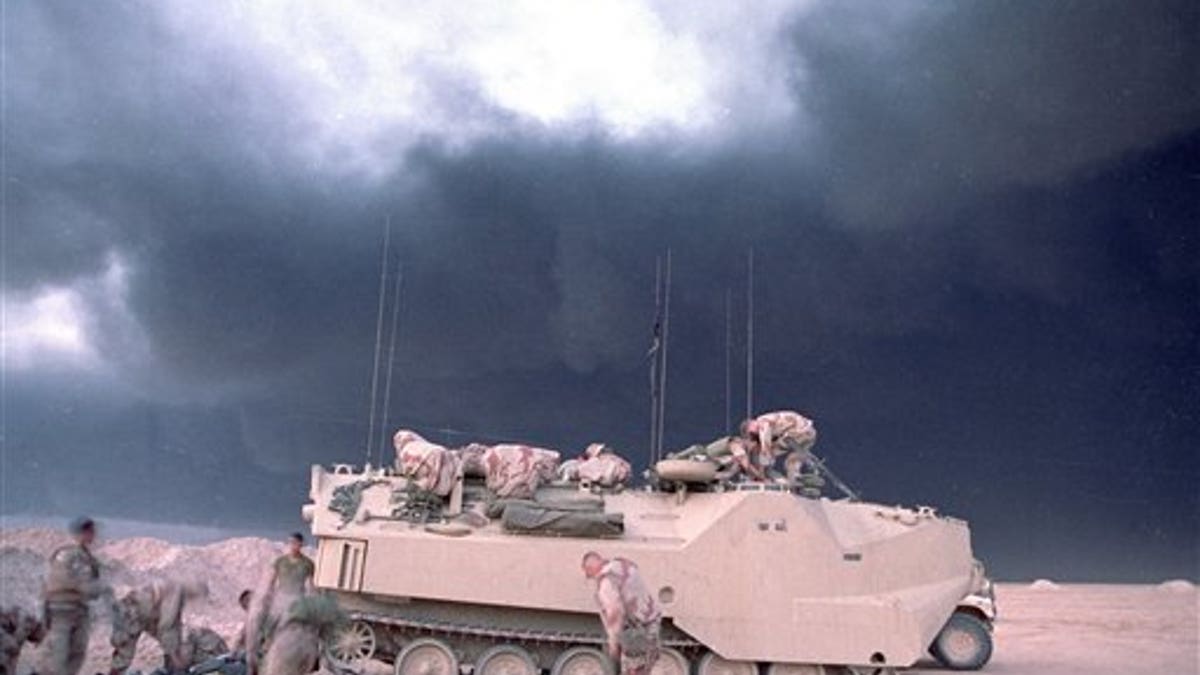
You’ve probably seen the grainy, lime-green footage of anti-aircraft fire over Baghdad. It’s iconic. Honestly, those specific pictures of gulf war operations defined an entire generation’s understanding of what "clean" war looks like, even if that wasn't the whole reality. When the coalition forces moved into Kuwait in 1991, the world didn't just hear about it on the evening news hours later; we watched it happen in real-time. It was the first "Nintendo War," a term critics coined because the digital crosshairs and laser-guided bomb footage made the whole thing look like a video game played out on a CRT television.
But behind those sanitized, high-tech images was a much grittier, more complicated visual record that took years to fully surface.
The Myth of the Bloodless Battlefield
For the average person sitting on their couch in January 1991, the war looked like a series of tactical successes viewed through a soda straw. The Department of Defense was very careful about what got out. They learned a lot from Vietnam—mostly that letting photographers have free rein can turn public opinion sour real fast. So, they implemented the "pool system." Journalists were escorted. Their film was reviewed. Because of this, the initial pictures of gulf war combat were mostly of sleek F-117 Nighthawks and Patriot missiles intercepting Scuds.
It felt precise. It felt sterile.
Then came the "Highway of Death." This was a stretch of road between Kuwait City and Basra where retreating Iraqi forces were caught in a bottleneck and devastated by Allied air power. The photos that eventually came out of that scene—specifically the work of Ken Jarecke—shattered the "video game" narrative. Jarecke took a photo of a charred Iraqi soldier slumped over the dashboard of a truck. It’s a haunting, brutal image. Most American publications refused to run it at the time. They thought it was too much for the public to handle.
Why the "Smart Bomb" Footage Was Misleading
We were told that 90% of the bombs were "smart." In reality, only about 7% to 10% of the munitions dropped during Operation Desert Storm were actually precision-guided. The rest were old-school "dumb bombs." However, the pictures of gulf war targets being obliterated with surgical precision were the only ones being fed to the networks.
This created a massive gap between public perception and the kinetic reality on the ground. When you look at the archives today, you see the massive B-52 carpet bombing runs that left the desert looking like the surface of the moon. That wasn't the footage being looped on CNN during the first 48 hours.
Real Stories Behind the Lens
Photographers like David Turnley and Peter Turnley weren't just looking for explosions. They wanted the human cost. David Turnley captured one of the most famous pictures of gulf war grief: a young U.S. Army Sergeant named Ken Kozakiewicz crying as he realized his friend’s body was in a nearby body bag. That photo bypassed the censors because it was taken during a Medevac, and it fundamentally shifted the tone of the coverage. It reminded people that even in a "high-tech" war, people still die in the dirt.
The equipment mattered too. This was the tail end of the film era.
Digital wasn't a thing yet. Photographers were lugging around heavy Nikon F4s and Canon EOS-1s. They had to find ways to get their film back to London or New York, often relying on "pigeons"—travelers at airports who would carry rolls of film across borders.
- The SCUD Hunt: Journalists spent nights on hotel roofs in Dhahran and Tel Aviv, cameras mounted on tripods, hoping to catch the arc of a missile.
- The Oil Fires: When Saddam Hussein’s forces retreated, they torched over 600 oil wells. The resulting photos, like those from Sebastiao Salgado, look like something out of Dante’s Inferno. The sky turned pitch black at noon. Firefighters worked in soot that looked like thick black ink.
- The Surrender: Pictures of bedraggled Iraqi conscripts surrendering to news crews—not even soldiers, just guys with cameras—showed how broken the Iraqi morale actually was after weeks of aerial bombardment.
The Environmental Disaster No One Expected
The oil fire photos are arguably the most striking pictures of gulf war history. It wasn't just about the war; it was an ecological apocalypse. Salgado’s images of the oil-soaked workers are textures of pure black and white. You can almost smell the sulfur and burning crude through the print. These images didn't just document a conflict; they documented the intentional destruction of an ecosystem as a parting gift from a retreating army.
It was a total contrast to the green-tinted night vision footage. One was cold and technological; the other was hot, messy, and ancient.
How to Analyze Historic War Photography
If you're looking through archives—whether it's the AP, Getty, or the Imperial War Museum—you have to look for what isn't there. Notice the lack of close-up combat photos from the ground during the initial 100-hour land war. Everything was moving so fast that the "pool" photographers often arrived after the fighting was over.
You’ll see plenty of shots of abandoned T-54 tanks buried in the sand. You'll see the "Victory Arch" in Baghdad in later years. But the actual moment-of-impact ground combat shots are incredibly rare compared to the Vietnam era or the later 2003 invasion of Iraq.
What We Learned from the Visuals
Basically, the Persian Gulf War was the moment the military realized they could control the "vibe" of a war through imagery. They saw that a well-placed video of a missile going down a chimney could win more support than a thousand speeches.
But for the historians and the curious, the real pictures of gulf war value lie in the uncensored, post-conflict shots. The abandoned trenches. The Kurdish refugees fleeing in the north. The skeletal remains of the Iraqi "Lion of Babylon" tanks.
These photos tell a story of a lopsided conflict that was far more devastating than the "Nintendo War" labels suggested. They show the transition from the Cold War-era tactics to the 21st-century digital battlefield.
Actionable Insights for Researching Gulf War History
- Cross-reference the source: Always check if a photo was a "DoD Handout" versus an independent journalist’s work. Handouts are usually the "clean" tech shots.
- Look for the "Unseen" archives: Search for the work of Ken Jarecke or the Turnley brothers to see the images that were originally suppressed by major Western media outlets.
- Check the National Archives: The U.S. National Archives (NARA) has thousands of digitized images that weren't part of the flashy news cycles. These often show the mundane reality of logistics and desert life.
- Analyze the color palettes: Note the difference between the 1991 film grain and the 2003 digital clarity. The 1991 photos have a specific "warmth" and "grit" because of the Kodachrome or Fujichrome film used.
- Study the "Highway of Death": If you want to understand the true kinetic power of the 1991 air campaign, look at the wide-angle aerial shots of the road to Basra. It’s a sobering reality check on the "precision" narrative.
Understanding these photos isn't just about looking at old war tech. It's about recognizing how the way we see war changed overnight. We went from being observers to being participants in a curated, televised event. That legacy still impacts how we digest news from conflicts today.