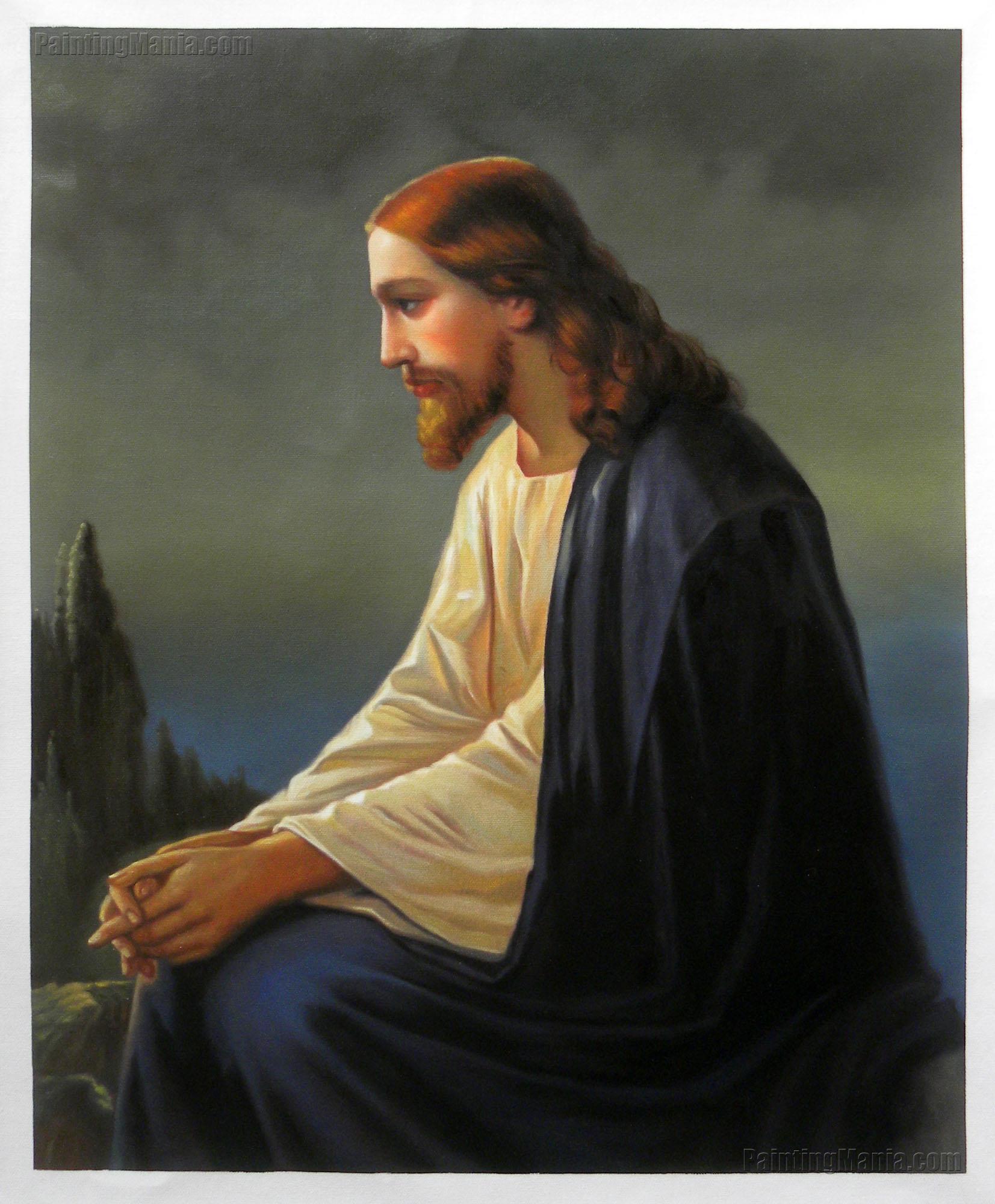
You’ve probably seen the "standard" image of Jesus a thousand times. Blue eyes. Flowing light-brown hair. Often looks like he just walked out of a shampoo commercial in Northern Europe. But if we’re being honest, that version of the historical figure doesn't make much sense given where he was actually born. It’s a colonial leftover. Because of this, paintings of Black Jesus aren't just a modern "trend" or a political statement; they are a massive, necessary correction to a long-running historical error.
People get defensive about this. They really do. But for centuries, artists from Ethiopia to the streets of Chicago have been reclaiming the image of the Messiah to reflect the people who worship him. It's about identity. It’s about seeing yourself in the divine.
The History Nobody Taught You in Sunday School
We need to talk about Ethiopia. While European artists were busy painting Jesus to look like their local nobility during the Renaissance, Ethiopian Christians had been creating paintings of Black Jesus for over a thousand years. The Garima Gospels, which date back to the 5th or 6th century, contain some of the oldest Christian illustrations in existence. They don't show a blonde-haired man. They show figures with dark skin and tight, textured hair. This isn't "revisionist history." It's just... history.
Then things changed.
The Transatlantic Slave Trade and European colonialism didn't just move people; they moved iconography. If you want to control a population, you give them a god that looks like the people in power. That's basically "Colonization 101." By the time the 20th century rolled around, the image of "Head of Christ" by Warner Sallman—painted in 1940—became the global gold standard. You know the one. It’s on every prayer card and church wall. It’s also incredibly white.
The 1960s Spark
The Civil Rights Movement changed the game. Black theologians like James Cone started asking why the "Prince of Peace" looked like the people enforcing Jim Crow. This birthed Black Liberation Theology. Artists responded by picking up brushes. They weren't just making art; they were protesting.
Take a look at the work of Janet McKenzie. In 1999, her painting "Jesus of the People" won a major competition. It was controversial. Why? Because the model was a Black woman. McKenzie wasn't saying Jesus was literally a woman; she was using the Black female form to represent the ultimate "other" in society, suggesting that if Jesus is in the "least of these," he is surely there.
Why the "Original" Jesus Looked Nothing Like the Movies
Science kinda settles this one. In 2001, Richard Neave, a retired medical artist from the University of Manchester, used forensic anthropology to reconstruct what a typical Semitic man from first-century Judea would look like.
He didn't find a guy who looked like Ewan McGregor.
The result was a man with a broad face, dark olive skin, short curly hair, and a prominent nose. While this doesn't strictly mean Jesus was "Black" in the way we define race in 21st-century America, he certainly wasn't white. He was a person of color. Therefore, paintings of Black Jesus are, in many ways, much closer to the biological reality than the images hanging in the Vatican.
The Artists You Actually Need to Know
If you're looking for the heavy hitters in this space, you can't just look at one style. It’s a spectrum.
- Robert Lentz: A Franciscan friar who creates "icons." His painting of "Christ the Liberator" is famous. It depicts Jesus as a Black man in a way that feels ancient and modern all at once.
- Vincent Barzoni: His work often depicts a very muscular, powerful Black Jesus. It’s a far cry from the "meek and mild" imagery of the past. It’s about strength and survival.
- Harmonia Rosales: She’s a contemporary powerhouse. She reimagines classic Renaissance works—like the Sistine Chapel ceiling—with Black women and men. Her "The Creation of God" replaced the white God and Adam with Black women. It broke the internet for a reason.
Honestly, the variety is staggering. Some artists use the image to highlight police brutality, while others just want to show a family dinner in Nazareth that looks like a Sunday in Harlem.
What Most People Get Wrong About These Paintings
A big misconception is that these paintings are about "exclusion." That’s not it.
When a community that has been marginalized for centuries paints Jesus to look like them, it’s an act of spiritual reclamation. It’s saying, "The Divine isn't foreign to me." It’s also a rejection of the "White Jesus" who was used to justify slavery and segregation. If "God made man in His own image," then a Black man looking at a painting of a Black Jesus is finally seeing that scripture reflected back at him.
It's also worth noting that this isn't just a "Black thing." In Korea, you’ll find paintings of Jesus in a hanbok. In Latin America, he’s often depicted with indigenous features. The "Whiteness" of Jesus is actually the outlier when you look at global history, yet it's treated as the default. That's the bias we're all still unlearning.
The Cultural Impact in 2026
We are seeing a massive resurgence in this imagery right now. From murals in downtown Los Angeles to digital art on Instagram, paintings of Black Jesus are becoming more mainstream. Why now? Because the gatekeepers are losing their grip. In the past, you needed a gallery or a church board to approve an image. Now, an artist can post a reimagined "Last Supper" on social media and reach millions instantly.
This visibility matters. It changes how kids see themselves. It changes how they perceive power and holiness.
How to Find and Support This Art
If you’re interested in this world, don’t just buy a mass-produced print from a big-box retailer. Look for the creators.
- Check out the Schomburg Center for Research in Black Culture. They have incredible archives and often feature contemporary religious art.
- Follow "The Black Christ" movements on social media. There are dozens of hashtags where independent artists share their work.
- Visit local HBCU galleries. Schools like Howard or Spelman often have collections that explore the intersection of race and faith in ways you won't see in a suburban museum.
- Look for "Icons." If you prefer a more traditional vibe, search for "Black Byzantine Icons." The gold leaf and stylized features are stunning and carry a lot of weight.
Moving Beyond the Canvas
Understanding the importance of paintings of Black Jesus requires a shift in perspective. It's not about "changing" Jesus. It’s about admitting that he was never the person the 16th-century Europeans said he was. It’s about historical honesty.
When you look at these paintings, don't just look at the colors. Look at the eyes. Look at the struggle and the hope depicted in the brushstrokes. Whether it's an Ethiopian manuscript from 500 AD or a street mural from 2024, the message is the same: the sacred belongs to everyone. No exceptions.
To truly engage with this art form, start by auditing your own visual diet. Look at the religious imagery you're exposed to daily and ask yourself who is missing. Seek out local galleries that prioritize African American liturgical art. If you're a collector, prioritize purchasing directly from living Black artists who are continuing this tradition. By supporting this work, you aren't just buying a painting—you're supporting a more inclusive and historically accurate version of human spirituality.