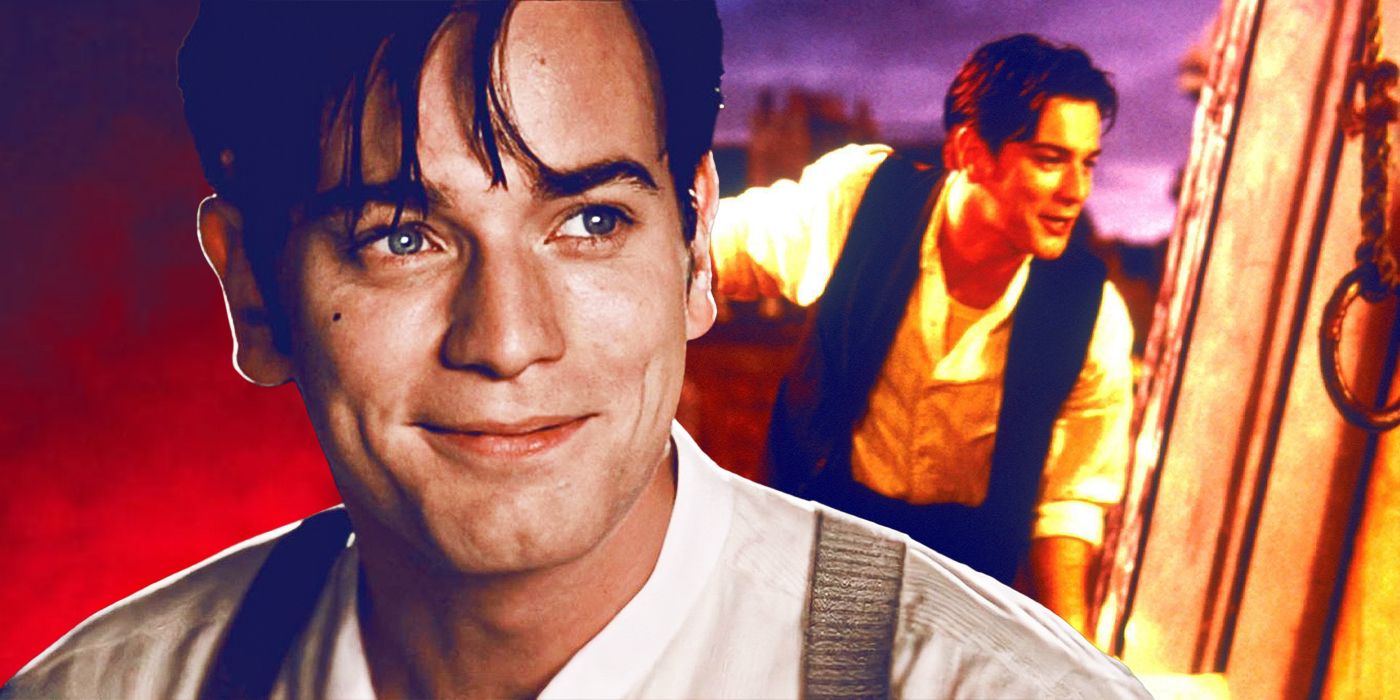
It was the year 2001. Baz Luhrmann, a man who clearly doesn't believe in the concept of "too much," decided to drop a jukebox musical into a cinematic landscape that wasn't exactly begging for one. Then Ewan McGregor opened his mouth. When you think about Ewan McGregor Moulin Rouge Your Song, you probably see that rooftop. You see the artificial moon, the glowing Paris skyline, and a young Scotsman with a haircut that launched a thousand early-aughts salon appointments.
But it wasn't just about the aesthetics.
Honestly, the stakes were high. Elton John’s original version is a sacred cow of pop music. Messing with it is usually a one-way ticket to being forgotten in a bargain bin. Yet, McGregor’s rendition didn't just survive; it became the definitive version for an entire generation of theater kids and hopeless romantics. He wasn't a "singer" in the traditional pop star sense back then, which is exactly why it worked.
The Raw Vulnerability of a Non-Singer
Most movie musicals today are polished to within an inch of their lives. You can hear the Auto-Tune humming in the background of almost every modern Disney live-action remake. In 2001, things were a bit grittier. When McGregor starts those first few lines—"It's a little bit funny, this feeling inside"—he sounds nervous. Because his character, Christian, is nervous.
He’s a penniless writer trying to woo a courtesan who thinks he’s a Duke. The crack in his voice isn't a technical flaw; it’s the whole point of the scene.
Luhrmann’s direction pushed McGregor to lean into the theatricality. If you watch the behind-the-scenes footage or listen to the commentary tracks from the old DVDs, the crew talks about the sheer energy on set. They weren't just making a movie; they were trying to reinvent a genre that had been dead since the sixties. McGregor had to carry the emotional weight of that transition. If he didn't sell the sincerity of "Your Song," the rest of the movie—with its fast cuts and chaotic can-can dancers—would have collapsed under its own weight.
Breaking Down the Arrangement
Craig Armstrong, the composer, did something brilliant with the arrangement. It starts with a simple piano, much like Elton’s, but then it swells. It turns into this massive, orchestral explosion that mirrors the literal fireworks happening on screen.
There's a specific moment—you know the one—where McGregor hits the belt on "I hope you don't mind." It’s loud. It’s slightly over the top. It’s pure operatic melodrama.
Why the "Elephant Love Medley" Had to Come Second
A lot of people forget that Ewan McGregor Moulin Rouge Your Song serves as the anchor for the entire first act. Without that moment of pure, unadulterated romance, the "Elephant Love Medley" later in the film wouldn't have the same impact. You have to believe Christian is capable of that level of devotion before you can watch him engage in a playful lyrical battle with Nicole Kidman’s Satine.
Satine is cynical. She’s all about the money, the "Diamonds Are a Girl's Best Friend" vibe. Christian is the antithesis of that. By using a song the audience already knew and loved, Luhrmann bypassed the need for ten minutes of exposition. We know how Christian feels because we know how that song feels. It’s a shortcut to the heart.
The Elton John Approval Factor
It’s worth noting that Elton John himself was a fan. Getting the rights to these songs wasn't easy. The production had to prove they weren't just parodying the tracks. Bernie Taupin’s lyrics are deceptively simple, and McGregor treated them like Shakespearean soliloquies.
Critics at the time were split. Some hated the frenetic editing. Others thought the singing was "breathless." But the audience reaction was undeniable. The soundtrack went multi-platinum. McGregor, who had mostly been known for Trainspotting and a certain galaxy far, far away, suddenly found himself a romantic lead.
The Technical Reality of the Rooftop Scene
Let's get real about the filming for a second. That rooftop wasn't a rooftop. It was a massive set at Fox Studios in Sydney.
- The "sky" was a series of digital matte paintings and practical lights.
- McGregor and Kidman had to perform those sequences dozens of times to get the lighting right.
- The singing you hear is a mix of studio recording and on-set "live" vocals to capture the breathiness.
It’s a masterclass in artifice. The movie doesn't try to look real. It tries to look how love feels. That’s a distinction a lot of modern directors miss. They try to make things grounded. Moulin Rouge! is the opposite of grounded. It’s soaring. It’s flying through the air while a giant moon sings at you.
How to Capture That Energy Today
If you're a performer or a creator looking at Ewan McGregor Moulin Rouge Your Song as a blueprint, there are a few things to take away. First, stop trying to be perfect. The perfection is in the passion. McGregor’s high notes are strained, and that’s why they’re beautiful.
Second, context is everything. The song works because of the silence that precedes it. Christian is stuttering, failing to find his words, and then the music saves him. It’s a narrative tool, not just a music video.
To really appreciate the craft, go back and watch the scene with the sound off. Look at McGregor’s face. The way he looks at Kidman isn't just "acting"; it’s an intentional choice to stay present in a scene that is surrounded by green screens and wind machines.
Actionable Takeaways for Movie Buffs and Singers
To truly understand the impact of this performance, try these steps:
- Listen to the "Studio" vs. "Film" versions: There are slight differences in the mixing. The film version keeps more of the raw vocal takes.
- Compare to the Broadway Musical: The stage version of Moulin Rouge! uses the same song, but notice how the Broadway performers (like Aaron Tveit) use a much more polished, technical approach. It changes the character of Christian from an amateur poet to a professional-grade singer.
- Watch the "Spectacular Spectacular" pitch scene again: Notice how "Your Song" is the melody Christian uses to prove his worth. It’s his currency.
Ultimately, Ewan McGregor didn't just cover a song. He re-contextualized a piece of pop history for a new medium. He proved that you don't need to be a Grammy-winning vocalist to deliver a performance that stays in the cultural consciousness for twenty-five years. You just have to mean it.
If you're revisiting the film, pay attention to the transition from the spoken word to the first piano chord. It’s one of the smoothest hand-offs in musical cinema. It’s the moment the movie stops being a comedy and starts being a tragedy. And it all hinges on that one song.
Check the original 2001 soundtrack credits—you'll see Alessandro Safina providing backup vocals on the operatic portions, which added that layer of "epicness" that McGregor’s more intimate voice needed to fill the theater. It was a collaborative effort that understood exactly when to be small and when to be massive.
Next Steps for the Ultimate Fan
To dive deeper into the technical side, track down the "Behind the Red Curtain" documentary. It features the vocal coaches explaining how they worked with Ewan to find a range that felt authentic to a young, starving artist rather than a polished performer. Also, look for the 20th-anniversary interviews where the cast discusses the "Your Song" sequence as the hardest day on set due to the complex choreography on the narrow "rooftop" set pieces. Observing these details will change the way you view Christian's "simple" love song forever.