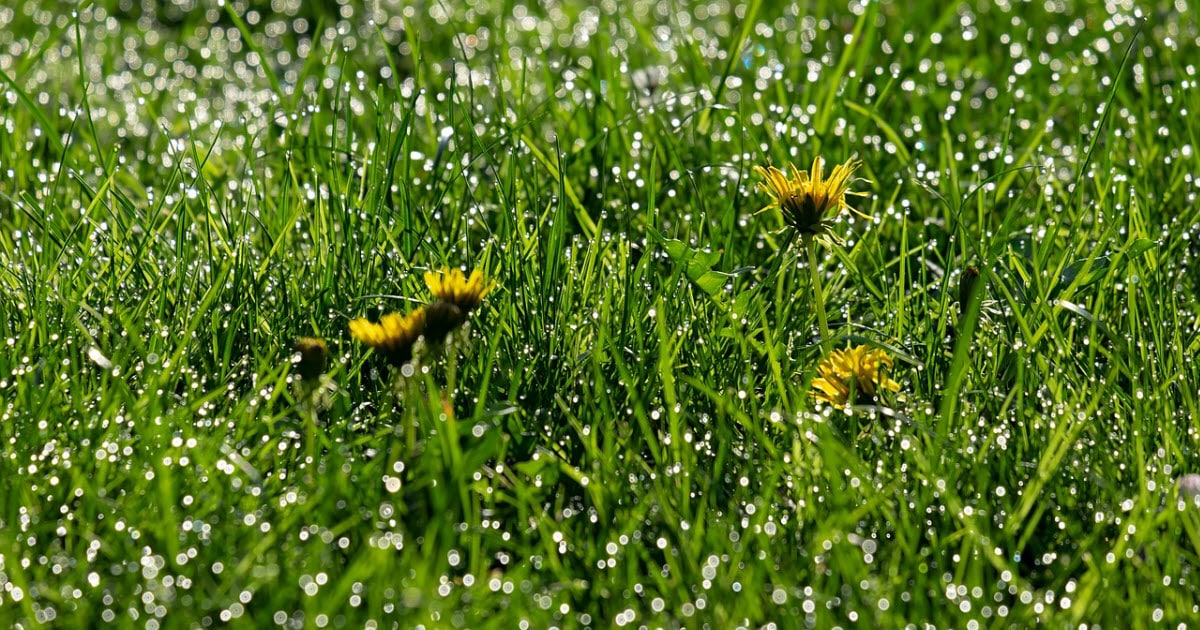
You’re looking at your yard and something is definitely off. One day it’s a sea of green, and the next, it’s dotted with these tiny, stubborn white spots. It’s a lawn weed with white flowers, but honestly, which one is it? Most people just assume everything with a white petal is clover, but that’s a mistake that can lead to some pretty frustrated Saturday mornings spent pulling the wrong thing.
Identifying these plants isn't just about being a "plant nerd." It’s about survival—for your grass, at least. If you treat White Clover the same way you treat Hairy Bittercress, you’re basically throwing money into the wind. Some of these plants are actually trying to tell you that your soil is starving, while others are just opportunistic invaders waiting for you to scalp your lawn with the mower.
The Usual Suspect: Why White Clover is Taking Over
White Clover (Trifolium repens) is the king of the "lawn weed white flower" category. You know the one. It has those three round leaflets and the ball-shaped flower heads that bees absolutely obsess over. Back in the 1950s, clover was actually a standard ingredient in grass seed mixes. It’s true. People wanted it there because it stays green when everything else turns brown and crispy in the July heat.
Why is it in your yard now if you didn't plant it?
Nitrogen. Or rather, a lack of it. Clover is a legume. It has this cool biological superpower where it takes nitrogen from the air and "fixes" it into the soil. If your lawn is looking yellowish and thin, clover moves in like a freelance contractor to fix the dirt. If you see it spreading rapidly, your soil is likely screaming for a snack.
Honestly, some people are moving back to "clover lawns" because they require zero fertilizer and less water. But if you're a "golf course green" purist, clover is your mortal enemy because it grows in clumps that disrupt that smooth carpet look. It’s a perennial, meaning it’ll be back next year, and the year after, unless you address the underlying soil health or use a broadleaf herbicide containing Dicamba or Triclopyr.
The Sneaky Spring Invaders
Then there’s the stuff that shows up before you’ve even pulled the mower out for the first time. Hairy Bittercress is a classic. It’s a winter annual. It grows in a little rosette flat against the ground, and then—boom—it shoots up a tiny stalk with microscopic white flowers.
The "fun" part? If you touch it when the seed pods are ripe, they explode. Literally. They can launch seeds up to three feet away. It’s a mechanical defense mechanism that makes it incredibly hard to control once it flowers. You’ve got to pull these before they "pop," or you’re just planting next year’s crop while you work.
Common Chickweed is another one. It looks dainty with its star-shaped white flowers, but it’s a mat-forming beast. It loves damp, shady spots. If you have a corner of the yard that stays soggy, chickweed will find it. Interestingly, Chickweed (Stellaria media) is actually edible and tastes a bit like corn silk, though I wouldn't recommend snacking on it if you've recently sprayed your yard with chemicals.
Wild Strawberry vs. Mock Strawberry
Have you noticed white flowers that look like tiny roses? You might have Wild Strawberry (Fragaria virginiana). These have five white petals and a yellow center. They spread by runners—long, vine-like arms that reach out and take root.
Don't confuse them with Mock Strawberry, which usually has yellow flowers, but sometimes people get them mixed up in the "creeping white flower" category. Real wild strawberries are a sign of decent soil, but they can be aggressive. They won't die off just because you mowed over them; they’ll just hug the ground tighter next time.
How to tell the difference quickly:
- White Clover: Ball-shaped flower, three leaves with a white "V" mark.
- Hairy Bittercress: Tiny four-petal flowers, exploding seed pods, vertical growth.
- Chickweed: Five petals that are so deeply notched they look like ten.
- English Daisy: Yellow center, many thin white petals, usually in coastal or cooler climates.
Dealing with Pearlwort and Oxalis
If you see something that looks like moss but suddenly sprouts tiny white dots, you’re probably looking at Pearlwort. It loves compacted soil. If you walk the same path across your lawn every day, Pearlwort is likely there. It thrives where the grass is too stressed to grow.
Then there’s White Woodsorrel (Oxalis). Most people know the yellow version, but the white-flowered variety is a common sight in partially shaded lawns. It looks like a shamrock, but the leaves are heart-shaped, not round. Oxalis contains oxalic acid—the same stuff in spinach—which gives it a sour taste, but it’s a pain to get rid of because it grows from tiny underground bulbs (bulbils). If you just pull the top off, the bulbs stay behind and laugh at you.
Why Your Mower is Making it Worse
We have a habit of cutting the grass too short. We think it saves time. "If I cut it to an inch, I won't have to do this again for two weeks."
Wrong.
When you scalp your lawn, you open up the canopy. Sunlight hits the soil surface, which is exactly what weed seeds need to germinate. A lawn kept at 3 or 4 inches shades out the seeds of the lawn weed white flower varieties like Clover and Chickweed. Longer grass also means deeper roots, which makes your lawn more competitive. Most of these white-flowering "weeds" are low-growers. They love it when you keep the grass short because it removes their competition for sunlight.
The Soil Connection: What the Flowers are Telling You
Plants are indicators. They don't just grow places by accident; they grow where the conditions suit them.
- Daisies and White Clover: Your soil might be low in nitrogen but high in phosphorus.
- Chickweed: Your soil is likely compacted and holds too much water. You might need to aerate.
- Pearlwort: Extreme compaction. The ground is basically a brick.
- English Daisy: Your soil is likely acidic. A bit of lime might help the grass outcompete the daisies.
According to Dr. John Stier, a turfgrass specialist at the University of Tennessee, the best defense against any weed is a thick stand of grass. It sounds like a circular argument, but it's the truth. Most herbicides are just a temporary fix. If you don't fix the soil, the white flowers will return as soon as the chemical barrier breaks down.
Practical Steps to Clean Up Your Yard
First, stop the "exploding" weeds. If you see Hairy Bittercress, pull it now. Don't wait for the weekend. Grab it by the base and get the root.
Second, check your mower height. Move it up to at least 3.5 inches. This is the single easiest thing you can do to reduce weed pressure without spending a dime.
Third, get a soil test. Most local university extension offices provide these for about $15 to $20. It’ll tell you exactly what’s missing. If you have a ton of clover, the test will likely show low nitrogen. Adding a slow-release nitrogen fertilizer in the fall and spring will help the grass thicken up and naturally squeeze the clover out.
Fourth, spot treat if you must. You don't need to blanket the whole yard in chemicals. Use a handheld sprayer with a "Broadleaf Weed Killer" that specifies it works on Clover and Oxalis. Look for ingredients like 2,4-D or MCPP. Apply it on a calm day when no rain is expected for 24 hours.
Finally, consider the "if you can't beat 'em, join 'em" approach. In 2026, the trend of "bee-friendly" lawns is massive. If your "weeds" are mostly White Clover, you’re providing a huge service to local pollinators. If the lawn is green and you can walk on it, maybe those little white flowers aren't the end of the world.
Aerate your soil in the fall to break up the compaction that Pearlwort and Chickweed love. Use a core aerator—the kind that pulls actual plugs of dirt out—not the spike kind that just pushes the dirt sideways and makes compaction worse. Overseed with a high-quality turf-type tall fescue or Kentucky bluegrass immediately after aerating. The new grass will fill the holes before the weeds can get a foothold. This creates a biological barrier that works better than any liquid chemical you can buy at a big-box store.