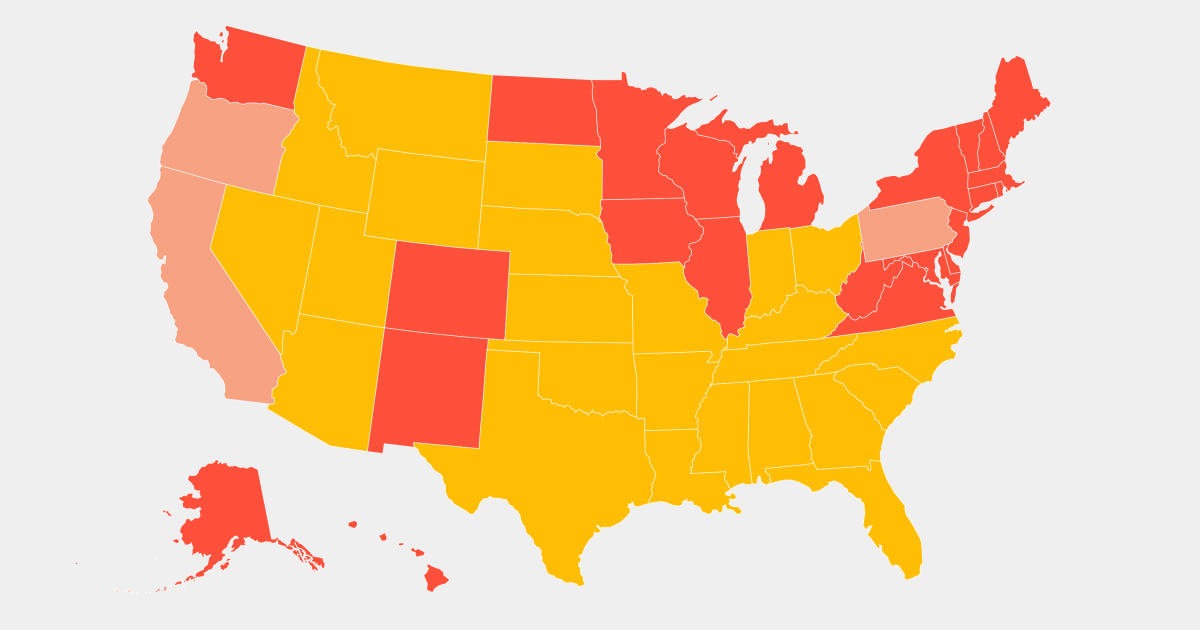
Honestly, if you look at a map of the United States to figure out which states allow death penalty laws, you’re going to get a headache. It isn't a simple "yes" or "no" situation anymore. We’ve entered this weird, fragmented era where a state might technically have a death row but hasn't turned on the lights in the execution chamber for thirty years. Or, conversely, a state like Florida might suddenly ramp up its schedule so fast it makes your head spin.
As of early 2026, the count stands at 27 states that technically retain capital punishment. But that number is a massive oversimplification. It’s like saying 27 people own a car—some are driving 90 mph on the interstate, while others have theirs up on blocks in the driveway with no engine.
The "Active" Players vs. The Quiet Ones
You’ve got your heavy hitters. Texas, Florida, and Oklahoma. These states don't just have the laws; they use them. In 2025, Florida alone was responsible for nearly 40% of all executions in the country. Governor Ron DeSantis signed laws recently that basically thumbed their nose at old precedents, allowing for death sentences even when a jury isn't unanimous. That's a huge shift.
Then you have the "dormant" states. Think of places like Kansas or Wyoming. They’ve got the death penalty. It’s right there in the books. But Kansas hasn't actually executed anyone since 1965. If you're on death row there, you're statistically more likely to die of old age than by a lethal injection.
The Moratorium Club
Then there’s the third category: states where the governor has basically said, "Not on my watch."
- California: They have the largest death row in the country, but Governor Gavin Newsom issued a moratorium years ago.
- Pennsylvania and Oregon: Similar story. The law exists, the sentences are handed down, but the actual execution process is frozen by executive order.
Which States Allow Death Penalty? The Current 2026 List
If you need the raw data, here is the breakdown of where capital punishment still "exists" in some legal capacity:
Alabama, Arizona, Arkansas, California (Moratorium), Florida, Georgia, Idaho, Indiana, Kansas, Kentucky, Louisiana, Mississippi, Missouri, Montana, Nebraska, Nevada, North Carolina, Ohio, Oklahoma, Oregon (Moratorium), Pennsylvania (Moratorium), South Carolina, South Dakota, Tennessee, Texas, Utah, and Wyoming.
Wait. You might notice some names missing if you’re looking at older lists. Virginia—once a prolific executioner—scrapped the whole thing in 2021. New Hampshire got rid of it in 2019, though they kept one person on death row because the law wasn't retroactive. It's a patchwork.
New Methods and The Return of the Firing Squad
One of the wildest things happening right now is the scramble for how to carry out these sentences. For a long time, it was all about lethal injection. But pharmaceutical companies got tired of the bad PR and stopped selling the drugs.
So, states started getting creative. Kinda macabre, right?
Alabama and Louisiana have started using nitrogen hypoxia. Basically, the inmate breathes pure nitrogen until they pass out and die from lack of oxygen. It’s controversial, to say the least. Witnesses in recent 2025 executions reported some pretty grim scenes—struggling, twitching—which totally contradicts the "peaceful" image the states were trying to sell.
And then there's the firing squad. Idaho made it their primary backup method in 2023 because they couldn't find the drugs for injections. South Carolina followed suit. In March 2025, South Carolina carried out its first firing squad execution in fifteen years. It’s like we’re stepping back into the 19th century because the 21st-century tech is too hard to buy.
Why the Map Keeps Shifting
Public opinion is at a 50-year low. Only about 52% of Americans support the death penalty now. That’s a massive drop from the 80% highs of the 1990s.
You see this reflected in the jury box. Even in "pro-death" states, juries are increasingly choosing life without parole. In 2025, more than half of capital cases ended in a life sentence rather than death. People are just... less sure than they used to be. Whether it's the cost (it's way more expensive to execute someone than to keep them in prison for life due to legal fees) or the fear of executing an innocent person, the momentum is clearly slowing down in most of the country.
Actionable Insights: What This Means for You
If you're following this for legal research, advocacy, or just to stay informed, here’s how to navigate the noise:
- Check the "Status," not just the "Law": If you see a state listed as "allowing" the death penalty, immediately check for a gubernatorial moratorium. A "yes" in the law books often means a "no" in practice.
- Watch the Method Legislation: Keep an eye on your local state house. Many states are currently debating adding things like nitrogen gas or firing squads to bypass drug shortages.
- Follow the Money: Capital cases are a huge drain on county budgets. If you live in a state like Nevada or Ohio where executions are rare, the debate often shifts from "is it right?" to "can we afford this legal bill?"
- Stay Updated on Retroactivity: When states like Virginia or Colorado abolish the penalty, they usually commute the sentences of those already on death row. But in places like New Hampshire, they didn't. Knowing the "effective date" of a law is everything.
The reality of which states allow death penalty executions is that the U.S. is a house divided. We have two completely different justice systems operating under one flag. One side is doubling down on "tough on crime" measures, while the other is dismantling the gallows for good.