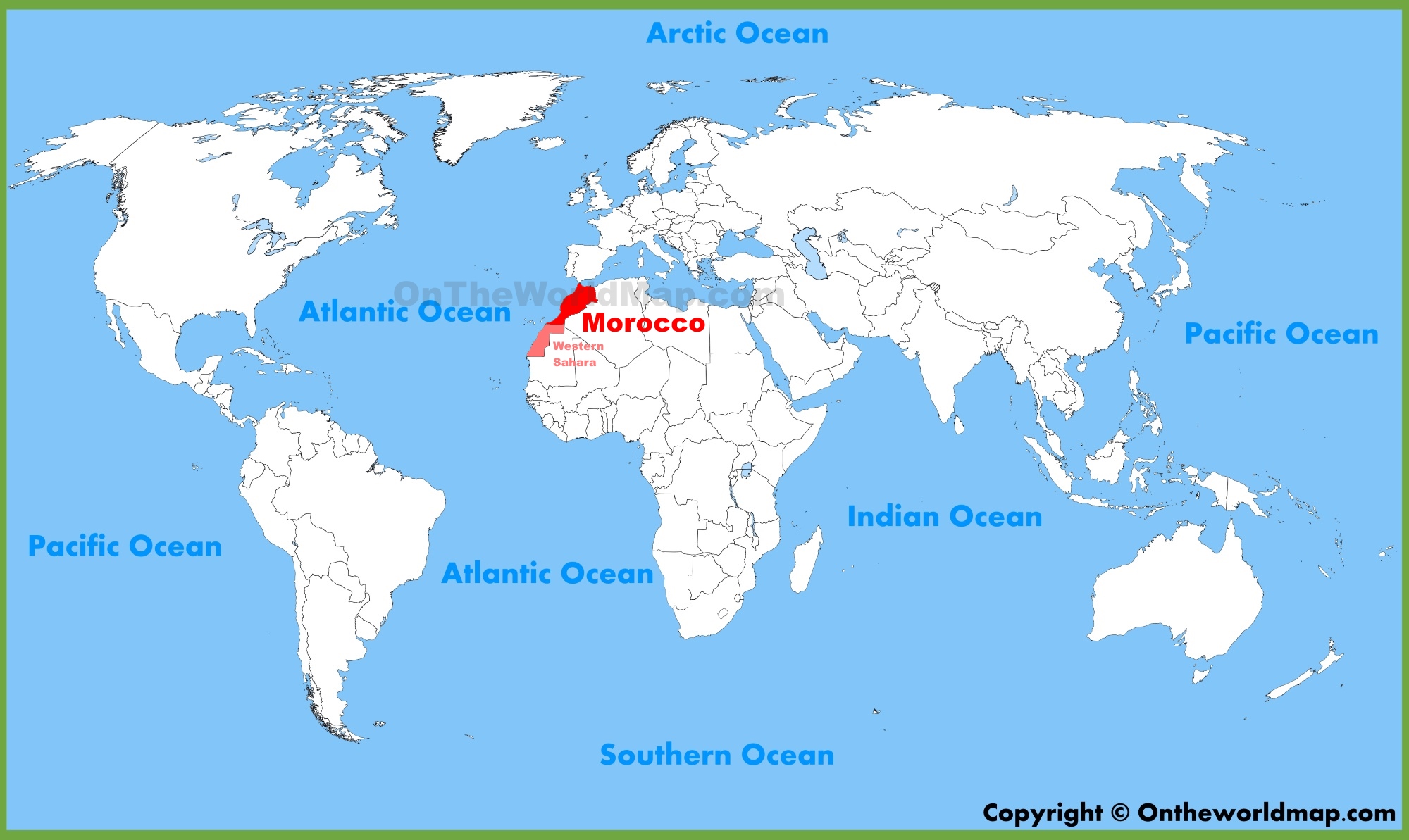
You’d think finding a whole country would be easy. But honestly, when people try to show Morocco on a map, they often point to the wrong spot or realize they have no clue how close it actually is to Europe. It’s right there. Seriously. If you’re standing on the southern coast of Spain in a town like Tarifa, you can literally see the Moroccan mountains across the water. It’s only about 8 miles. That’s a short morning jog, if you could run on water.
Morocco sits at the very top-left corner of Africa. It’s the gateway.
Finding the Coordinates: How to Show Morocco on a Map Right Now
If you're looking at a standard world map, find the Mediterranean Sea. Follow it all the way to the west where it meets the Atlantic Ocean. That pinch point is the Strait of Gibraltar. Morocco is the landmass forming the southern side of that pinch. It’s bordered by Algeria to the east and the Western Sahara to the south.
Most people don't realize that Morocco is one of only three countries in the world to have both Atlantic and Mediterranean coastlines. France and Spain are the others. This geography is why the weather is so weirdly diverse. You’ve got the humid, salty air of Casablanca and Tangier, but then you head inland and hit the Atlas Mountains where it actually snows. Yes, you can ski in Africa. It’s a real thing at Oukaïmeden, which is the highest ski resort in Africa, sitting at about 8,500 feet.
The Geography of Diversity
The country isn't just one big desert. Far from it. When you show Morocco on a map, you’re looking at four distinct zones:
- The coastal plains where most people live.
- The Rif Mountains in the north (where the famous blue city of Chefchaouen hides).
- The Atlas Mountains (Middle, High, and Anti-Atlas) cutting through the center like a spine.
- The Sahara Desert in the far south and east.
The Western Sahara Complexity
We have to talk about the borders. If you look at a map produced in the United States or by the Moroccan government, the southern border includes the Western Sahara. However, if you look at a map from the United Nations or many European sources, you’ll see a dotted line. This is one of the longest-running territorial disputes in the world.
In 2020, the U.S. officially recognized Moroccan sovereignty over the Western Sahara. This changed how digital maps, including Google Maps, display the region to users in certain locales. It’s a nuanced bit of geopolitics that makes "showing Morocco on a map" a bit of a political statement depending on whose map you’re using.
Why the Location Matters for Your Trip
Morocco’s spot on the globe creates a "cool-to-hot" gradient that catches travelers off guard. Because it’s in the Northern Hemisphere, its seasons align with Europe and North America. But the proximity to the Sahara means that "hot" is a different level of hot.
Marrakech is inland. It’s a furnace in July. But Essaouira, which is almost directly west on the coast, stays breezy and mild because of the "Alizé" trade winds. Travelers often make the mistake of packing only for heat. If you’re heading to the High Atlas to hike Mount Toubkal (the highest peak in North Africa at 13,671 feet), you need a heavy jacket even in the summer.
The Flight Time Reality
How far is it really?
- From London: About 3.5 hours.
- From Madrid: Barely 1 hour.
- From New York: Roughly 7 to 8 hours (Royal Air Maroc runs a direct flight to Casablanca).
It’s surprisingly accessible. You can leave the rainy streets of London after breakfast and be drinking mint tea in a Marrakech riad by lunchtime.
The Cultural Crossroads
Because of where Morocco is tucked, it has been a mixing bowl for millennia. You have the indigenous Amazigh (Berber) culture, which predates the Arab arrivals. Then you have the Arab-Islamic influence from the east. To the north, you have centuries of back-and-forth with Spain and France.
This is why you’ll hear people in Tangier effortlessly switching between Moroccan Arabic (Darija), French, and Spanish in the same sentence. The map explains the language. It explains why the food has that specific blend of Mediterranean olive oils and sub-Saharan spices like cumin and saffron.
Pro Tips for Locating Your First Stop
If you're planning a visit, don't just stick to the famous spots.
- Fes: This is the spiritual heart, located in the northeast. The medina is a car-free labyrinth of 9,000 streets.
- Agadir: Further south on the Atlantic coast, it’s the go-to for surfers.
- Merzouga: This is where you find the massive sand dunes (Erg Chebbi) you see in movies. It’s way over on the eastern edge, near the Algerian border.
Practical Next Steps for Your Journey
If you are ready to stop looking at the map and start packing, here is what you need to do next to make the most of Morocco’s unique geography:
Check the "Wind" Forecast, Not Just Heat
If you’re heading to the coast, check the wind speeds. Places like Essaouira are world-famous for kitesurfing because the wind is relentless. If you just want to tan on a beach, you might prefer the Mediterranean side near Al Hoceima where the water is calmer and the wind is blocked by the Rif Mountains.
Book a "Grand Taxi" for Cross-Country Travel
Morocco has a decent train system (including the Al Boraq high-speed train between Tangier and Casablanca), but to see the real geography, you need the Grand Taxis. These are shared long-distance cabs. It’s the best way to see the landscape change from green valleys to red rock canyons as you cross the Atlas.
Respect the Border Realities
Be aware that the border between Morocco and Algeria is closed. You cannot drive or walk across it. If you’re trying to navigate a regional road trip, you’ll have to fly if you want to visit both countries.
Time Your Sahara Visit
Avoid the desert in July and August. It’s dangerous. The best time to see the dunes on the map is between October and April. The nights are freezing—literally—but the days are perfection.
Morocco is more than a spot on a map; it’s a vertical slice of every climate imaginable, squeezed into a corner of the continent that refuses to be ignored. Get there, get lost in a medina, and see the view for yourself.