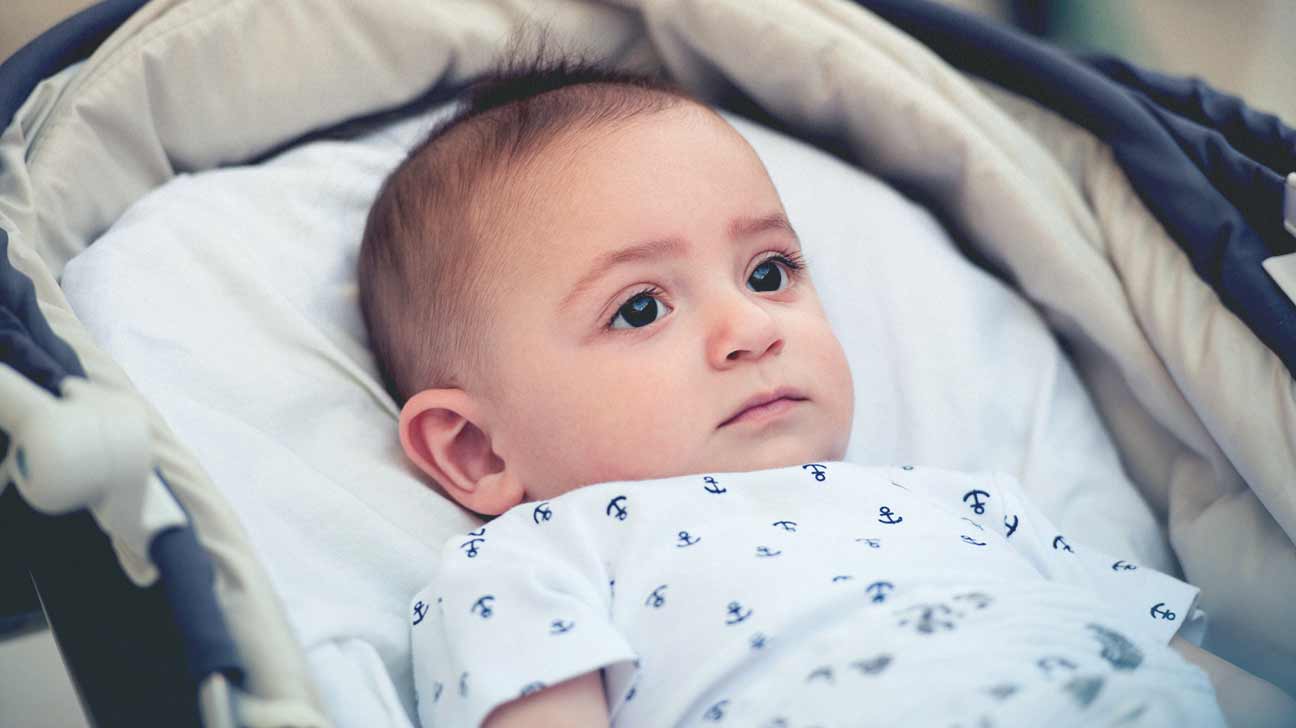
You’re staring into your two-week-old’s eyes, wondering if they actually see that bright red rattle or if they're just reacting to the noise. It’s a common parent thing. Honestly, we spend a lot of time decorating nurseries in soft pastels, but the reality is your baby probably sees that "serene sage" wall as a blurry, muddy gray.
Vision is arguably the most complex sense for a human to develop. Unlike hearing, which is pretty sharp by the time a baby is born, sight takes a massive amount of "calibration" in the brain. If you’re asking when can newborns see color, the short answer is that they can see some high-contrast hues almost immediately, but the full rainbow doesn't kick in for months. It’s a process. It isn't like a light switch flipping on; it’s more like an old-school Polaroid camera slowly developing in the sun.
The Gray World of the First Few Weeks
Fresh out of the womb, a newborn’s world is mostly black, white, and varying shades of gray. Their retinas aren't fully developed yet. Specifically, the "cones"—those tiny photoreceptor cells in the eye responsible for color—aren't yet sensitive enough to distinguish between similar tones.
Think about it this way.
The world is a high-ISO photograph with a lot of "noise." A newborn’s visual acuity is roughly 20/600. That’s legally blind in adult terms. They can see light, they can see shapes, and they can see movement, but the nuances of color are basically lost in the fog.
Why Red is the First Guest to the Party
If there’s one color your baby might notice early on, it’s red. Researchers, including those at the American Academy of Ophthalmology, generally agree that if a baby can distinguish any color in the first few weeks, it's a deep, saturated red. Why? Red has the longest wavelength of the visible light spectrum. It’s "loud" enough for those developing cones to register.
But don't go out and buy a 100% red nursery.
While they might see it, they still lack "color constancy." This is the brain's ability to recognize a color regardless of the lighting. To a newborn, a red ball in the sun and a red ball in the shadows might as well be two different objects. They’re just trying to figure out where the edge of the ball ends and the floor begins.
When Can Newborns See Color Like Adults?
By the time your baby hits the two-month mark, things start getting interesting. This is the period where the "color circuit" in the brain starts wiring itself together. You’ll notice them staring more intently at things. They might track a toy across their field of vision.
Around eight weeks, most babies can distinguish between red and green.
Blue and yellow take a little longer. Blue light has shorter wavelengths and requires more "computational power" from the brain and more mature cones in the retina. Usually, by three to four months, your baby is seeing a fairly decent range of colors. A study published in the Journal of Vision suggests that by five months, infants have categorization abilities—meaning they can tell the difference between "blue" and "light blue," even if they can't name them yet.
The Contrast Obsession
You've probably seen those black-and-white board books. There is a reason they’re everywhere. High contrast—black on white, or white on black—is the only thing a newborn’s brain can process with 100% clarity. It’s like a visual anchor.
When you ask when can newborns see color, you have to realize that "contrast" is actually more important than "hue" for the first 90 days.
A pale pink flower against a light green leaf? Invisible.
A black chevron pattern on a white background? Total fascination.
Dr. Alice Sterling Honig, a well-known child development expert, has often highlighted how these high-contrast images actually help the eyes learn to focus. The "edge" of the shape gives the eye a target. Without that target, the eye muscles don't get the "workout" they need to develop binocular vision—which is when both eyes work together to create a single, 3D image.
Milestones of the Visual Journey
It’s helpful to look at this as a timeline rather than a single date on the calendar. Every baby is different, but the biological hardware usually follows this path:
- 0–4 Weeks: High-contrast world. Can only focus on things 8 to 12 inches away (basically the distance to your face during feeding).
- 5–8 Weeks: The eyes start to track moving objects. The first hints of primary colors (red) might appear.
- 2–3 Months: Color perception expands significantly. Depth perception begins to develop as the eyes start working as a team.
- 5 Months: The baby can distinguish between different shades of the same color. Their "reach" improves because they can see where things are in space.
- 8–12 Months: Vision is almost at adult levels of clarity and color. They can spot a tiny piece of lint on the carpet from across the room.
The Role of the Primary Caregiver's Face
Humans are biologically programmed to seek out faces. It's a survival mechanism. Even before a baby can see the blue of your eyes or the pink of your lips, they are looking at the "topography" of your face.
The hairline. The eyes. The mouth.
These are high-contrast areas. When you talk to your baby, keep your face close. That 10-inch sweet spot is where they are gathering the most data. Interestingly, some research suggests that babies prefer looking at faces that are "attractive" by conventional standards, which really just means faces that are symmetrical. Symmetry is easier for a developing brain to map.
Common Myths About Infant Vision
People say a lot of weird stuff about babies. You've probably heard that babies see the world upside down.
Actually, that’s a bit of a misunderstanding of how optics work. While the image on the retina is technically inverted (as it is for adults), there is no evidence that a baby’s brain "sees" it that way. The brain is learning to interpret signals from the very beginning. There is no "flipped" phase they have to grow out of.
Another myth is that if a baby’s eyes cross, there is a permanent problem.
In the first two months, it’s totally normal for a baby’s eyes to wander or cross. They are literally learning how to control the muscles. It's like learning to walk but with your eyeballs. If the crossing is constant or persists after four months, that’s when you call the pediatrician.
Practical Ways to Support Visual Development
If you want to help your baby navigate their way into a world of color, you don't need expensive "brain-training" apps. You just need to be intentional with their environment.
1. Use "Visual Anchors" in the Nursery
Instead of an all-beige room, put one or two high-contrast posters or toys near the changing table. A black-and-white striped pillow or a bold primary-colored mobile works wonders.
2. The "Slow Move" Game
Take a brightly colored toy—ideally red or orange—and move it slowly in front of their face at that 10-inch distance. See if they track it. If they lose it, bring it back to the center. This builds the "tracking" skill which is vital for later reading and hand-eye coordination.
3. Change the View
Babies get bored. If they are always facing the same wall in their bassinet, they aren't getting new visual stimuli. Flip their position occasionally so they see the room from different angles. This helps them understand depth and "object permanence"—the idea that the dresser is still there even if they are looking at the door.
4. Go Outside
Natural light is the best way to experience color. The way sunlight hits leaves or the sky creates a spectrum that artificial bulbs can't replicate. Just keep them in the shade; those little eyes are sensitive to UV rays.
When to Be Concerned
Most of the time, vision develops perfectly fine on its own. However, keep an eye out for "red flags" (no pun intended). If your baby isn't tracking an object by three months, or if one eye seems to stay "stuck" in one direction, bring it up at your next well-baby visit. Also, excessive tearing or extreme sensitivity to light can sometimes indicate a blocked tear duct or other minor issues that are easily fixed if caught early.
Actionable Steps for Parents
Understanding when can newborns see color helps you meet them where they are developmentally. Don't stress if they don't seem interested in the "soft pastels" of their expensive toys yet.
- Audit your gear: Look at your baby’s toys. If they are all muted tones, grab a few high-contrast board books like Hello, Animals! or anything by Tana Hoban.
- Get close: When you interact, get your face within that 8–12 inch "golden zone." It’s where they feel most secure and where they can actually see you.
- Narrate the world: Even if they can't see the "green" of the grass clearly, hearing you name it helps build the cognitive bridge for later.
- Monitor the "eye-team": By four months, their eyes should be working together most of the time. If you notice a persistent "lazy eye," mention it to your doctor.
The transition from a gray, blurry world to a vibrant, sharp one is one of the fastest developmental leaps your baby will ever make. Enjoy the phase where they are mesmerized by something as simple as a black-and-white striped sock. To them, it's the most interesting thing in the universe.