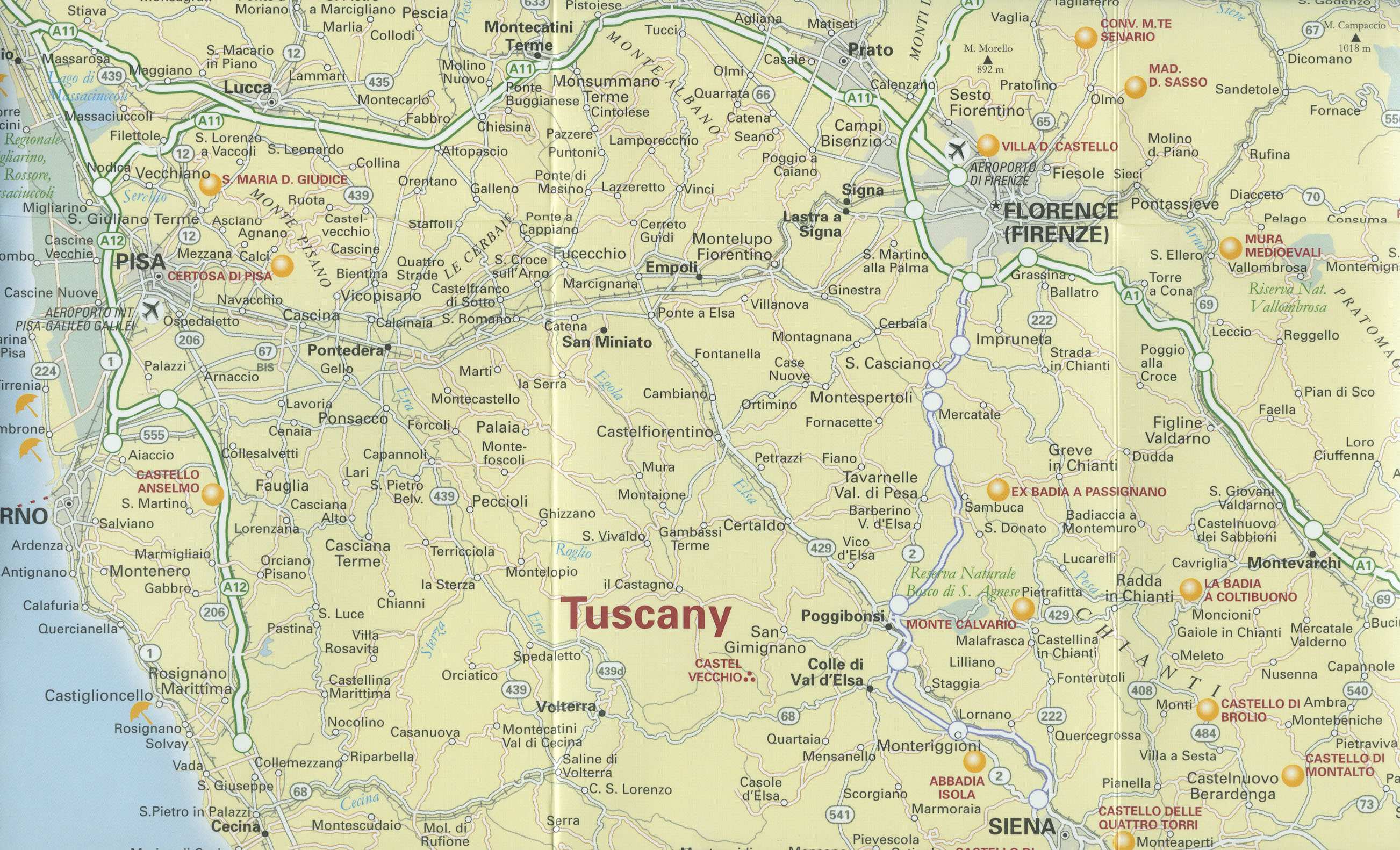
You’ve probably seen the postcard. The one with the lone cypress tree standing on a perfectly manicured hill while the sun sets in a hazy orange glow. It’s beautiful. It’s also only about 5% of what’s actually there. Honestly, when people look for Tuscany Italy on map, they usually zoom straight into a tiny triangle between Florence and Siena and call it a day. But if you really want to understand the layout of this place, you have to look at the edges.
Tuscany is big. Like, nearly 9,000 square miles big.
It sits right in the "shin" of the Italian boot, tucked between the Mediterranean Sea and the spine of the Apennine Mountains. If you’re looking at a map of Italy, it’s that chunky, roughly triangular block on the west coast, about halfway up. It borders Liguria to the northwest, Emilia-Romagna to the north, Marche and Umbria to the east, and Lazio to the south.
The Coast No One Mentions
Most travelers forget that Tuscany has a massive coastline. We’re talking about 250 miles of it. To the west, the Ligurian and Tyrrhenian Seas define the border. This isn't just one long beach, though.
In the north, you’ve got the Versilia coast, famous for fancy beach clubs in places like Forte dei Marmi. Move further south, and you hit the Maremma. This area used to be a swampy marshland before it was drained, and now it’s one of the wildest, least-populated parts of the region. If you find Tuscany Italy on map and look at the very bottom left corner, you’ll see Monte Argentario—a rocky peninsula that looks like an island but is actually tethered to the mainland by three narrow strips of land. It’s gorgeous.
Why the Provinces Matter
Tuscany isn't just "Tuscany." It’s a collection of ten distinct provinces, and honestly, they feel like different countries sometimes.
- Firenze (Florence): The capital. It’s inland, sitting in a basin surrounded by hills.
- Siena: South of Florence. This is the heart of the "classic" hill country.
- Pisa: Toward the coast. Everyone knows the tower, but the province actually reaches deep into the hills.
- Lucca: North of Pisa. A flat city surrounded by some of the most dramatic mountains in Italy.
- Arezzo: The eastern frontier, bordering Umbria.
- Grosseto: The big southern chunk. Coastal and rugged.
- Livorno: A narrow coastal strip that also includes the islands.
- Pistoia and Prato: Tucked between Florence and the mountains.
- Massa-Carrara: The far north, where the marble comes from.
If you’re planning a trip, you’ve gotta realize that driving from the marble quarries of Massa-Carrara in the north to the thermal baths of Saturnia in the south takes nearly four hours. It’s not a "day trip" kind of distance.
Tuscany Italy on Map: Decoding the Valleys
If you want to sound like an expert, stop talking about provinces and start talking about valleys (valli). This is how the locals define the land.
The Val d’Orcia is the one you see on the posters. It’s south of Siena. Because of its unique, rolling clay hills and Renaissance-era planning, the whole valley is a UNESCO World Heritage site. If you’re looking at a map, look for Pienza and San Quirico d'Orcia. That’s the "sweet spot."
Then there’s the Chianti region. Contrary to popular belief, Chianti isn't a province. It’s a hilly area that straddles the provinces of Florence and Siena. On a map, it’s the rugged, wooded section between the two cities. It’s higher in elevation and much rockier than the Val d’Orcia.
North of Lucca, you’ll find the Garfagnana. This is the part of the map that looks green and jagged. It’s mountainous, wet, and feels more like the Alps than the typical "Italian sun" vibe. It's where the locals go when they want to escape the tourists in Florence.
The Forgotten Islands
Look at the water. You see those seven dots off the coast? Those are the jewels of Venus’s necklace, or so the legend says. The Tuscan Archipelago.
Elba is the big one. It’s where Napoleon was exiled, and it’s massive. Most people forget that the islands of Giglio, Capraia, and even the mysterious, restricted island of Montecristo (yes, from the book) are part of Tuscany. If you’re looking at Tuscany Italy on map, don’t stop at the shoreline. The region extends far into the sea.
How to Navigate Like a Local
The highway system here is... unique. You have the A1 (Autostrada del Sole) which cuts through the eastern side, connecting Florence to Rome. It’s fast, but you see nothing but sound barriers.
Then you have the FI-PI-LI. It’s the free expressway connecting Florence, Pisa, and Livorno. It’s famously congested and full of speed cameras. Avoid it if you can, but you’ll probably end up on it anyway.
For the best views, you want the SR2 (Via Cassia). This is the old Roman road that runs from Florence down to Rome. It takes you right through the heart of the Val d'Orcia. If you look at a map, it’s the squiggly line that looks like a nightmare to drive but a dream to look at.
Practical Steps for Your Map Research
If you’re sitting down to plan a route, don't just rely on a standard digital map.
- Check the elevations. A "20-mile drive" in the Crete Senesi (the clay hills south of Siena) can take an hour because of the switchbacks.
- Identify the ZTL zones. Every major city on the map has a Zona Traffico Limitato. If you drive your rental car into the center of the Florence or Siena map, you’re getting a $100 fine in the mail six months later.
- Look for "Agriturismi." These are farm stays. They are usually located at the end of unpaved "white roads" (strade bianche). On a map, these look like tiny grey threads.
Tuscany is a region of layers. The map tells you where the borders are, but the geography tells you why the wine tastes different ten miles down the road. Use the map to find the Garfagnana for hiking, the Maremma for empty beaches, and the Val d'Orcia for those classic views. Just don't try to see it all in three days.
Next Step: Download an offline map of the "Strade Bianche" area in the Province of Siena to ensure you don't lose GPS signal while navigating the backroads of the Val d'Orcia.