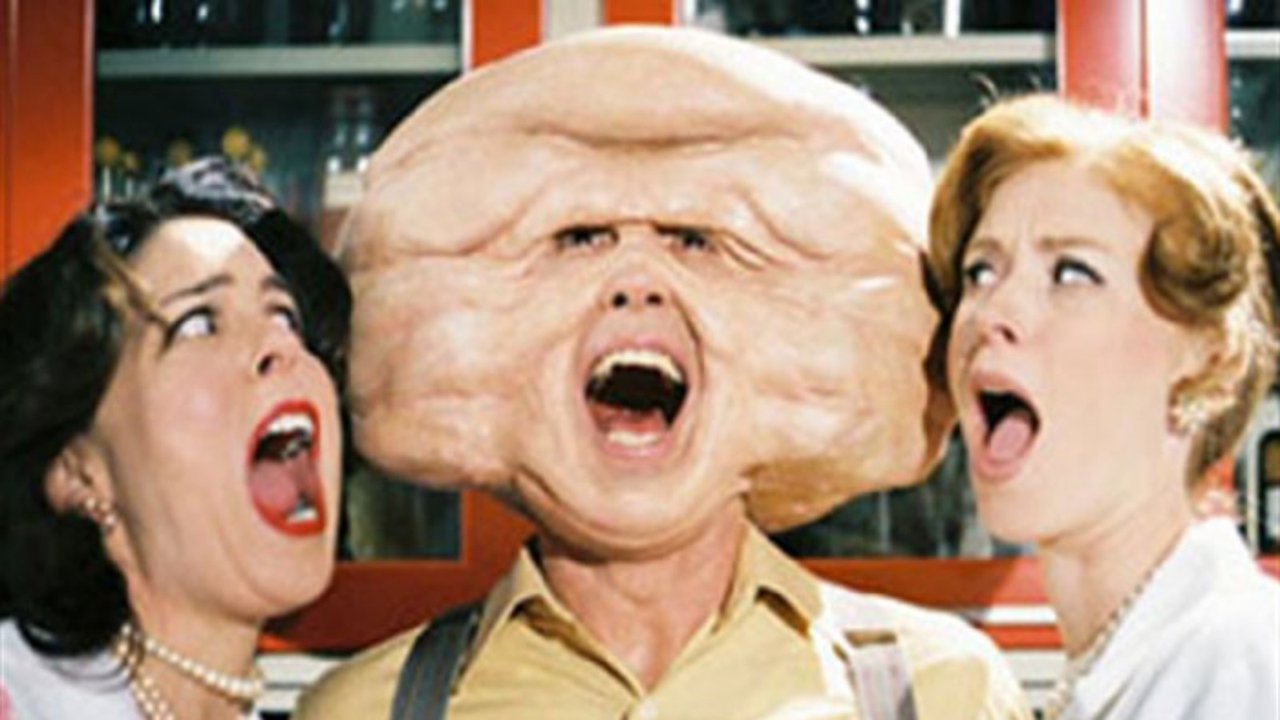
You ever see a movie that feels like it was filmed inside a fever dream, but a fever dream that specifically wants to make fun of 1950s sci-fi tropes? That is exactly what you get with Trail of the Screaming Forehead. It’s bizarre. It’s loud. Honestly, it’s one of the most unapologetically "indie" things to come out of the mid-2000s cult cinema scene. If you haven't heard of it, you’re not alone, but if you have, you probably can't stop thinking about the foreheads.
The movie is a love letter—or maybe a sarcastic postcard—to the era of Invasion of the Body Snatchers and It Came from Outer Space. Director Larry Blamire, the guy who gave us The Lost Skeleton of Cadavra, basically took the concept of alien possession and turned the "absurd" dial up to eleven. Instead of pods or brain slugs, we get crawling, detached foreheads.
It sounds ridiculous because it is. But there’s a craft to this kind of nonsense that most modern parodies miss.
What Is Trail of the Screaming Forehead Actually About?
Basically, the plot follows a small town called Longview. It’s your classic, idyllic Americana setting where everyone talks in that weird, stilted mid-century cadence. Suddenly, these alien foreheads start dropping from the sky. They don't just sit there; they latch onto people’s brows.
Once attached, these fleshy stowaways take over the host's mind. The characters are great caricatures. You’ve got Dr. Sheila Carter (played by Fay Masterson) and Dr. Philip Reed (Andrew Parks), who are trying to solve the mystery while navigating their own hilariously repressed romantic tension.
Then there’s Big Dan Frater. Daniel Roebuck plays him with this incredible, over-the-top machismo that feels like he walked straight off a 1954 film set. The whole conflict hinges on "Foreheadicine," a pseudo-science the town is obsessed with. The movie treats the forehead as the most vital organ in the human body. It’s a brilliant bit of world-building because it’s so stupidly specific.
The Genius of Larry Blamire’s Low-Budget Aesthetic
Some people watch Trail of the Screaming Forehead and think it looks "cheap." They’re missing the point. The "cheapness" is a choice. Blamire isn't trying to compete with Marvel; he’s trying to replicate the look of a movie that had a budget of fifty dollars and a ham sandwich in 1958.
The special effects are deliberately practical. You can see the seams. You can tell those foreheads are basically props being pulled along or stuck on with spirit gum. In an age where everything is smoothed over with boring CGI, there’s something genuinely refreshing about seeing physical objects on screen. It gives the film a tactile, "hand-made" quality that makes the humor land better.
It’s also about the language. The dialogue is dense. It’s rhythmic. Characters repeat phrases and use overly formal grammar in ways that shouldn't be funny, but somehow are. They talk about "scientific principles" and "the dignity of the human brow" with a straight face. That’s the secret sauce. If the actors winked at the camera, the whole thing would fall apart. They play it dead serious, which makes the sight of a man being chased by a piece of skin even funnier.
Why the "Cult Classic" Label Actually Fits Here
Most movies called "cult classics" are just popular movies that underperformed at the box office. This one is different. It’s a niche within a niche. To really get Trail of the Screaming Forehead, you kinda need to have a passing knowledge of Ed Wood or the early works of Roger Corman.
It’s a communal experience. This is the type of film you show to friends on a Friday night just to see their reactions. There’s a specific joy in the confusion of a first-time viewer.
The Cast of Characters (And Why They Matter)
- Fay Masterson: She brings a level of sincerity to Dr. Carter that anchors the madness.
- Daniel Roebuck: He’s a veteran character actor who clearly understands the assignment. His "tough guy" routine is a masterclass in physical comedy.
- Ray Walston: Fun fact—this was the legendary actor's final film role. Seeing a guy who won an Emmy and starred in My Favorite Martian show up in a movie about screaming foreheads is surreal and wonderful.
- Kevin McCarthy: Yes, the guy from the original Invasion of the Body Snatchers. His presence gives the movie "genre street cred."
Breaking Down the Foreheadicine Lore
The movie leans hard into the idea that the forehead is the seat of all human emotion and intellect. In the world of the film, "Foreheadicine" isn't just a joke; it’s the primary field of study. Dr. Reed is trying to isolate "Foreheadic pheromones."
This is where the satire gets a bit deeper. It’s poking fun at how 1950s "science" movies would just invent words that sounded vaguely academic to explain away plot holes. By centering the entire movie on the least threatening part of the human face, Blamire highlights the absurdity of the "technobabble" trope.
The aliens themselves aren't even "beings" in the traditional sense. They are just the foreheads. They crawl around like little inchworms. It’s a bizarrely creepy visual that stays with you. You'll never look at your own hairline the same way again. Honestly.
The Production Struggle and the 2007 Release
Making a movie like this is a nightmare. It was filmed around 2005-2006 and finally hit the festival circuit and limited release in 2007. Because it's so stylized, it’s a hard sell for distributors. It doesn't fit into a neat box. Is it horror? Sorta. Is it comedy? Definitely. Is it a parody? Yes, but it’s more of a "homage-parody" hybrid.
It eventually found its home on DVD and later on streaming platforms like Shout! Factory or specialized cult cinema sites. For a long time, it was actually pretty hard to find. That scarcity only added to its reputation. People would talk about the "movie with the foreheads" like it was an urban legend.
How to Watch It Without Getting Confused
If you’re going to sit down and watch Trail of the Screaming Forehead, you have to flip a switch in your brain. Don't look for logic. Don't look for a "message" about society—though you could argue it's a commentary on conformity.
Just enjoy the rhythm of the words. Listen to the way the actors pronounce "forehead." Notice the color palette—it’s bright, saturated, and feels like a Technicolor postcard. It’s a visual feast for anyone who misses the era of physical sets and matte paintings.
Practical Insights for the Aspiring Cult Film Buff
If you’re diving into the world of Larry Blamire or just want more movies that feel like this, there are a few things you should do to get the most out of the experience:
- Watch "The Lost Skeleton of Cadavra" first. It’s the spiritual predecessor and helps you understand the "language" Blamire uses.
- Look for the cameos. There are tons of nods to classic sci-fi actors and tropes that you’ll miss if you’re scrolling on your phone.
- Pay attention to the sound design. The music and foley work are specifically designed to mimic the shrill, dramatic scores of 1950s B-movies.
- Don't skip the credits. The movie stays in character until the very last frame.
Trail of the Screaming Forehead isn't for everyone. It’s polarizing. Some people find the intentional badness annoying. But for those who "get" it, it’s a brilliant piece of comedic filmmaking that honors the history of the genre while ruthlessly mocking its flaws.
The next step for any fan is to track down the physical media versions. Often, these releases include commentaries that explain exactly how they achieved certain "bad" effects, which is a lesson in creative problem-solving for any indie filmmaker. If you want a break from the "samey" feel of modern streaming catalogs, this is your ticket to something genuinely different.