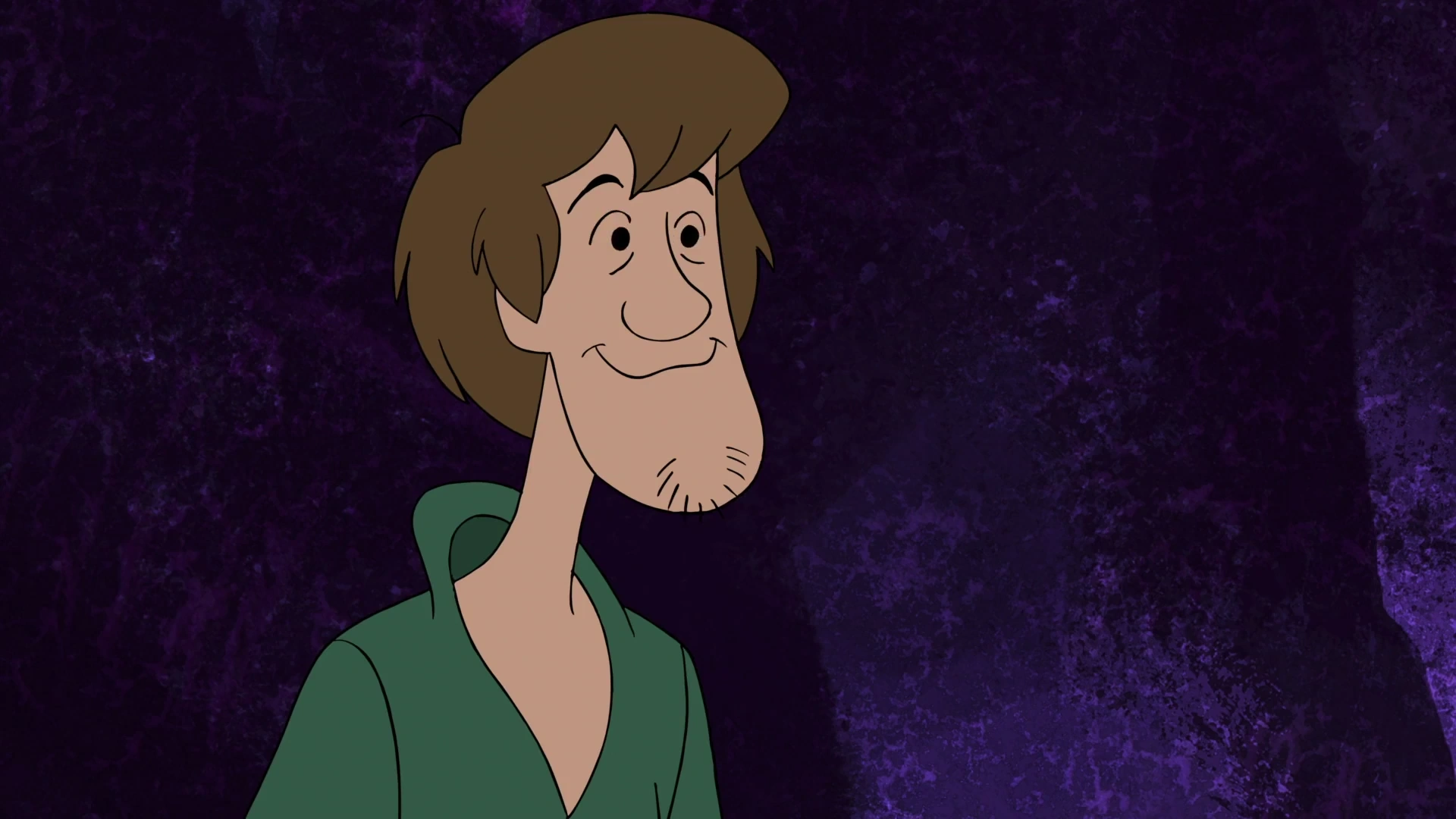
You know that weird, gulping sound Shaggy makes whenever he sees a ghost? That giant lump in his neck that bobbles up and down like a panicked ping-pong ball? It’s iconic. Honestly, if you grew up watching Scooby-Doo, Where Are You!, you probably spent more time than you’d like to admit wondering why a teenage guy—even a perpetually hungry one—had a neck that looked like it was hiding a whole grapefruit.
People have some pretty wild theories. Some folks think it's a visual gag for his constant snacking. Others swear it’s a sign of his "alternative" lifestyle. But if we’re being real, the Shaggy Scooby-Doo Adam's apple is more than just a character design quirk. It’s a masterclass in 1960s animation shortcuts and character archetypes that have survived over fifty years of reboots.
Why Shaggy’s Neck Does That
Let’s talk about the 1969 character designs. When Iwao Takamoto, the legendary character designer at Hanna-Barbera, first sketched out Norville "Shaggy" Rogers, he wasn't just drawing a random hippie. He was drawing a "beatnik." This was a specific subculture. Beatniks were skinny. They were lanky. They were a little bit disheveled.
The prominent Adam's apple was a way to emphasize Shaggy's extreme lankiness. If you look at the original model sheets, his neck is incredibly long and thin. In animation, you need "secondary action" to show emotion. When Shaggy gets scared, his hair doesn't just stand up. His whole body reacts. That massive Adam's apple gulp is a visual shorthand for "extreme terror." It’s basically a physical manifestation of his "zoinks" moment.
Interestingly, it wasn't just Shaggy. Hanna-Barbera was famous—or maybe infamous—for their limited animation style. They needed ways to show movement without actually redrawing the whole character. Moving a single lump on a neck is a lot cheaper than animating a complex facial expression. It's efficiency masquerading as a personality trait.
The Mystery of the Disappearing Gulp
If you’ve watched the newer iterations, like Scooby-Doo! Mystery Incorporated or the live-action movies, you might notice something. The Adam's apple isn't always there. It’s kinda inconsistent. In the 2002 live-action movie, Matthew Lillard (the definitive Shaggy, let's be honest) doesn't have a prosthetic neck lump. Why? Because it looks terrifying in real life.
Animated physics don't translate to 3D very well. A cartoon can have a neck that's three inches wide and a larynx that sticks out four inches. In real life, that’s a medical emergency.
Even in some of the digital animations from the 2010s, the "gulp" is reserved only for high-stress scenes. It’s no longer a permanent fixture of his character model. It’s become a "special effect." Fans have noticed. There are entire Reddit threads dedicated to the "disappearing anatomy" of Norville Rogers. Some people argue it’s a sign of the character aging up, while others think it’s just modern animators being lazy or trying to make the characters look "cleaner" for a Gen Alpha audience.
The Casey Kasem Influence
We can't talk about Shaggy's throat without talking about the voice. Casey Kasem, the original voice actor, was a vegetarian and a staunch advocate for his beliefs. He actually quit the show for a while because he didn't want Shaggy to appear in a Burger King commercial.
Kasem’s voice was naturally raspy. To get that "Shaggy sound," he had to put a lot of strain on his vocal cords. When you see Shaggy’s neck bobbing, you’re seeing a visual representation of that specific, cracking voice. It’s an audio-visual link. The gulp happens, the voice cracks, and the audience knows Shaggy is about to run in the opposite direction of the mystery.
The Internet Theories: From Munchies to Mutations
Since we live in the age of the internet, people have taken the Shaggy Scooby-Doo Adam's apple to some dark and weird places. You’ve probably heard the one where Shaggy is a "stoner." The theory goes that his throat is constantly moving because he’s perpetually thirsty or has a permanent case of the munchies.
While that makes for a funny meme, it’s not backed up by anything in the actual production notes. The creators at Hanna-Barbera were working under strict 1960s broadcast standards. They weren't trying to slip in drug references; they were trying to make kids laugh with physical comedy. The "lump" is just a classic trope of the "scaredy-cat" character, similar to how Ichabod Crane was depicted in older Disney shorts.
There's also a smaller, weirder theory that Shaggy actually has a medical condition. Some fans have pointed to goiters or thyroid issues. While it's fun to apply real-world science to cartoons, the truth is much simpler: it’s just a drawing of a guy who needs to eat a sandwich.
Why It Still Matters in 2026
You might think a drawing from the 60s shouldn't matter this much. But Shaggy’s design is one of the most recognizable silhouettes in history. The Adam's apple is a key part of that "lanky coward" look. When you remove it, the character feels "off."
It’s about visual identity. In a world of high-def 4K animation, we sometimes lose the "crunchy" details that made old cartoons feel alive. That weird neck lump gave Shaggy a sense of vulnerability. He wasn't a polished hero. He was a skinny kid who was clearly uncomfortable in his own skin, which made him the most relatable person in the Mystery Machine.
How to Spot a "Classic" Shaggy
If you’re a collector or a hardcore fan, pay attention to the neck. It’s a great way to date the animation style.
- The Original Era (1969-1970s): The Adam's apple is almost always visible, even when he’s just standing there. It’s sharp and pointed.
- The "Scrappy" Years (1980s): The design becomes softer. The neck lump is still there but looks more like a rounded curve.
- The "What's New" Era (2000s): The design gets modernized. The neck becomes thicker, and the Adam's apple only appears during the "gulp" animation.
- Modern Reboots: It’s hit or miss. Some artists lean into the retro look, while others flatten it out entirely to make him look more like a standard "teen" protagonist.
Taking a Closer Look at Character Design
If you’re interested in why characters look the way they do, Shaggy is a great case study. He’s the opposite of Fred. Fred is all broad shoulders and no neck. He’s built like a brick. Shaggy is all neck and no shoulders. He’s built like a noodle. This contrast is what makes the group dynamic work visually before a single line of dialogue is even spoken.
Next time you’re watching an old episode, wait for the chase scene. Watch that Adam's apple. It’s a tiny piece of animation history that tells you everything you need to know about how the creators felt about Norville Rogers. He wasn't just a guy with a dog; he was a guy whose very anatomy was designed to show how much he didn't want to be in a haunted mansion.
Identify the era of Scooby-Doo you are watching by the prominence of Shaggy’s neck features. If you see a sharp, constant protrusion, you are likely watching the original 1969-1970 runs. If the feature is only visible during specific sound effects, you're watching a post-2000s digital era production. Use this visual cue to understand the animation budget and stylistic priorities of the decade.