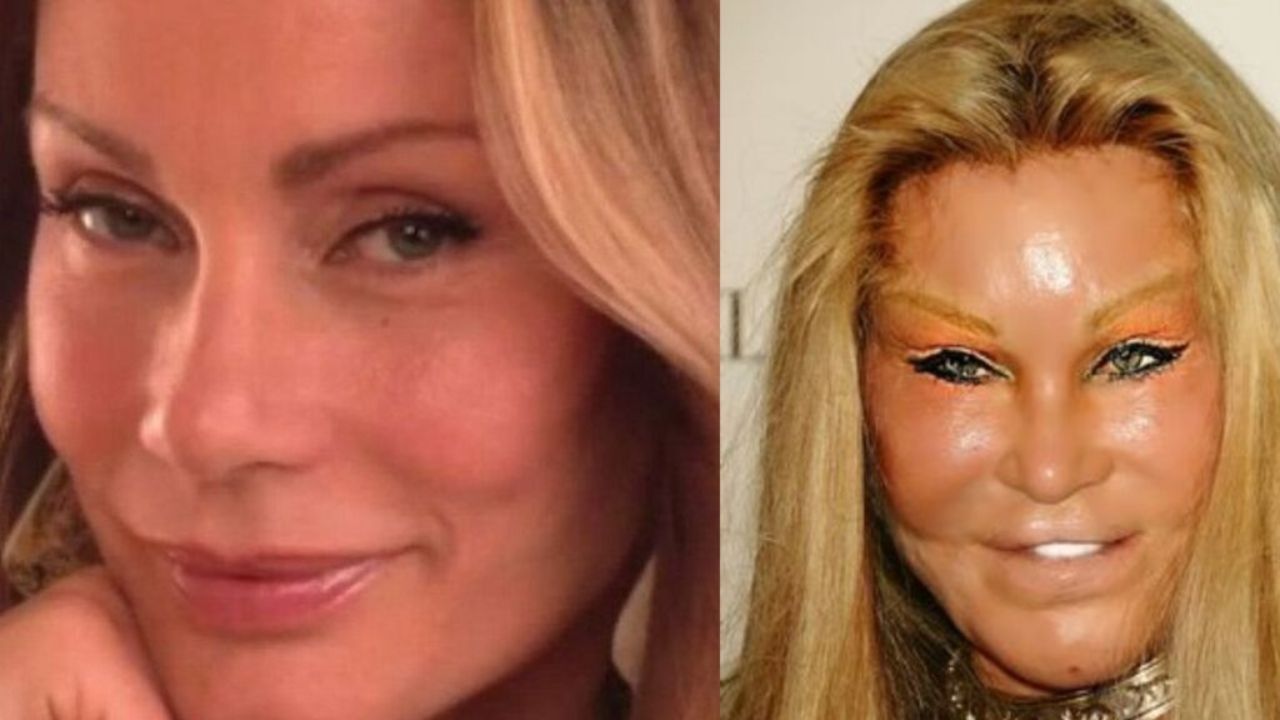
When people search for cat woman plastic surgery before, they are usually looking for a freak show. They want to see the "then and now" photos of Jocelyn Wildenstein, the Swiss-born socialite who became the poster child for cosmetic procedures gone wrong. But if you actually look at her history, the story isn't just about a woman who wanted to look like a lynx. It's a complicated, weirdly tragic tale of high-society pressure, a crumbling marriage, and a very specific aesthetic vision that backfired in the most public way possible.
She didn't wake up one day and decide to look like a cat. Honestly, the transformation took decades.
In the beginning, Jocelyn was undeniably beautiful. In the 1970s, she was a fresh-faced blonde who moved in the inner circles of the global elite. She was an avid hunter and pilot. When she married Alec Wildenstein, a billionaire art dealer, she entered a world where appearance was a primary currency. The obsession with "feline" features reportedly started because her husband loved big cats. She wanted to please him. She wanted to keep his attention. That’s the irony—she started the surgeries to save a marriage that was already falling apart.
What Cat Woman Plastic Surgery Before and After Photos Don't Tell You
Most people see the extreme swelling and the slanted eyes and think "botched surgery." While the results are certainly polarizing, a lot of what we see in cat woman plastic surgery before and after comparisons is the result of multiple, intentional procedures designed to mimic the anatomy of a jungle cat. This wasn't one mistake. It was a calculated series of choices.
She allegedly spent upwards of $4 million on these procedures. Think about that for a second. That's not just a couple of facelifts. We're talking about canthopexy (which lifts the corners of the eyes), cheek implants that were likely oversized for her bone structure, and aggressive lip augmentation.
The medical community often points to Jocelyn's case when discussing body dysmorphic disorder (BDD). Dr. Richard Fleming, a noted plastic surgeon in Beverly Hills, has often commented on how surgeons have an ethical responsibility to say "no." When a patient asks for features that defy natural human anatomy, the red flag shouldn't just be raised; it should be used to stop the procedure entirely.
But in the 80s and 90s, for a woman with unlimited funds, finding someone to say "yes" wasn't hard.
The early photos show a subtle shift. A slightly higher brow. A more pronounced cheek. Then, the volume increased. The skin became tighter. By the time the infamous divorce proceedings hit the news in the late 90s, the "Cat Woman" persona was fully formed. Alec Wildenstein famously told Vanity Fair that he didn't even recognize her toward the end. He claimed she thought she could fix her face like one would fix a house. You can't just renovate a face forever without the foundation crumbling.
The Specific Procedures That Defined the Look
If you're trying to understand the technical side of the cat woman plastic surgery before transition, you have to look at the "feline" markers.
- Canthopexy/Canthoplasty: This is the big one. It’s a surgery that tensions the lower eyelid and moves the outer corner of the eye upward. In Jocelyn’s case, it was taken to an extreme degree to create that "tilted" cat-eye look.
- Mid-face Volumization: Her cheekbones became incredibly high and wide. This was likely achieved through large silicone implants or aggressive fat grafting. Over time, as tissues age, these implants can look "stuck on" rather than integrated into the face.
- Upper and Lower Blepharoplasty: Removing skin from the eyelids. When combined with the eye-lifting, it often leaves the eyes looking perpetually startled or unable to close fully.
- Skin Resurfacing: The texture of her skin changed. Deep chemical peels or early laser treatments can sometimes leave the skin with a waxy, unnatural sheen if overdone.
The result is a face that lacks "negative space." In art and in facial aesthetics, you need balance. If everything is "high" and "tight," the human eye registers it as a mask rather than a face. It’s a phenomenon called the "Uncanny Valley." We see something that looks almost human, but something is off, and it triggers a visceral reaction.
The Cultural Impact of the Cat Woman Transformation
Why are we still talking about this in 2026?
Because Jocelyn Wildenstein represents the extreme end of a spectrum we all live on now. In the era of "Instagram Face" and "Fox Eye" threads, the "Cat Woman" look has actually become somewhat commercialized. You see influencers today getting the same lateral brow lifts and cheek fillers that Jocelyn was mocked for 30 years ago. The difference is mostly in the subtlety of the technique and the quality of the materials used.
We’ve moved from permanent implants to dissolvable fillers. That’s a huge safety net Jocelyn didn't have. If a 22-year-old today gets too much filler, they can melt it away with hyaluronidase. In the 90s, you were stuck with what the surgeon put in there, or you had to undergo invasive surgery to cut it out.
There is also the element of "The Billionaire's Divorce." The 1999 divorce settlement was legendary. Jocelyn was awarded $2.5 billion plus $100 million annually for 13 years. However, the judge famously stipulated that she could not use any of the alimony for further plastic surgery. That might be the only time in legal history a judge has issued a "stop" order on someone's face.
It didn't work, by the way. She continued to have work done well into the 2000s and 2010s.
Misconceptions About Her Current State
If you look at recent interviews, Jocelyn is surprisingly candid. She often denies having as much surgery as people claim. She’s even posted "before" photos on social media to prove she always had "cat-like" eyes. While experts disagree—pointing to the obvious scars and structural changes—her personal narrative is one of self-acceptance. She doesn't see a monster when she looks in the mirror. She sees the version of herself she worked hard to create.
That's the part that's hard for the public to grasp. We view her as a "cautionary tale," but she views herself as a woman who took control of her own image. Whether that image is "successful" depends entirely on who is looking.
But let's be real. From a clinical perspective, the cat woman plastic surgery before and after trajectory is a case study in "over-correction." When you lose the ability to show emotion through facial expressions because the muscles are pinned or the skin is too tight, you lose a fundamental part of human communication.
Lessons for Anyone Considering Cosmetic Work
If you're looking at Jocelyn's photos because you're considering your own procedures, there are actual, practical takeaways here. This isn't just about pointing fingers.
First, the "less is more" rule isn't just a cliché. It's a biological reality. The skin can only handle so much trauma. Every time you go under the knife, you create scar tissue. Scar tissue is inelastic. Eventually, the surgeon isn't working with skin anymore; they're working with something that behaves like leather.
Second, consider the "Trend Trap." The "cat eye" is a trend. Trends die. Your face is permanent. In the 90s, the "heroin chic" look was in. In the 2010s, it was the "BBL" look. Now, we're seeing a return to "Ozempic face" and thinness. If you surgically alter your bone structure to fit a 2026 trend, you’re going to look dated by 2036.
Third, the importance of psychological screening. A good surgeon will ask why you want the change. If the answer is "to save my marriage" or "because I want to look like an animal," that surgeon should show you the door.
What You Should Do Instead
If you feel the urge to dramatically change your appearance, start with non-invasive options.
- Focus on Skin Quality: Instead of pulling the skin tight, focus on the health of the dermis. Microneedling, Tretinoin, and high-quality sun protection do more for "youthfulness" than a facelift ever will.
- The 10% Rule: Never change more than 10% of your look at once. Subtle tweaks allow your brain and your social circle to adjust.
- Consult Multiple Experts: Don't just go to the "celebrity surgeon." Go to the boring, academic surgeon who specializes in reconstruction. They have the best understanding of anatomy.
- Wait Six Months: If you want a major procedure, wait half a year. If you still want it with the same intensity, then proceed. Most "impulse" surgeries are driven by temporary emotional states.
Jocelyn Wildenstein’s story isn't over. She remains a fixture in the fashion world, often seen at Paris Fashion Week, seemingly unbothered by the decades of tabloid scrutiny. She is a reminder that beauty is subjective, but anatomy is not. You can change your face, but you have to live with the physics of that change for the rest of your life.
If you're researching cat woman plastic surgery before and after, use it as a map of where not to go. Look at the early photos and realize she was already enough. Most of us are.
To move forward with a healthy approach to aesthetics, prioritize procedures that restore what time has taken rather than trying to build a face that never existed. Realize that volume (fillers) should be used to replace lost fat, not to create new structures. Finally, remember that the most "successful" plastic surgery is the kind that nobody notices. If people are Googling your name followed by "before and after," the goal of "natural enhancement" has probably been lost along the way.