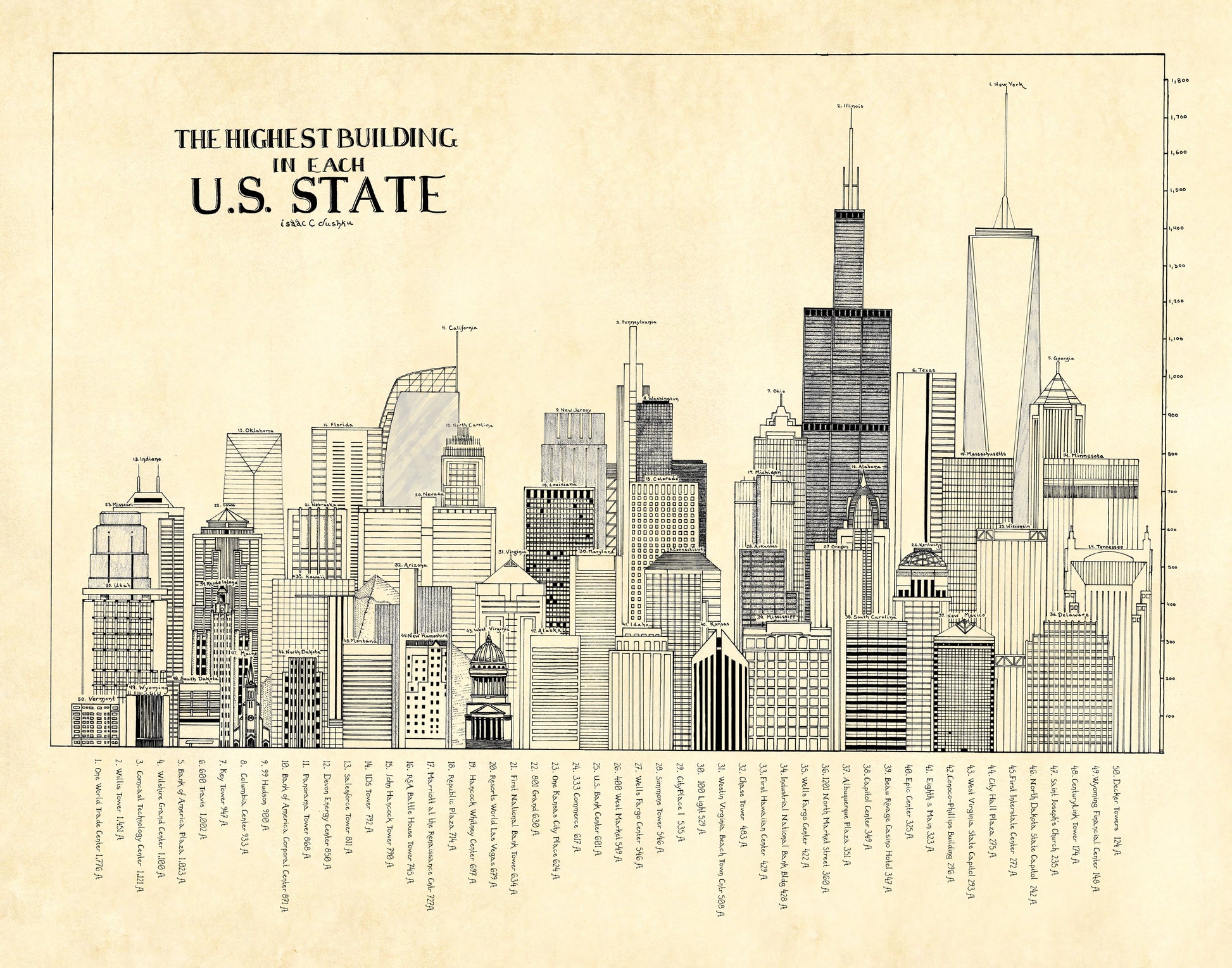
You probably think every state has some massive, glass-sheathed monolith piercing the clouds. Honestly, that’s just not the case. If you stand in downtown Burlington, Vermont, looking for a skyscraper, you’re going to be looking for a very long time. The "tallest" building there is basically a 124-foot apartment complex called Decker Towers. It’s 11 stories. In Manhattan, that wouldn't even count as a mid-rise.
Size is relative.
When we talk about the tallest buildings in each state, we’re really looking at a map of American economics. You've got the titans like New York and Illinois, where the race for the sky never actually ended. Then you have places like Wyoming or South Dakota, where the horizon is dominated by grain elevators or rolling hills rather than steel beams. It’s a weird, vertical patchwork of history.
The Heavy Hitters: Where 1,000 Feet is the Baseline
Only five states actually boast "supertall" status with buildings breaking the 1,000-foot mark. New York obviously takes the crown. One World Trade Center stands at a very deliberate 1,776 feet. It’s a symbolic nod to the year the Declaration of Independence was signed, though if you ask an architect, they’ll tell you the "real" height to the roof is lower. It's the spire that does the heavy lifting.
Chicago is the original home of the skyscraper. The Willis Tower—everyone still calls it the Sears Tower, let’s be real—hits 1,451 feet. For 25 years, it was the king of the world. It’s still a beast of a building.
In Pennsylvania, Philadelphia’s Comcast Technology Center reached 1,121 feet in 2018, officially snatching the state title. It’s got a cooling system that uses chilled water beams, which is kinda wild for a building that looks like a giant glowing thumb.
California has the Wilshire Grand Center in Los Angeles. It’s 1,100 feet tall. Interestingly, it broke the long-standing "flat roof" rule in LA, which required every tall building to have a helipad for fire rescues. They finally scrapped that in 2014, allowing for the decorative spire that gives the Wilshire its record.
Texas rounds out the club. For years, the JPMorgan Chase Tower in Houston held the line at 1,002 feet. But keep an eye on Austin. The Waterline is currently under construction and is slated to top out at 1,034 feet in 2026. Things move fast in the South.
The Surprisingly Short Records
It’s almost funny to compare the giants to the modest "high-rises" of the rural US. Vermont is the extreme example with Decker Towers (124 feet), but others aren't much further ahead.
- South Dakota: The CenturyLink Tower in Sioux Falls is just 174 feet.
- Wyoming: Wyoming Financial Center in Cheyenne stands at 148 feet.
- North Dakota: Their capitol building is the winner at 242 feet. It’s one of the few "skyscraper" capitols in the country, built in the 1930s because they wanted something functional rather than fancy.
Maine has a church as its tallest structure. Saint Joseph’s Church in Biddeford hits 235 feet. It’s a beautiful piece of masonry, but it's a far cry from a corporate headquarters. It’s also one of the oldest buildings to hold a state record.
Why Some States Stop Climbing
You might wonder why Phoenix, Arizona doesn't have a 1,000-foot tower despite being one of the largest cities in the country. The Chase Tower there is only 483 feet. Why? Mostly the FAA. Since the airport is so close to downtown, there’s a hard cap on how high you can build without becoming a hazard to navigation.
Then there's the "Basement Factor." In places like Florida, the soil is basically a wet sponge. Building the Panorama Tower (868 feet) in Miami required massive pilings driven deep into the limestone. It’s expensive.
The Mid-Range Legends
Most states fall into the 500-to-800-foot range. These are your "standard" big-city skylines.
Georgia’s Bank of America Plaza in Atlanta is a standout at 1,023 feet (technically the 6th state to hit 1,000+). It’s got a glowing pencil-tip top that looks incredible at night.
In the Midwest, Minnesota’s IDS Tower (792 feet) is the centerpiece of Minneapolis. It was designed by Philip Johnson and basically defined the modern "glass box" look for an entire generation of architects.
Oklahoma is a surprise to many. The Devon Energy Center in Oklahoma City is 850 feet. It literally towers over everything else in the city; you can see it from miles away across the flat plains. It looks like a spaceship landed in the middle of a cow pasture.
The Evolution of the List
This list isn't static. In the next couple of years, we're going to see some major shifts. Nashville is growing like crazy, and their "Batman Building" (AT&T Building, 617 feet) might soon have competition.
In Nevada, the Fontainebleau Las Vegas (735 feet) recently took the title after being a "blue ghost" construction site for nearly a decade. It’s finally finished, proving that even the most cursed projects can eventually claim a record.
Actionable Tips for Skyscraper Enthusiasts
If you're planning a trip to see the tallest buildings in each state, don't just look at them from the sidewalk. Here is how to actually experience them:
- Check for Observation Decks: Only about a dozen of these buildings have public decks. The Willis Tower (Skydeck) and One World Trade (One World Observatory) are obvious, but the IDS Tower in Minneapolis has a stunning crystal court at the base that's worth the visit.
- Look for Rooftop Bars: If there isn't an official observatory, there’s often a high-end bar near the top. The Westin in Virginia Beach (508 feet) has residential and hotel spaces that offer views you can't get elsewhere in the state.
- Download an AR Sky-Mapping App: Use apps like Skyview or specialized architecture apps to identify heights and names in real-time. It’s much easier than squinting at a map.
- Consider the "Shadow" Rule: If you're photographing these giants, go during "Golden Hour" (the hour before sunset). The long shadows and reflected light off the glass make for much better photos than the harsh midday sun.
Architecture tells you who a city wants to be. Whether it's a 1,700-foot glass spire or a 120-foot brick apartment building, these structures are the exclamation points on the local landscape.