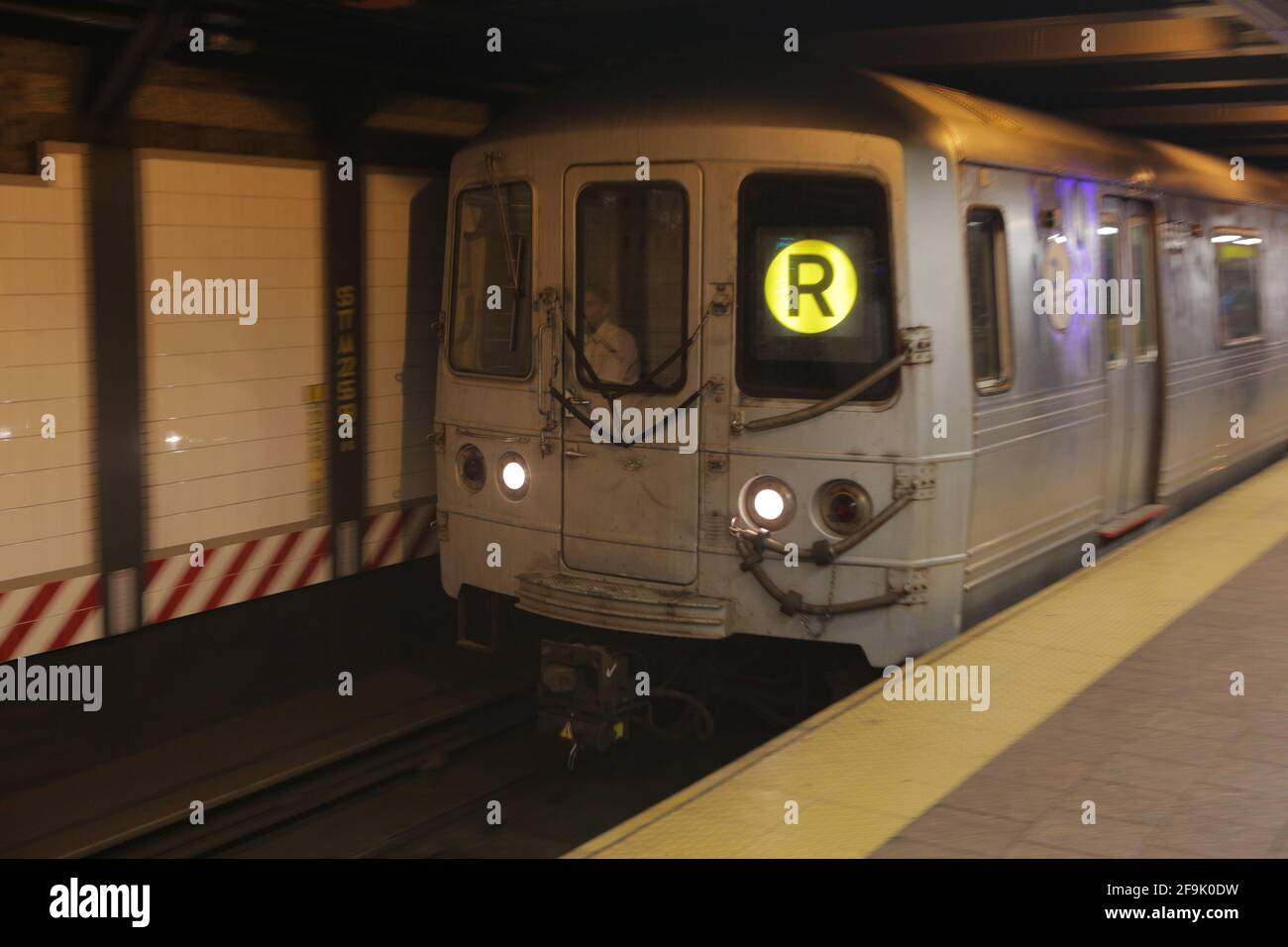
You know that feeling when you're standing on the platform at 4th Avenue-9th Street and the countdown clock just... stops? It says "8 minutes" for about twenty minutes. That is the quintessential experience of the New York subway R train. It's a yellow-line enigma. People love to hate it, but if you live in Bay Ridge or work in Downtown Brooklyn, it is basically your lifeline to the rest of civilization. It’s long. It’s slow. Yet, it manages to hit some of the most iconic spots in the five boroughs without ever crossing a single bridge.
The R is a workhorse. It runs local all the time. Unlike the N or the Q, which get to skip stations and feel like they’re actually going somewhere, the R stops at every single local station from Forest Hills in Queens all the way down to 95th Street in Brooklyn. It’s a 45-station marathon. If you’ve ever ridden the whole thing, you deserve a trophy, or at least a very long nap.
What makes the New York subway R train so different?
Honestly, the R is the "Yellow Submarine" of the system. It’s officially the Broadway Local. Because it stays underground through the Montague Street Tunnel, you don't get those Instagrammable views of the Manhattan Bridge that you get on the B, D, N, or Q. You just get darkness and the screech of metal on metal. But that tunnel is a piece of history. After Hurricane Sandy in 2012, the Montague Street Tunnel was flooded with millions of gallons of saltwater. It took a massive, year-long shutdown in 2013 and 2014 to fix the damage. Most New Yorkers forgot how much they relied on the R until it was gone and they were forced to cram onto the 4 or 5 trains just to get across the river.
There’s a weird myth that the R stands for "Rare." It doesn't, obviously, but when you're waiting at 36th Street in Brooklyn at 11:00 PM, it certainly feels that way. The headways—that's the fancy transit nerd word for the time between trains—can be brutal. During peak hours, you might see a train every 6 to 10 minutes. Late at night? Good luck. You’re looking at 20-minute gaps.
The Fleet: From R46 to the R211
For decades, the R was the land of the R46 cars. These were those 75-foot-long monsters built by Pullman Standard in the 1970s. They had the faux-wood paneling and the bright orange and yellow seats that made you feel like you were in a gritty 70s crime drama. They were heavy. They creaked. But they had a certain soul. Recently, the MTA has been shuffling the deck. You’re now much more likely to see the R160 cars—the "New Millennium" trains with the automated voices and the clearer LED displays.
And keep your eyes peeled for the R211s. These are the brand-new, open-gangway models that the MTA is slowly rolling out. While they mostly live on the A and C lines for now, the R is slated for a major tech upgrade. Why? Because the R train is part of the Queens Blvd line, which is getting CBTC (Communications-Based Train Control). This is the same tech that made the L train and the 7 train actually reliable. It allows trains to run closer together, which should, in theory, end the "Rare" train jokes forever.
Navigating the route: From Forest Hills to Bay Ridge
The New York subway R train starts its journey at Forest Hills–71st Avenue. This is a massive transit hub where it meets the E, F, and M. In Queens, the R acts as the local relief for the E and F express trains. If you’re heading to Woodside or Jackson Heights, the R is your slow-and-steady friend.
Then it hits Manhattan.
It enters via the 60th Street Tunnel and snakes down Broadway. This is the tourist goldmine.
- 59th Street-Lexington: Bloomingdale’s and the bridge.
- Times Square: You know the drill.
- 34th Street-Herald Square: Macy’s and the B, D, F, M, N, Q.
- Canal Street: Cheap sunglasses and the smell of street food.
The Manhattan stretch is where the R feels the most "New York." It’s crowded, it’s loud, and the stations are some of the oldest in the city. City Hall station is a particular favorite for history buffs, though the "active" R train station is much less glamorous than the legendary abandoned City Hall station nearby.
Crossing into Brooklyn
Once it leaves Whitehall Street at the tip of Manhattan, it dives under the East River. It pops up at Court Street in Brooklyn Heights. This is where the R becomes the primary north-south artery for Western Brooklyn. It runs under 4th Avenue, a massive boulevard that used to be a bustling industrial corridor and is now being lined with luxury high-rises.
The 4th Avenue line is interesting because it’s a four-track setup. The N and D trains fly past on the express tracks, while the R plods along on the local tracks. At 36th Street and 59th Street, there are cross-platform transfers. This is the "Brooklyn dance." You see a crowd of people sprinting across the platform to catch an N train that’s just about to close its doors. It’s a high-stakes sport.
The Bay Ridge Struggle
Bay Ridge is a beautiful neighborhood. It has the pier, the Verrazzano-Narrows Bridge views, and some of the best food in the city. But it only has one train: the R.
If the R is delayed, Bay Ridge is effectively cut off. Residents there have been lobbying for better service for decades. The "R-Train Blues" is a real thing. Because the line is so long, a problem at 71st Ave in Queens can ripple down and cause a 20-minute delay in South Brooklyn three hours later. It’s a domino effect.
The MTA has tried to help. They did a series of station renovations under the "Enhanced Station Initiative" a few years back. Stations like Prospect Avenue and 53rd Street got new tiles, USB charging ports (that rarely work), and better lighting. It looks nicer, sure, but the train still moves at the same speed.
Technical quirks and misconceptions
People think the subway is just a series of tunnels, but the New York subway R train is a masterpiece of early 20th-century engineering. It uses the BMT (Brooklyn-Manhattan Transit) standards, which means the cars are wider than the numbered lines (the IRT).
One thing people get wrong: they think the R is always 24/7. While it does run 24 hours a day, its route changes slightly at night. In the wee hours, the R often runs as a shuttle between 95th Street and 36th Street in Brooklyn, or it stays in Brooklyn entirely. If you’re trying to get from Queens to Manhattan at 3 AM, you’re usually looking at the E or the N instead. Always check the MYmta app. Seriously. The weekend service changes are legendary for being confusing. One Saturday it’s running via the Q line, the next it’s ending at Whitehall Street, and the next it’s just... not there.
The "R" stands for Reliability? Not quite.
Expert tip: If you are in Manhattan and need to get to Brooklyn fast, don't take the R. Take the N or the Q. The R is for when you have a book to read or you’re going to a specific local stop like Union St or 25th St.
The R train is also notorious for "train bunching." This is when you wait 15 minutes for a train, and then three show up at once. This happens because the R has to merge with other lines at several points. Every time a train merges, there’s a chance for a delay. It’s like a highway on-ramp during rush hour, but with 400-ton steel carriages.
How to actually survive the R train
If you're going to be a regular on the R, you need a strategy. First, understand the car placement. At many Brooklyn stations, the exits are at the very front or very back of the platform. If you're at 95th St, the exit is at the front. If you're at 4th Ave-9th St, you want to be in the middle to catch the F train transfer.
Second, embrace the local life. The R stops at 53rd St in Brooklyn, which is right by Industry City. This place is a massive complex of food halls, design shops, and breweries. It’s one of the best "hidden" gems in Brooklyn, and the R train is the only way to get there directly.
Third, watch the signals. The R train moves through some of the most complex interlockings in the system, specifically near DeKalb Avenue. If your train stops in the tunnel for five minutes, it’s probably waiting for a D or B train to pass. It’s not a breakdown; it’s just traffic.
Actionable Insights for Riders
- Check the Clock: Don't trust the scheduled times on Google Maps. Use the "Live" data in the MTA app or Citymapper. The R is prone to "ghost trains" that disappear from the board.
- The DeKalb Bypass: If you’re coming from Manhattan and the R is taking forever, take the Q to DeKalb Ave and wait for the R there. It’s much more pleasant than waiting at a stuffy underground station like Prince St.
- The 59th St Transfer: In Brooklyn, 59th St is your golden ticket. You can hop off the R and wait for the N. The N is express and will save you about 15 minutes of travel time to Atlantic Avenue.
- Bay Ridge Commuters: If the R is totally dead, look for the x27 or x37 express buses. They cost more ($7.00 compared to $2.90), but they go straight to Manhattan via the Gowanus Expressway and are a lifesaver during signal failures.
- Weekend Check: Always, always check for "Planned Service Changes." The R is the MTA’s favorite train to reroute on Saturdays. It might be running on the F line in Manhattan or skipping Queens entirely.
The New York subway R train isn't the fastest, and it definitely isn't the prettiest. But it’s a vital piece of the city's backbone. It connects the residential quiet of Bay Ridge to the hustle of Midtown and the suburban feel of Forest Hills. It’s the quintessential local experience. Next time you're on it, just lean back, ignore the screeching brakes, and enjoy the slow ride through the heart of New York.