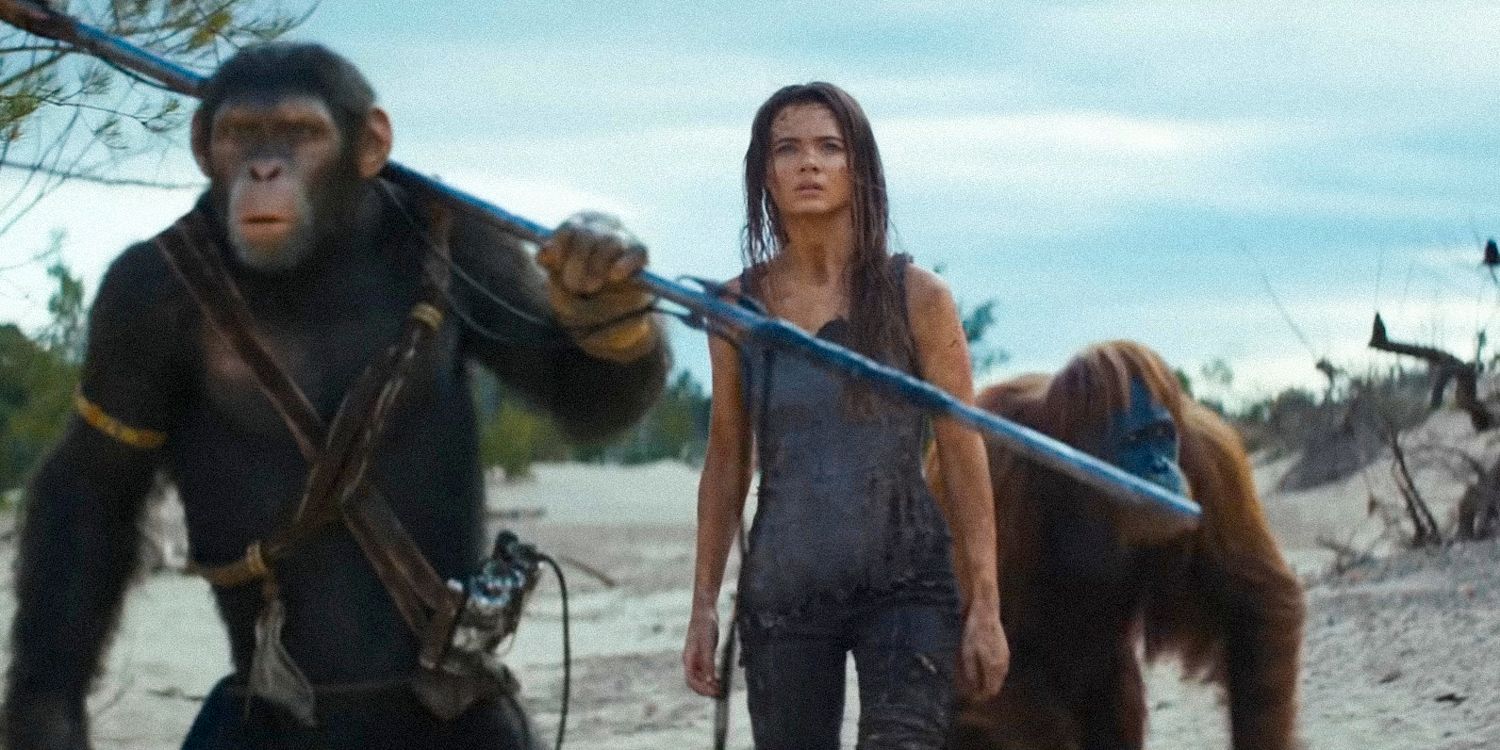
If you walked out of the theater feeling a little bit uneasy about Mae, you aren't alone. Honestly, that’s exactly what director Wes Ball and actress Freya Allan were aiming for. Most blockbusters give you a hero you can cheer for without a second thought, but Kingdom of the Planet of the Apes Mae is a different breed of protagonist entirely. She isn't Nova. She isn't a damsel. She’s arguably the most dangerous person on the planet because she knows exactly what humanity used to be, and she’s willing to do some pretty dark stuff to get it back.
The movie starts out making you think she's just another "feral" human like we saw in the Caesar trilogy. But the second she opens her mouth and starts talking, the whole power dynamic shifts.
Who is Kingdom of the Planet of the Apes Mae Really?
Let’s get the basics out of the way before we dive into the messy moral stuff. Mae is a scavenger, but not the kind that digs for scraps. She’s a remnant of a hidden human enclave—specifically one located in a high-tech bunker that hasn't been ravaged by the Simian Flu mutation. While the rest of the humans on the surface have devolved into animalistic states, Mae has an education. She has a mission. She has a gun.
That last part is vital.
When we first meet her, she’s trailing Noa’s tribe. It looks like she’s just hungry or looking for protection. But as the plot thickens, it becomes clear she’s using Noa. Noa is a young ape trying to save his family from Proximus Caesar, a tyrant who has twisted Caesar’s "Apes Together Strong" motto into a fascist dictatorship. Proximus wants "the secret" inside a massive vault. Mae also wants what’s in that vault. The difference is that Proximus wants to use human technology to conquer other apes, while Mae wants to use it to restart human dominance.
She’s basically a soldier for a dead world.
Think about the scene where she kills one of Proximus's human "advisors" (played by William H. Macy). That wasn't an accident. It wasn't self-defense. It was a cold, calculated move to ensure that the secrets of the vault stayed between her and the apes she was manipulating. It’s a moment that makes you realize Mae isn't the "sidekick." She’s a player in a much larger game.
The SATCOM Key and the Deception
The "MacGuffin" of the movie is a SATCOM encryption key. Mae knows that if she can get this key to a functioning satellite array, humanity can communicate again. Across the globe. All those isolated pockets of humans who haven't lost their intelligence could finally unite.
To get it, she plays on Noa's kindness. She lets him think they are partners.
Is she a villain? That’s the wrong question. In her mind, she’s the hero of the human race. If you were the last of your kind and you saw the world being taken over by another species, wouldn't you do whatever it took to keep your species from going extinct? But for Noa, Mae represents a betrayal of trust. He sees her as a friend, but to Mae, Noa is a tool. This friction is why Kingdom of the Planet of the Apes Mae is such a compelling character. She’s the bridge between the old world and the new, and she’s ready to burn that bridge if it means humans get to be on top again.
Why the Ending is So Polarizing
The final standoff between Mae and Noa is haunting. After they successfully blow the vault (drowning Proximus’s dreams in the process), Mae goes back to her people. But she takes a detour to say goodbye to Noa. She’s wearing a hazmat suit. She’s holding a gun behind her back.
She doesn't trust him.
Noa gives her the eagle medal, a symbol of his tribe’s heritage. It’s a peace offering. But Mae’s hand stays on that weapon. She knows that as long as apes are the dominant species, humans will always be in cages or hiding in holes. The movie ends with her delivering the SATCOM key, and we see humans in another bunker making contact with other survivors. It’s a victory for her, but it feels like a declaration of war for the audience.
Wes Ball has mentioned in several interviews that the goal was to create a "complicated" relationship. You want her to succeed because she’s us, but you want Noa to be safe because he’s the moral heart of the film.
The Freya Allan Factor
Freya Allan, who most people know from The Witcher, brings a jittery, desperate energy to the role. She doesn't play Mae as a badass action hero. She plays her as someone who is constantly terrified but refuses to back down. Every time she speaks, you can hear the weight of her ancestors on her shoulders.
It’s worth noting that her costume is also a storyteller. Her clothes are rugged, but they aren't "ape-made." They are remnants. Just like her knowledge of the stars and technology. She’s a walking ghost of the 21st century.
What Most People Get Wrong About Mae’s Motivation
A common complaint I see online is that Mae is "unlikable." Well, yeah. She’s supposed to be. If she were a typical Hollywood protagonist, she would have stayed with Noa and helped him rebuild his village. They’d be best friends forever.
But that’s not what this franchise is about.
The Planet of the Apes series has always been a tragedy. It’s about the inevitable clash between two species that cannot coexist. Mae understands this better than anyone. She knows that if humans get their tech back, they won't just share the planet. They will try to take it back. All of it.
She isn't unlikable; she’s honest.
She knows that the "Kingdom" isn't big enough for two kings. When she looks at Noa, she doesn't just see a talking ape. She sees the reason why her kind is living in a basement. That’s a level of nuance you rarely get in summer blockbusters.
Actionable Insights for Fans and Theorists
If you’re looking to dive deeper into the lore or prepare for the inevitable sequel, here is what you need to keep an eye on regarding the future of this character:
- Watch the eyes: In the final scene, look at the way Mae looks at the sky compared to how Noa looks at it. For Noa, the sky is about the future of his tribe and their connection to nature. For Mae, the sky is a tactical advantage.
- The Hazmat Suit Significance: The humans in the bunker are terrified of the mutated virus. This suggests that while they have technology, they are incredibly fragile. A single exposure could turn them "feral" like the surface humans.
- The Gun: Mae’s handgun is more than a weapon; it’s a symbol of the "Old World." It represents the violent history of humanity that Caesar tried to move away from.
- Re-watch the Vault Scene: Notice what Mae prioritizes. She doesn't grab food or gold. she grabs information. In the new world, information is the only currency that matters.
The story of Kingdom of the Planet of the Apes Mae is far from over. As we move into the next chapter of this new trilogy, the tension between her desire for human restoration and Noa’s desire for ape sovereignty is going to be the main engine of the plot. You can bet that the next time they meet, it won't be as allies. It will be as representatives of two different worlds, both fighting for the right to exist on a planet that might not have room for both.
Keep an eye on the official 20th Century Studios social channels for casting updates for the sequel, as the "Bunker Humans" are expected to play a much larger role. If you want to understand the historical context of the Simian Flu that Mae is running from, revisiting the original Matt Reeves trilogy is a must.