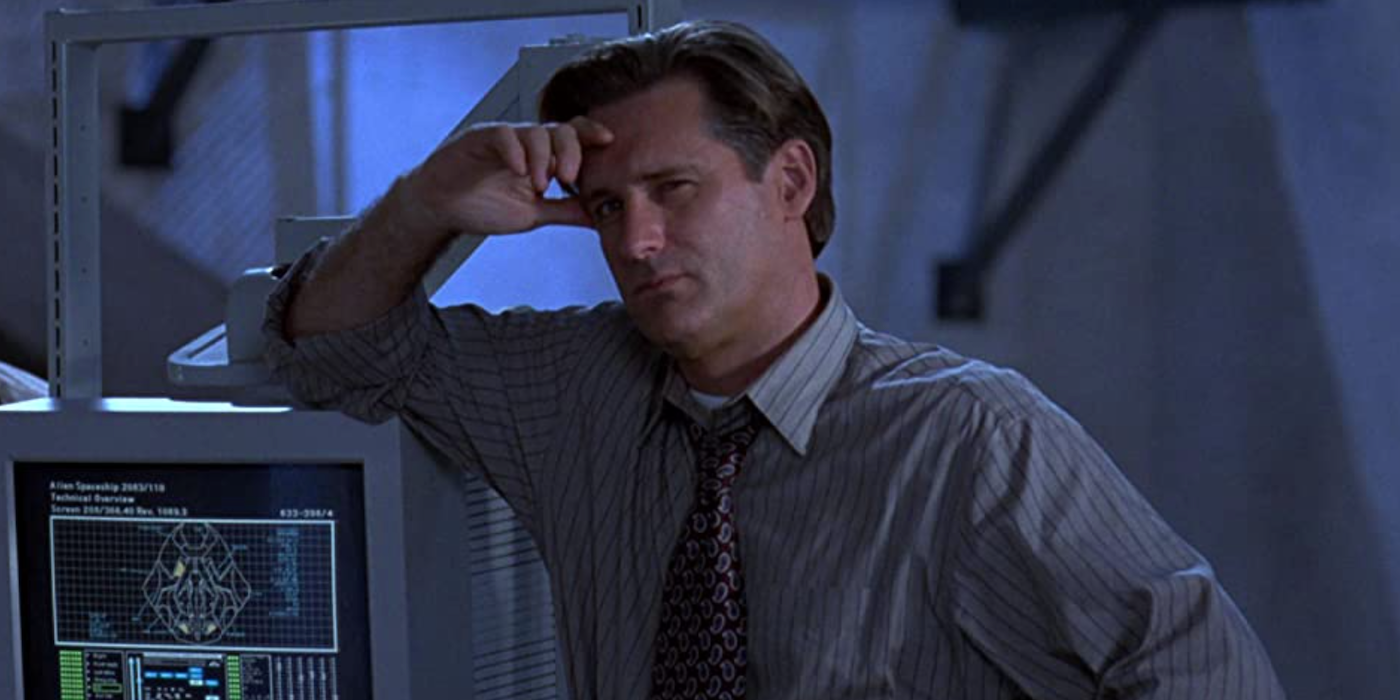
It was late. August 6, 1995, to be exact. The crew of Independence Day was filming in the middle of a desert at Wendover Airfield in Utah. Bill Pullman stood on the bed of a truck, looking out at a crowd of extras and a collection of F-18s. Everyone was tired. The movie didn’t even have its final title yet; the studio, 20th Century Fox, was leaning hard into calling it Doomsday.
Then Pullman started talking.
That speech from independence day bill pullman gave us wasn’t supposed to be the "final" version. In fact, screenwriter Dean Devlin basically vomited it onto the page in about five minutes. It was a placeholder. Devlin and director Roland Emmerich figured they’d go back and polish it into something more "presidential" later. They never did. Why would you touch something that made the hair on the back of the crew's necks stand up during the first take?
The Secret Battle Over the Movie's Title
Most people don't realize that the speech from independence day bill pullman delivered was actually a strategic weapon. Fox was being stubborn about the title. They thought Independence Day sounded too much like a period piece or a boring historical drama. They wanted something punchy and disaster-oriented. Doomsday was the frontrunner.
Devlin and Emmerich hated it. They knew the movie was about hope, not just destruction.
They deliberately moved the speech up in the filming schedule. They wanted to capture Pullman's performance and use it as leverage. Pullman himself has recounted how he felt the pressure that night. He knew that if he nailed the delivery, and specifically that final line—"Today, we celebrate our Independence Day!"—the studio wouldn't be able to argue.
It worked. After seeing the dailies, Devlin popped a VHS tape into Pullman's trailer a few nights later. Pullman watched himself rally the troops and allegedly said, "Holy Mother, they have got to name this movie Independence Day." The studio folded. The speech literally gave the film its name.
Why It Hits Different (The Kennedy Influence)
Kinda weird to think about, but Bill Pullman didn't look at other action movies for inspiration. He went deeper. He actually studied a speech given by Robert F. Kennedy in 1968.
Specifically, he looked at the moment RFK had to break the news of Martin Luther King Jr.’s assassination to a crowd in Indianapolis. It was an off-the-cuff, raw, and deeply human moment. Pullman wanted that same "no notes" energy. He didn't want President Whitmore to sound like he was reading a teleprompter. He wanted him to sound like a guy who just crawled out of a bunker and was ready to die with his friends.
The Breakdown of the Rhetoric
If you look at the structure, it’s a masterclass in what experts call "ethos, pathos, and logos," even if Devlin wrote it while he was probably running on caffeine and stress.
- The Shift from "You" to "We": It starts with the President talking to the pilots ("You will be launching..."). Then, halfway through, it pivots. It becomes "We will be united in our common interests."
- The Dylan Thomas Nod: "We will not go quietly into the night" is a direct riff on the famous poem Do Not Go Gentle Into That Good Night. It adds a layer of literary weight to a movie where a guy punches an alien in the face.
- The Universal Scope: It’s not about America. That’s the genius. It’s about the "history of mankind." By reframing the 4th of July as a global event, it bypassed the usual "America saves the world" eye-roll that some international audiences might have had.
Filming on a Grave of History
There is a pretty chilling fact about where this scene was shot. The speech from independence day bill pullman gave was filmed in front of a hangar that sat right near the one that housed the Enola Gay—the plane that dropped the atomic bomb on Hiroshima.
The date they filmed the scene? August 6th. The 50th anniversary of that very bombing.
Pullman has mentioned in interviews that the weight of that location wasn't lost on the cast. Standing on ground associated with the most destructive weapon in human history while giving a speech about the "annihilation" of the human race... yeah, that adds some real-world gravitas you can't fake with CGI.
The Speech’s Weird Political Afterlife
Honestly, the way this speech has been used in the real world is almost as famous as the movie itself. Because it hits all the right patriotic notes without being tied to a specific political party, it’s become a "safe" way for people to express unity.
- Political Rallies: Candidates from both sides of the aisle have used clips or paraphrased lines.
- Sporting Events: It’s a staple in stadium jumbotrons during rain delays or pre-game hype reels.
- The Trump Video: In 2020, Donald Trump tweeted a video where his face was superimposed over Pullman's during the speech.
Pullman's reaction was pretty classic. He basically told the press, "My voice belongs to no one but me." It’s a testament to the power of the writing that 30 years later, people still want to borrow that "President Whitmore" energy to look like a leader.
How to Capture That Same Energy
If you're a writer or a public speaker, there are a few things you can actually learn from the speech from independence day bill pullman mastered. It isn't just about yelling.
- Keep it short. The whole thing is barely 200 words. Most corporate "motivational" speeches are ten times that long and half as effective.
- Use the Rule of Three. "We will not go quietly... we will not vanish... we’re going to live on!" It’s a rhythmic trick that builds momentum.
- Acknowledge the fear. He doesn't say "we're definitely going to win." He says "should we win the day." That vulnerability makes the bravado feel earned.
What Most People Get Wrong
People often remember this as a "cheesy" moment. But if you watch the scene again, Pullman is actually quite restrained at the start. He’s tired. His wife is dead. He’s wearing a flight suit because he’s actually going up there himself.
It’s not a speech given from a balcony. It’s a speech given by a pilot to other pilots. That’s why it works. It’s a locker room talk, not a State of the Union address.
Step-by-Step: How to Analyze the Speech for Your Own Projects
- Watch the "Silent" Performance: Watch the scene with the sound off. Look at Pullman’s body language. He’s not standing tall; he’s leaning into the crowd.
- Transcribe and Mark the Beats: Highlight where the tone changes from "the situation is bad" to "here is what we do."
- Compare to the Script: If you can find the original screenplay online, look at the minor tweaks Pullman made. Most of the "ums" and "ahs" were ad-libbed to make it feel more authentic.
Next time you're stuck on a project or a presentation, remember that one of the most iconic moments in cinema history was written in five minutes as a "temporary" fix. Sometimes your first instinct—the raw, unpolished one—is the one that actually sticks.
Don't overthink it. Just make sure you don't go quietly into the night.