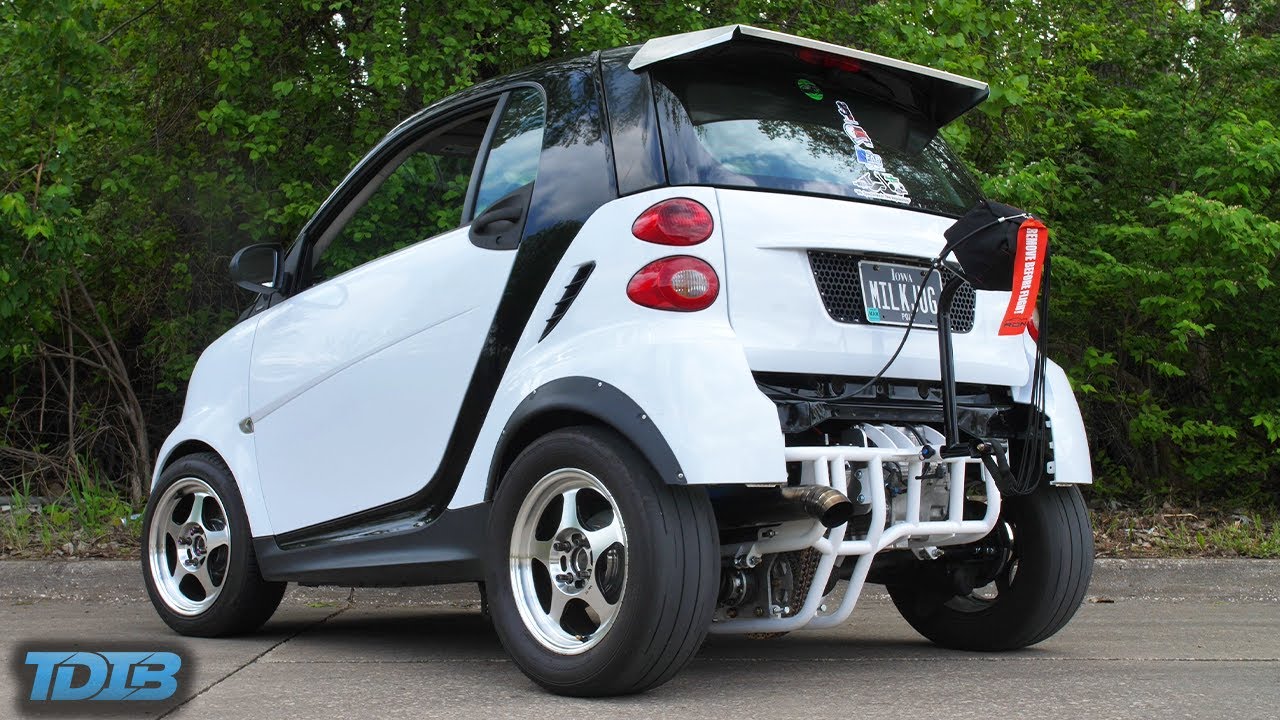
Look, the Smart Fortwo was never meant to be cool. It was a city runabout designed by Swatch—yes, the watch company—and Mercedes-Benz to fit into parking spots sideways. It was slow. It had a transmission that felt like it was thinking about every gear change for three to five business days. But then, someone somewhere looked at that tiny wheelbase and thought, "You know what this needs? A 1340cc inline-four engine from a Suzuki Hayabusa."
And just like that, the hayabusa swap smart car became a legend of the underground tuning world.
It's a death trap. Honestly, there is no other way to describe it. You are taking a car that weighs about 1,600 pounds and shoving a motorcycle engine into the back that screams to 11,000 RPM. We are talking about 197 horsepower in a chassis originally designed for about 70. The power-to-weight ratio starts approaching supercar territory, but instead of Italian leather and aerodynamics, you’re sitting in a plastic bubble that wants to wheelie at every stoplight.
Why the Suzuki Hayabusa Engine is the King of Swaps
People ask why it's always the 'Busa. Why not a GSX-R 1000 engine or a Kawasaki Ninja ZX-14R? Well, the Hayabusa engine is basically the LS small-block of the motorcycle world. It is famously overbuilt. The crank, the rods, the casing—it can all handle way more boost and abuse than it has any right to.
When you drop a Hayabusa mill into a Smart Car, you aren't just gaining speed. You’re gaining a sequential gearbox. That’s the real secret sauce.
Standard Smart Fortwo gearboxes are automated manuals that are notoriously jerky. They kill the fun. But with the Hayabusa swap, you get that click-click-click rapid-fire shifting. You’ve probably seen the videos of these things drifting in snowy parking lots or gapping Porsches on the drag strip. That is all thanks to the high-revving nature of the 1.3L Suzuki engine. It transforms a commuter pod into a snarling, vibrating monster that sounds like a Formula 1 car had a baby with a lawnmower.
The Engineering Nightmare Nobody Tells You About
It isn't a bolt-on kit. Don't let anyone on a forum tell you otherwise. While companies like Smartuki in the UK pioneered the subframe kits, this is still a massive fabrication job. You have to remember that the Smart is rear-engined. You're basically ripping out the entire rear drivetrain and replacing it with a custom cradle.
Then there is the reverse gear. Motorcycles don't have reverse.
Most builders have to get creative here. Some use a heavy-duty starter motor geared to the axle just to nudge the car backward out of a driveway. Others use specialized reverse gearboxes like those from Quife, but those are expensive. Really expensive. If you’re building a hayabusa swap smart car on a budget, you’re probably just going to get used to pushing it out of parking spots.
Then you have the cooling. The Smart’s tiny radiator was meant for a 3-cylinder engine that barely breaks a sweat. A Hayabusa engine runs hot. Like, melt-your-interior-plastics hot. Most successful builds require rerouting coolant lines to much larger, often front-mounted radiators with high-flow fans. If you don't do this, your "Smartbusa" will be a very expensive paperweight within twenty minutes of spirited driving.
Handling a Car That Wants to Kill You
Driving one of these is an exercise in managed chaos. The wheelbase is so short that the car is inherently unstable at high speeds. It’s twitchy. One wrong move at 100 mph and you’re a pinball.
Most people who do the hayabusa swap smart car also end up widening the track. You’ll see them with massive fender flares and wide tires to keep the rubber on the road. Even then, the weight distribution is wonky. Because the engine sits so far back, the front end gets light under acceleration. It’s not uncommon to see the front wheels skip off the pavement when the rider—I mean, driver—bangs through the gears.
But that’s the draw, isn't it?
It's the absurdity. You’re in a car that looks like a grocery getter but moves like a bat out of hell. It’s the ultimate "sleeper," even though the screaming exhaust note usually gives the game away before you even hit second gear.
The Cost of Living on the Edge
How much does this actually cost? If you have to ask, you probably shouldn't do it, but I’ll tell you anyway.
- Donor Smart Car: $2,000 - $4,000.
- Used Hayabusa Engine: $2,500 - $5,000 (depending on the generation and mileage).
- Conversion Subframe/Kit: $3,000 - $6,000.
- Wiring, ECU, and Cooling: $1,500.
- Wheels, Tires, and Brakes: $2,000.
You’re looking at $12,000 to $20,000 just to get it running right. And that’s if you’re doing the labor yourself. If you pay a shop to do it? Double it. You could buy a used Corvette for that. But a Corvette isn't going to get you five million views on YouTube or make people stop and stare in sheer confusion at a Cars & Coffee event.
What Most People Get Wrong About the Smartbusa
The biggest misconception is that these are daily drivers. They aren't. They are terrible at being cars. They are loud. They vibrate so much your teeth will hurt. There is no air conditioning because there’s no room for the compressor. There is no trunk because the engine is taking up all the space.
It is a toy. It is a very fast, very dangerous, very loud toy.
Another myth is that they are "safe" because of the Smart's Tridion safety cell. While it’s true that the steel cage of a Smart car is incredibly strong, it was designed for low-speed urban impacts. It wasn't designed for hitting a concrete barrier at 130 mph after a tank-slapper. The physics of a 1,600-pound car hitting something at high speed are still brutal, regardless of how strong the cage is.
The Legacy of the Hayabusa Swap Smart Car
Is the trend dying? Maybe a little. Electric swaps are starting to take over the "crazy small car" niche because of the instant torque. But there is something about the visceral, mechanical scream of a high-revving bike engine that an EV just can't replicate.
The hayabusa swap smart car represents a specific era of car culture. An era where "because I can" was a good enough reason to do anything. It’s the pinnacle of "shoving a big engine in a small hole." It’s a middle finger to boring, sensible transportation.
If you’re actually thinking about building one, start with the brakes. Seriously. Everyone focuses on the engine, but the stock Smart brakes will fade and fail the first time you try to slow down from triple-digit speeds. Upgrade to a bigger brake kit before you even buy the engine.
Actionable Steps for the Aspiring Builder
If the madness has truly taken hold and you want to pursue a hayabusa swap smart car, here is how you actually start without wasting five grand on the wrong parts.
First, source a Gen 2 Hayabusa engine (2008-2020). The Gen 1 is okay, but the Gen 2 has better electronics and slightly more displacement. Avoid the Gen 3 for now; the electronics are too complex to easily bypass for a car swap.
Second, join the "Smartuki" or "Hayabusa Swaps" groups on social media. The documentation for these builds is scattered across old forums and private groups. You need to talk to people who have already figured out the wiring harness—specifically how to trick the ECU into thinking it's still on a bike so it doesn't go into limp mode.
Third, find a donor Smart Fortwo 450 or 451. The 451 (2007-2014) is slightly more robust and handles the power a bit better than the older 450 models. Look for one with a blown engine or a bad transmission; you’re going to throw those parts away anyway, so don't pay a premium for a "running" car.
Finally, prepare your garage for a long-term project. This isn't a weekend job. It’s a six-month odyssey of busted knuckles and electrical gremlins. But the first time you merge onto the highway and drop it into third gear at 9,000 RPM, you’ll realize why people do this. It’s pure, unadulterated, terrifying fun.
Invest in a quality standalone ECU like a Haltech or Link if you want the car to actually be driveable. The stock bike ECU is great for a bike, but a car has different load requirements. A standalone unit allows you to tune the fuel maps for the extra weight of the car, which prevents the engine from leaning out and exploding under load.
Make sure your life insurance is paid up. I'm only half-joking.
Summary of Key Considerations
- Subframe: You need a custom cradle to mount the engine and align the chain drive or driveshaft.
- Cooling: Front-mount a high-capacity radiator; rear cooling will not suffice.
- Reverse: Decide between a starter-motor electric reverse or a dedicated mechanical reverse box.
- Brakes: Stock brakes are inadequate; upgrade to Wilwood or similar performance calipers.
- Tires: Use the widest, stickiest compound possible to manage the extreme power-to-weight ratio.
Building a hayabusa swap smart car is a rite of passage for the truly eccentric gearhead. It serves no practical purpose other than to turn gasoline into noise and adrenaline. And honestly, in a world of self-driving SUVs and silent electric sedans, we need more of that.