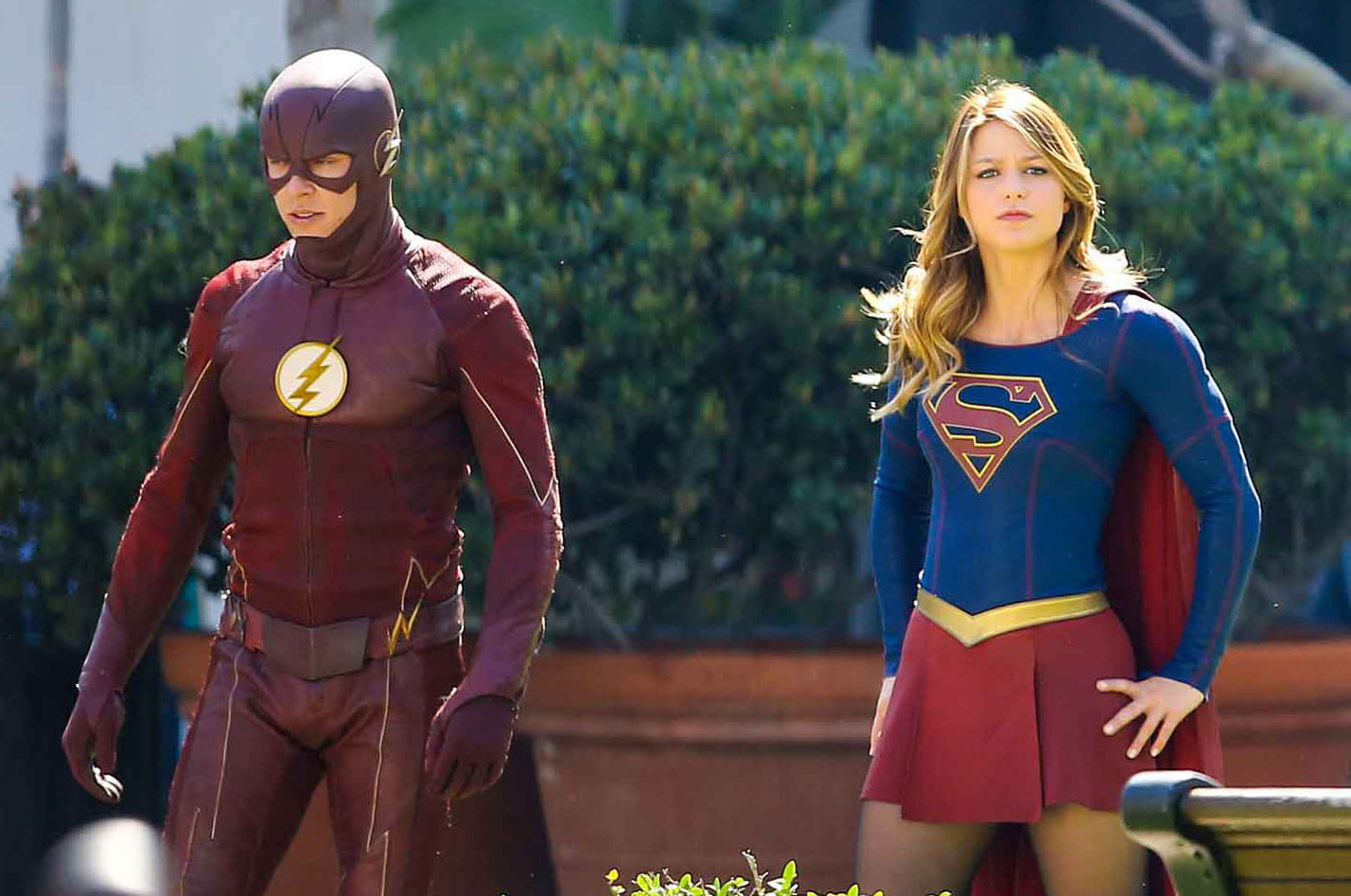
It was the ice cream that did it. Remember that? Barry Allen, the fastest man alive, running across city lines to grab four different flavors of ice cream just to prove a point to Kara Danvers. It was goofy. It was bright. Honestly, it was exactly what superhero TV needed back in 2016.
When we talk about the Flash in Supergirl, we aren’t just talking about a guest appearance. We’re talking about a moment that defied corporate logic. At the time, The Flash was on The CW, and Supergirl was still over at CBS. Different networks. Different budgets. A massive legal headache for the producers at Berlanti Productions. Yet, they pulled it off. "Worlds Finest"—the eighteenth episode of Supergirl's first season—didn't just bring two heroes together; it established a multiverse that would eventually lead to Crisis on Infinite Earths.
Why Barry Allen's Arrival Changed Everything
The tone shifted immediately. Before Barry accidentally vibrated his way into Kara’s dimension (Earth-38, for the lore junkies), Supergirl was struggling a bit with its identity. It was a heavy show sometimes, bogged down by the "DEO" procedural elements and the weight of the "S" on Kara's chest. Then Barry shows up. He’s charming. He’s nerdy.
The chemistry between Grant Gustin and Melissa Benoist was instant. They weren't brooding. They weren't fighting over a misunderstanding like Batman and Superman. They were just two kids who realized they were both incredibly powerful and incredibly lonely in their respective roles.
Barry’s role in National City served a very specific narrative purpose. He acted as a mentor, even though he was technically younger in "superhero years." He taught Kara about the importance of patience and the reality that you can't save everyone from their own anger—specifically regarding the public's then-failing trust in Supergirl after her Red Kryptonite incident.
The Multiverse Logistics of the Flash in Supergirl
How did he get there? Science. Or, well, "Speed Force" science. In the episode, Barry is testing his speed with a tachyon prototype on his chest. He goes too fast, tears a hole in the space-time continuum, and ends up catching Kara as she falls out of a window.
This was the first time the show explicitly confirmed that Supergirl existed in a completely different universe than the main Arrowverse (Earth-1). There were no Flashes in her world. No Green Arrows. Just her and her famous cousin.
- The Siobhan Smythe (Silver Banshee) Factor: This crossover gave us a team-up of villains, too. Silver Banshee and Livewire joined forces, which forced Kara to realize that she couldn't just punch her way out of every problem.
- The Race: Fans had been arguing for decades about who was faster. The episode teased a race, and while we didn't get a definitive "finish line" answer right then, it set the stage for years of playful rivalry.
- The Inter-Dimensional Extrapolator: This little piece of tech Barry gave Kara at the end is arguably the most important prop in the franchise. It allowed them to cross over whenever they wanted without needing a massive cosmic event.
Why "Worlds Finest" Still Holds Up
Look, the CGI hasn't aged perfectly. The fight scene in the park where Livewire is blasting electricity? It looks a little "2016 TV budget." But the writing is sharp. It’s the small moments that matter.
Barry being confused by the existence of aliens is hilarious because, in his world, he deals with "metahumans." To him, a guy who can turn into gas is normal, but a girl from Krypton is mind-blowing. Kara, on the other hand, is just impressed he can get brunch so quickly.
The episode also fixed a major plot hole regarding Kara's public image. By helping her defeat Livewire and Silver Banshee, and by seeing the citizens of National City literally stand in front of Supergirl to protect her from the villains, Barry helped Kara reclaim her hero status. It wasn't just a gimmick; it was a pivot point for the series.
What People Get Wrong About the Crossover
A lot of people think Barry showed up multiple times in the first few seasons. He didn't. This was a one-off for a long time. The next time they met was during the "Invasion!" crossover, which happened after Supergirl moved to The CW.
There's also a misconception that the Flash was more powerful than Supergirl during this encounter. Honestly, the episode treats them as equals. While Barry has the edge in raw speed and "phasing" through objects, Kara has the raw strength and durability. They balanced each other out perfectly, which is why their friendship became the emotional core of every subsequent crossover event like Crisis on Earth-X or Elseworlds.
The Legacy of the Flash in Supergirl
Without this crossover, the "Arrowverse" stays small. It stays grounded in Earth-1. By sending Barry to National City, the writers told the audience that the scale was infinite. It allowed for the later introduction of the Justice League (or the closest thing we got to it on TV).
It also paved the way for the musical crossover, "Duet." If you haven't seen it, Barry and Kara get trapped in a dream world by the Music Meister (played by Darren Criss). Because both Benoist and Gustin are Glee alumni, the episode was a fan-service masterpiece. But it only worked because "Worlds Finest" had already established that these two characters genuinely liked each other.
Moving Beyond the Screen
If you’re looking to dive deeper into the lore of the Flash in Supergirl, there are a few things you should actually do rather than just re-watching the episode.
First, check out the Adventures of Supergirl digital-first comics. They fill in some of the gaps of Kara's early days and how she viewed other "masked vigilantes." Second, pay attention to the tachyon device Barry wears in Season 2, Episode 18 of The Flash ("Versus Zoom"). That is the exact moment he disappears from his show and enters Kara's. If you watch them side-by-side, the continuity is actually pretty tight for a mid-2010s network show.
Actionable Next Steps for Fans
If you're a collector or a hardcore fan, here is how you can actually engage with this piece of TV history:
- Watch the "Tachyon Loop": Watch The Flash 2x18 up until the 25-minute mark, then switch to Supergirl 1x18. It creates a seamless viewing experience that shows exactly how the "breach" worked from both sides.
- Read "Crisis on Infinite Earths" (the comic): To understand why the "Flash in Supergirl" moment was so revolutionary, you have to see how the comics handled it. The show did it with much more heart and significantly less mass-death (at first).
- Analyze the "Super-Friends" Song: Listen to the lyrics of the song from the musical crossover. It explicitly references their first meeting and cements their dynamic as the "light" side of the DC universe, contrasting with the darker tones of the DCEU films of that era.
The Flash didn't just visit Supergirl; he validated her. He brought the spark of the wider DC universe to a show that was still finding its wings. Even now, years after both shows have ended, that first meeting remains the gold standard for how to do a crossover right: keep it simple, keep it fun, and always bring ice cream.
To fully grasp the impact, track the evolution of their "race" through the five-part Crisis event. You'll see how their rapport shifted from "new friends" to "battle-hardened veterans" of the multiverse. It’s a character arc that spans two different shows and dozens of episodes, all starting with a single accidental vibration into the wrong reality.