Thirteen days. That is all it took to bring the world to the ragged edge of a nuclear winter. Honestly, when we look back at the Cuban Missile Crisis 1962, it’s easy to treat it like a dry chapter in a history textbook, but for the people living through it, the vibe was pure, unadulterated terror. Imagine turning on your TV and seeing John F. Kennedy’s face, stone-cold, telling you that Soviet missiles—capable of wiping out your city in minutes—were being parked just 90 miles off the coast of Florida. It wasn't a movie. It was real.
History is messy. We like to pretend that Kennedy and Khrushchev were playing a high-stakes game of chess where every move was calculated, but the reality was way more chaotic. It was a series of misunderstandings, near-misses, and guys in bunkers making split-second decisions that could have ended everything.
How the Cuban Missile Crisis 1962 actually started
Most people think this started because the Soviet Union just felt like being aggressive. That’s a bit of a simplification. You've got to look at the context of the early sixties. The U.S. had already tried to topple Fidel Castro during the disastrous Bay of Pigs invasion in 1961. Castro was looking for a bodyguard, and Nikita Khrushchev was happy to provide one. But there was a more tactical reason: the U.S. had Jupiter missiles stationed in Italy and Turkey. These were pointed right at the Soviet heartland. Khrushchev basically thought, "Fine, let's see how they like having nukes in their backyard."
By summer, the Soviet Union began "Operation Anadyr." It was a massive, secret sealift. They weren't just sending soldiers; they were sending medium- and intermediate-range ballistic missiles. They even sent over 40,000 Soviet troops, dressed in civilian clothes to look like "agricultural specialists."
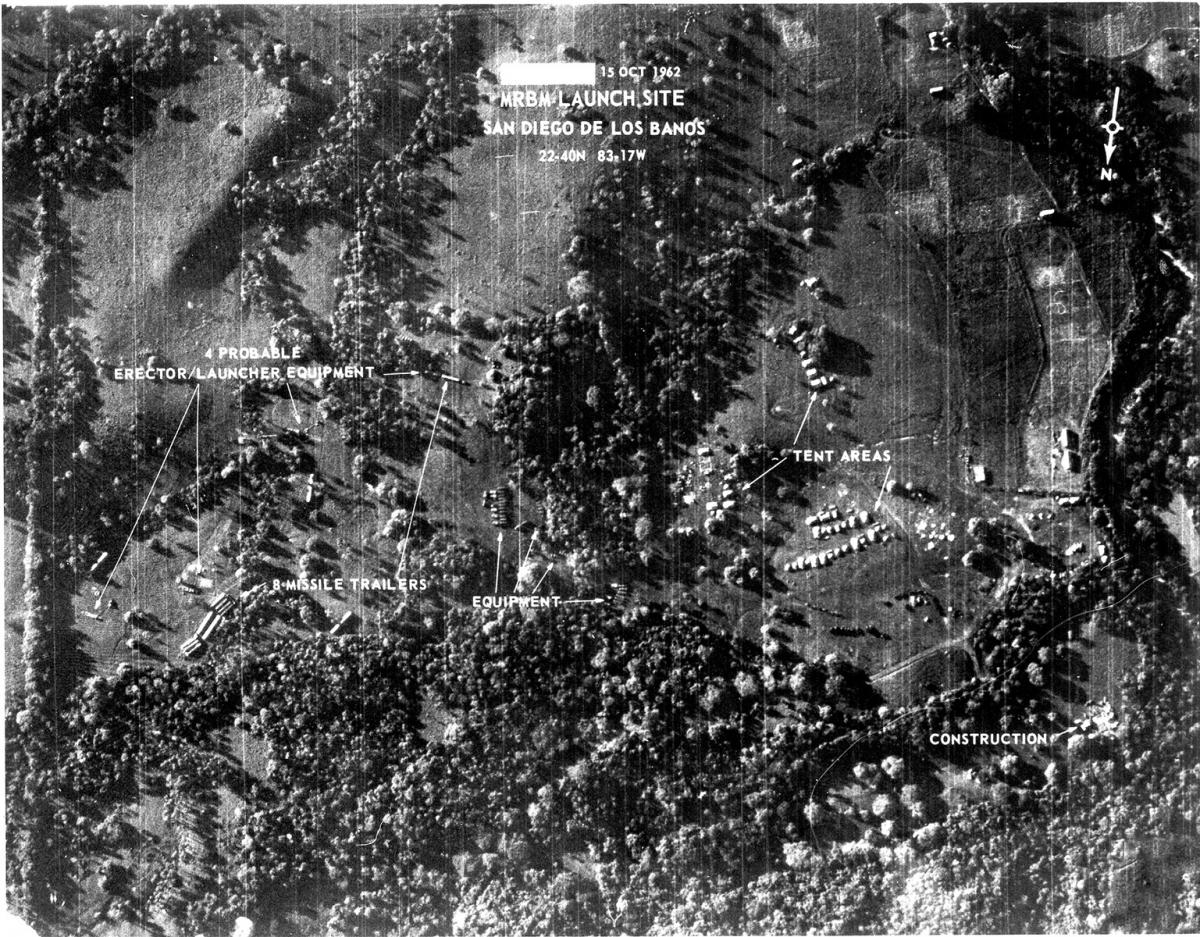
It didn't stay a secret for long. On October 14, 1962, a U-2 spy plane piloted by Major Richard Heyser flew over western Cuba. The photos he brought back changed history. When analysts at the National Photographic Interpretation Center looked at the shots, they didn't see farms. They saw launch pads. They saw the SS-4 Sandal.
Everything changed in an instant.
The ExComm and the "Quarantine" Gamble
When JFK got the news on the morning of October 16, he didn't go public immediately. He pulled together a group of advisors known as the Executive Committee of the National Security Council, or ExComm. This group was a total pressure cooker. You had the "Hawks," like General Curtis LeMay, who basically wanted to bomb the missile sites into oblivion right then and there. Then you had the "Doves," who were terrified that an airstrike would trigger a full-scale Soviet invasion of West Berlin or a nuclear exchange.
Kennedy was stuck in the middle. He knew that if he did nothing, the U.S. looked weak and the strategic balance shifted forever. But if he attacked, he might start World War III.
He settled on a "quarantine."
Why call it a quarantine instead of a blockade? Because a blockade is technically an act of war under international law. A "quarantine" sounded more like a medical necessity—sort of a "we're just stopping these specific items" approach. It was a clever bit of branding that gave Khrushchev a tiny bit of room to breathe without immediately declaring war. On October 22, Kennedy went on national television.
The world stopped spinning. People started hoarding canned goods. Schoolchildren practiced "duck and cover" drills, hiding under wooden desks as if that would do anything against a multi-megaton blast. It was a weird, somber time.
The moment we almost lost it all
There’s a specific moment during the Cuban Missile Crisis 1962 that doesn't get enough play in the history books. We call it "Black Saturday"—October 27. This was the day it almost went sideways for good.
First, a U-2 plane was shot down over Cuba, killing the pilot, Major Rudolf Anderson. The military brass in Washington was screaming for retaliation. They assumed Khrushchev had ordered the hit. In reality, a Soviet commander in Cuba had made the call on his own.
Then, thousands of miles away in the Sargasso Sea, a U.S. Navy destroyer, the USS Beale, began dropping "signaling" depth charges on a Soviet B-59 submarine. They wanted the sub to surface. What they didn't know was that the B-59 was carrying a nuclear-tipped torpedo.
The crew inside that sub was roasting. The air conditioning was broken, carbon dioxide levels were rising, and they were being rattled by explosions they thought were actual attacks. The captain, Valentin Savitsky, decided to prep the nuclear torpedo. He thought the war had already started.
Standard Soviet protocol required three officers to agree before launching. Savitsky said yes. The political officer, Ivan Maslennikov, said yes. But the second-in-command, Vasili Arkhipov, said no. He stayed calm. He argued that the "attacks" were signals, not a declaration of war. He eventually convinced Savitsky to surface. If Arkhipov hadn't been on that specific boat, the first nuclear shot of World War III would have likely been fired from an overheated submarine in the middle of the Atlantic.
The Secret Deal that ended the Cuban Missile Crisis 1962
While the world was bracing for impact, the real work was happening in back-channel meetings. Robert Kennedy, the President's brother and Attorney General, met secretly with Soviet Ambassador Anatoly Dobrynin.
The public deal was straightforward:
- The Soviet Union would remove the missiles from Cuba under UN supervision.
- The U.S. would publicly pledge never to invade Cuba.
But there was a "secret" part of the deal that the U.S. didn't admit to for decades. Khrushchev wanted those American Jupiter missiles out of Turkey. JFK agreed, but on one condition: it couldn't be part of the official public agreement. He needed it to look like the U.S. hadn't traded anything away under pressure. The U.S. promised to pull the missiles out of Turkey a few months later, under the guise that they were "obsolete" anyway.
By October 28, Khrushchev announced the removal of the missiles. The tension snapped like a rubber band.
Why it still haunts us today
The Cuban Missile Crisis 1962 wasn't just a win for the U.S. or a loss for the Soviets; it was a wake-up call. It's why the "Hotline" was established—that direct teletype link between Moscow and Washington. Before that, leaders were communicating through slow-moving diplomatic cables and public radio broadcasts. You can't run a crisis when it takes six hours to get a reply.
It also changed how we think about "brinkmanship." We realized that even with the best intentions, "accidental" war is a massive risk. Miscommunication is a killer.
Looking back, the crisis led to the 1963 Limited Test Ban Treaty, the first real step toward nuclear arms control. It forced both sides to admit that a nuclear war cannot be won and must never be fought.
Moving forward: Lessons for the modern era
If you're looking to understand the mechanics of global tension today, the events of 1962 are the blueprint. We see similar patterns in modern geopolitical standoffs. Here is what you can do to apply these historical lessons to your own understanding of current events:
- Audit your sources during a crisis: Just as JFK had to filter through the "Hawks" and "Doves," you need to look at who is providing your news. Is the source pushing for escalation? What is their "Jupiter missile"—the hidden leverage they aren't talking about?
- Look for the "Third Option": In 1962, the choices seemed to be "Do nothing" or "Bomb them." The quarantine was the third option. Whenever you are presented with a binary choice in a high-stakes situation, look for the middle path that allows both sides to "save face."
- Study the individuals, not just the nations: Systems don't make decisions; people do. Read the memoirs of the people who were actually there, like Robert Kennedy's Thirteen Days or Nikita Khrushchev’s edited tapes. It reminds you that history is often driven by human ego, fear, and, occasionally, the quiet bravery of someone like Vasili Arkhipov.
The Cuban Missile Crisis 1962 remains the closest we’ve ever come to the end of the story. Understanding it isn't just about dates and names; it’s about recognizing how fragile the world actually is. If you want to dive deeper, your next step should be exploring the declassified "ExComm tapes" available through the JFK Library. Hearing the actual voices of these men as they debated the fate of the planet is a haunting reminder of the responsibility that comes with power.