New Orleans is a city that eats its history. You can feel it in the humidity of the French Quarter, and you can certainly taste it when you walk through the wrought-iron gates at 613 Royal Street. If you've spent more than five minutes researching where to eat in the Crescent City, you've seen the name. The Court of Two Sisters is an institution. It’s famous. It’s touristy. It’s historic. But honestly, when people look up the Court of Two Sisters New Orleans menu, they aren't just looking for a list of food. They’re trying to figure out if the legendary daily Jazz Brunch is actually worth the price of admission or if they're just paying for the atmosphere of a 19th-century courtyard.
Let’s be real. The courtyard is stunning. Wisteria vines crawl up the walls, and the sound of live jazz bounces off the bricks. It feels like a movie set. But you can't eat the scenery. You’re there for the Creole classics.
The Buffet Paradox: Navigating the Jazz Brunch
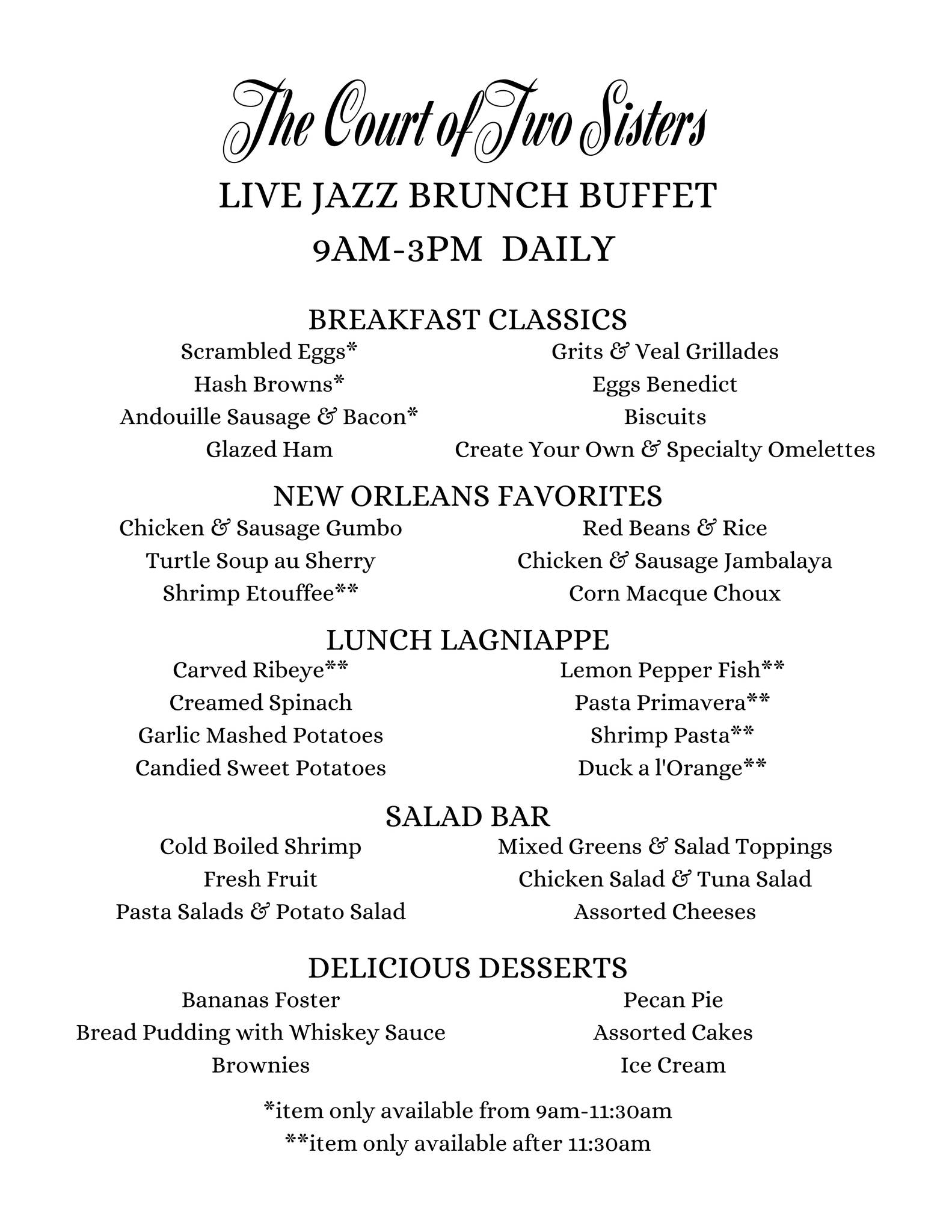
Most high-end restaurants in New Orleans stick to a traditional à la carte service. The Court of Two Sisters zigzags. They are world-renowned for their daily Jazz Brunch, which is served from 9:00 AM to 3:00 PM. It’s a buffet. Now, for some foodies, the word "buffet" triggers a bit of an eye-roll. We think of lukewarm heat lamps and soggy salad bars.
Forget that.
The Court of Two Sisters New Orleans menu for the brunch is an expansive, swirling collection of over 60 items. It’s designed to be a "greatest hits" album of Louisiana Creole cuisine. You’ve got the hot side, the cold side, and the dessert station. It’s a lot to take in. If you go in without a plan, you’ll fill up on rolls and miss the turtle soup. Don’t do that.
The Cold Section Isn't Just Filler
Usually, you skip the salad bar at a buffet. Here, that's a mistake. The cold station is where the seafood lives. You’ll find chilled peel-and-eat shrimp—standard, sure—but then there's the Crawfish Pasta Salad. It’s surprisingly zesty. They also do a Ceviche that changes based on what’s fresh.
One of the standouts that people often overlook is the Pate Maison. It’s rich, savory, and feels very "Old World New Orleans." You spread it on a bit of crusty French bread, grab a mimosa, and suddenly the $50+ price tag starts to make a little more sense. They also keep a steady supply of fresh fruit and domestic cheeses, but honestly, you're in New Orleans. Save the stomach space for the heavy hitters.
The Hot Line: Where Creole Dreams Live
This is the heart of the Court of Two Sisters New Orleans menu. If you want to understand why this place has survived since the 1960s (under the Fein family ownership), you look at the silver chafing dishes.
- Turtle Soup: This is the litmus test for any serious New Orleans kitchen. Theirs is thick, dark, and finished with a splash of sherry. It’s earthy. It’s complex. It’s exactly what you want on a rainy afternoon in the Quarter.
- Corn and Crab Chowder: Sweeter, creamier, and loaded with lumps of blue crab.
- Chicken and Sausage Gumbo: It’s a solid, reliable roux-based gumbo. It isn't the spiciest in the city, but it’s authentic.
- Grits and Grillades: This is the quintessential New Orleans breakfast. Tender veal medallions simmered in a rich brown gravy, served over creamy corn grits. It’s heavy. It’s salty. It’s perfect.
You also have the omelet station. You can get yours filled with shrimp, crawfish, or just standard veggies. Watching the chefs flip eggs in the outdoor air while a trumpet player hits a high note nearby is... well, it’s a vibe. You can't get that at a Denny's.
The "Hidden" Carving Station
People sometimes miss the carving station because they're too focused on the eggs. Look for the Roast Beef and the Glazed Ham. The beef is usually served with a horseradish cream that has a legitimate kick. It's the kind of protein-heavy anchor you need if you plan on walking ten miles through the Garden District later that afternoon.
Dinner at the Two Sisters: A Different Beast
While the brunch gets all the headlines, the dinner Court of Two Sisters New Orleans menu is a much more formal, seated affair. It’s classic Creole. No buffets here.
If you're visiting for dinner, the move is the Shrimp Toulouse. It’s a decadent dish featuring shrimp, mushrooms, and white wine cream sauce served over pasta. Or, if you want to go full "New Orleans Fancy," get the Veal Oscar. It’s milk-fed veal topped with asparagus, lump crabmeat, and Bearnaise sauce. It’s the kind of meal people ate in the 1950s when "going out to dinner" meant wearing a suit and a tie.
The dinner menu also features a "Chef’s Selection" four-course meal. It usually starts with the Turtle Soup, moves to a Caesar salad, offers an entree like the Trout Meuniere, and ends with Bananas Foster. It’s a curated experience for people who don't want to make decisions.
The Bananas Foster Factor
You cannot talk about the Court of Two Sisters New Orleans menu without talking about the dessert. Specifically, the Bananas Foster.
Invented at Brennan’s just down the street, Bananas Foster is a staple across the French Quarter. At Two Sisters, they do it justice. Bananas, brown sugar, cinnamon, butter, and a heavy pour of rum. They flame it, it smells like caramelized heaven, and they pour it over vanilla bean ice cream.
Is it sugary? Yes. Is it a cliché? Absolutely. Should you eat it anyway? Every single time.
If you aren't into the whole "flaming fruit" thing, they usually have a Bread Pudding with whiskey sauce. New Orleans bread pudding is different from what you find in the rest of the country. It’s denser, more custard-like, and the whiskey sauce should be strong enough to make your eyes water just a little bit.
What Most People Get Wrong About the Experience
A lot of visitors walk into the Court of Two Sisters expecting a quiet, romantic library vibe. It’s not that.
Especially during brunch, it’s loud. It’s bustling. There are families, bachelorette parties, and jazz musicians moving through the aisles. It is a celebration, not a seance. If you want a hushed, reverent dining experience, go to a white-tablecloth spot in the Uptown area. If you want the "New Orleans Experience" with a capital E, you’re in the right place.
Another misconception is the dress code. While the history of the building (which dates back to 1832) suggests formality, the brunch is pretty casual. You’ll see people in sundresses and others in shorts and t-shirts. Dinner is a bit more "dressy-casual," but they aren't going to kick you out for not wearing a dinner jacket.
Drinks and the Courtyard
The beverage menu is its own ecosystem. The "Court of Two Sisters Mint Julep" is the big seller. It’s refreshing but deceptively strong. They also have a solid wine list, but honestly, most people are there for the Bloody Marys or the Mimosas. The Bloody Marys here are often garnished to the hilt—pickles, beans, the works. It’s practically a snack on its own.
Practical Advice for Navigating the Menu
If you want to make the most of your visit, here are a few things to keep in mind:
- Reservations are mandatory. Don't just show up and hope for the best. You'll end up standing on Royal Street for an hour watching other people eat.
- Go early for brunch. The food is freshest, and the courtyard isn't quite as sweltering at 9:30 AM as it is at 1:00 PM.
- Try the Duck l'Orange. If it’s on the dinner menu when you visit, order it. It’s a classic French-Creole preparation that many modern restaurants have abandoned because it’s "old fashioned." At Two Sisters, "old fashioned" is the whole point.
- The Courtyard vs. Indoors. You can request seating, but the courtyard is the draw. However, in July and August, the indoor dining rooms have something the courtyard doesn't: aggressive air conditioning. Choose wisely.
The Court of Two Sisters New Orleans menu isn't trying to reinvent the wheel. It’s not trying to be "fusion" or "molecular gastronomy." It’s a love letter to the 1800s, served up with a side of live music. Whether you're piling your plate high with jambalaya at the buffet or savoring a slow veal dinner, you’re participating in a ritual that has defined the French Quarter for decades.
Your Next Steps for a French Quarter Feast
To ensure the best experience, your next move should be checking the official website for the most current pricing, as the brunch rate can fluctuate seasonally or on holidays. Once you have your date set, book your table through a platform like OpenTable at least two weeks in advance if you're visiting during peak times like Mardi Gras or Jazz Fest. When you arrive, ask for a table near the fountain in the courtyard; it offers the best acoustics for the jazz trio without being so close that you can't hold a conversation. Finally, make sure to pace yourself—the buffet is an endurance sport, and you’ll want to save room for at least two rounds of that whiskey-soaked bread pudding.