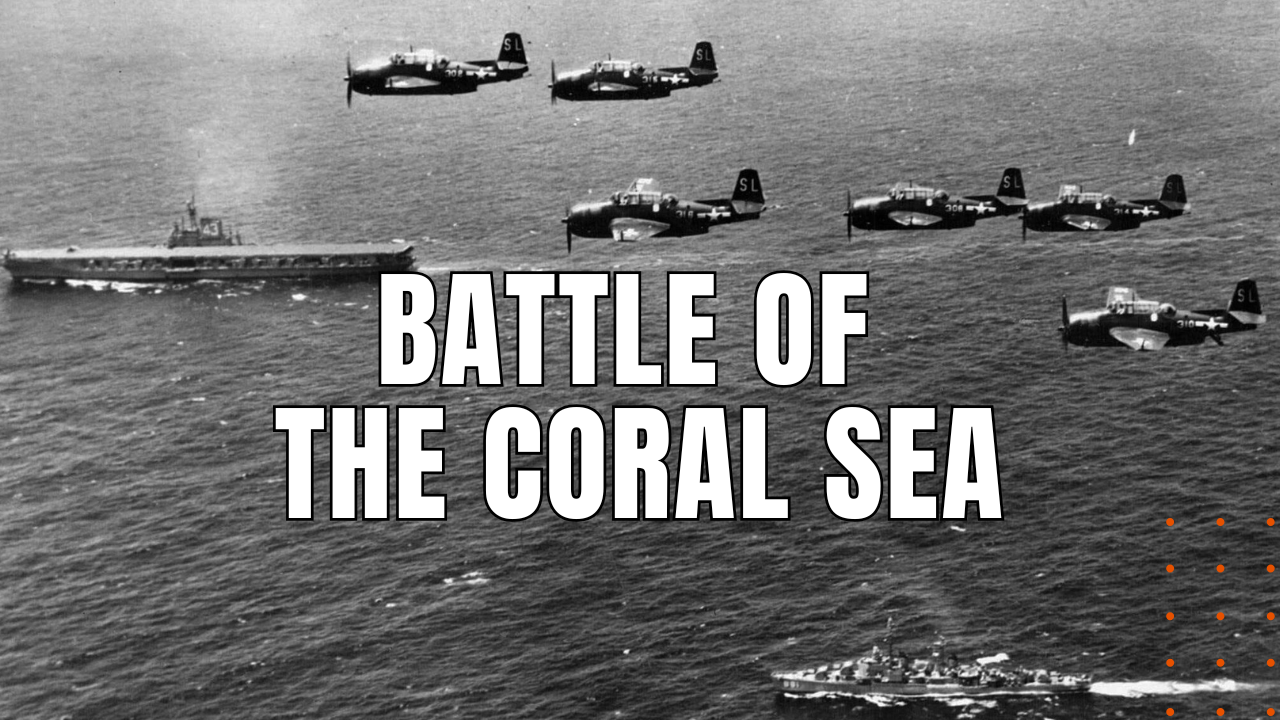
When we talk about the Pacific Theater, everyone immediately jumps to Midway. It’s the flashy one. The one with the big Hollywood movies. But honestly, the Battle of the Coral Sea is where the tide actually started to turn, and it was a total mess. It was the first time in history that two navies fought without ever seeing each other's ships. Basically, it was a boxing match where both fighters were blindfolded and swinging sledgehammers.
If you look at the map of May 1942, things looked pretty grim for the Allies. Japan was on a tear. They had already taken the Philippines, Singapore, and the Dutch East Indies. Next on the list? Port Moresby in New Guinea. If they took that, they could basically choke off Australia. The U.S. Navy, still licking its wounds after Pearl Harbor, had to do something. So, they sent Task Forces 11 and 17—centered around the carriers Lexington and Yorktown—into the humid, unpredictable waters of the Coral Sea.
The Battle of the Coral Sea: A New Kind of War
Before this, naval battles were about big guns. You’d line up your battleships, point the cannons, and hope for the best. This was different. The Battle of the Coral Sea was the first carrier-versus-carrier engagement. The sailors on the decks of the cruisers and destroyers spent the whole time looking at the sky, not the horizon.
It started with a lot of fumbling. On May 7, Japanese planes spotted what they thought was a carrier and a cruiser. They sent everything they had. Turns out, it was just the destroyer Sims and the oiler Neosho. They sank them, sure, but they wasted their primary strike on a gas station and its guard dog. Meanwhile, American pilots found the light carrier Shoho. They absolutely shredded it. Commander Robert E. Dixon famously radioed back, "Scratch one flat top!" It was the first time the U.S. had sunk a Japanese carrier, and the morale boost was massive.
But the real "main event" happened the next day, May 8. This is when the heavy hitters—the Lexington and Yorktown for the U.S., and the Shokaku and Zuikaku for Japan—finally traded blows.
Confusion, Smoke, and Luck
Military history is often written like a chess game, but the Battle of the Coral Sea felt more like a bar fight in a dark room. The weather was a huge factor. The Japanese carriers were hiding under a thick squall line, while the American ships were stuck under clear blue skies, making them sitting ducks.
The Lexington, affectionately known as "Lady Lex," took two torpedoes and several bombs. For a while, it looked like she might make it. The crew was actually eating ice cream while they waited for the fires to be put out. Then, a massive internal explosion—caused by leaking aviation fuel vapors—sealed her fate. They had to scuttle her. Seeing a massive ship like that go down is something you don't forget. My grandfather’s generation talked about the Lexington with a specific kind of reverence. It wasn't just a ship; it was a floating city.
On the other side, the Shokaku was badly damaged. The Zuikaku lost most of its aircrews. Even though the Japanese technically won a "tactical" victory because they sank a fleet carrier (Lexington) while only losing a light carrier (Shoho), they failed their mission. They didn't take Port Moresby. They turned back.
Why This Messy Fight Actually Matters
You’ve gotta realize that the Battle of the Coral Sea was a strategic win for the Allies. This is a nuance people often miss. Because the Shokaku and Zuikaku were beat up or missing their planes, they couldn’t participate in the Battle of Midway a month later. Imagine if Japan had two extra fleet carriers at Midway. The entire history of the 20th century might look different.
Also, it proved the U.S. could actually stand up to the Imperial Japanese Navy. Up until then, there was this aura of invincibility around the Japanese fleet. Coral Sea popped that bubble. It showed that carrier aviation was the future and the battleship era was effectively over.
Misconceptions and Reality Checks
A lot of people think the U.S. was "winning" the war by this point. They weren't. We were barely hanging on by our fingernails. The intelligence work by Joe Rochefort and the cryptanalysts at HYPO in Hawaii was the only reason we even knew where to go. They broke the Japanese naval code (JN-25B) and figured out "Operation MO" was the attack on Port Moresby. Without those codebreakers, the Battle of the Coral Sea never happens, and Australia potentially gets invaded.
Another thing: people think these battles were clean. They weren't. Communication was terrible. Radio silence was often broken by accident. Friendly fire was a constant fear. In fact, on the night of May 7, Japanese pilots actually tried to land on the U.S. carrier Yorktown by mistake because they were so disoriented in the dark. Imagine being a signal officer on a carrier deck and seeing an enemy plane trying to land on your ship. Crazy stuff.
Lessons from the Coral Sea
If you’re a history buff or just someone interested in how strategy works under pressure, there are some pretty clear takeaways from this engagement.
- Intelligence is the ultimate force multiplier. Knowing where the enemy is going to be is more important than having more guns.
- Adaptability wins. The U.S. Navy learned how to manage damage control under fire during this battle, which saved the Yorktown so it could fight again at Midway.
- Tactical losses can be strategic wins. Losing the Lexington was a gut punch, but stopping the expansion toward Australia changed the trajectory of the Pacific War.
To really understand the Battle of the Coral Sea, you have to look at the human cost. Over 600 Americans died. Over 1,000 Japanese sailors and airmen were lost. These weren't just dots on a map; they were highly trained crews in a brand-new type of warfare that no one truly understood yet.
How to Explore This History Further
If you want to get deeper into the grit of what happened in the South Pacific, stop watching the big-budget movies for a second and look at the primary sources.
- Read the Action Reports: The National Archives has digitized the actual after-action reports from the USS Yorktown and USS Lexington. Reading the dry, technical descriptions of the damage makes the reality of the fire and explosions much more visceral.
- Visit the Memorials: If you ever find yourself in Australia, the Coral Sea Memorial in Townsville is a sobering reminder of how close the war came to their shores.
- Study the Logistics: Look into the "Oilier" problem. The fact that the U.S. struggled so much to refuel its task forces in the middle of the ocean is a fascinating look at the "boring" side of war that actually decides who wins.
- Track the "Yorktown" Repair: Research how the Yorktown was patched up in just 72 hours at Pearl Harbor after the Coral Sea. It’s one of the greatest engineering feats of the war and directly led to the victory at Midway.
The Battle of the Coral Sea wasn't a perfect victory. It was a bloody, confusing, and expensive lesson in modern naval warfare. But without it, the map of the world would look a whole lot different today.