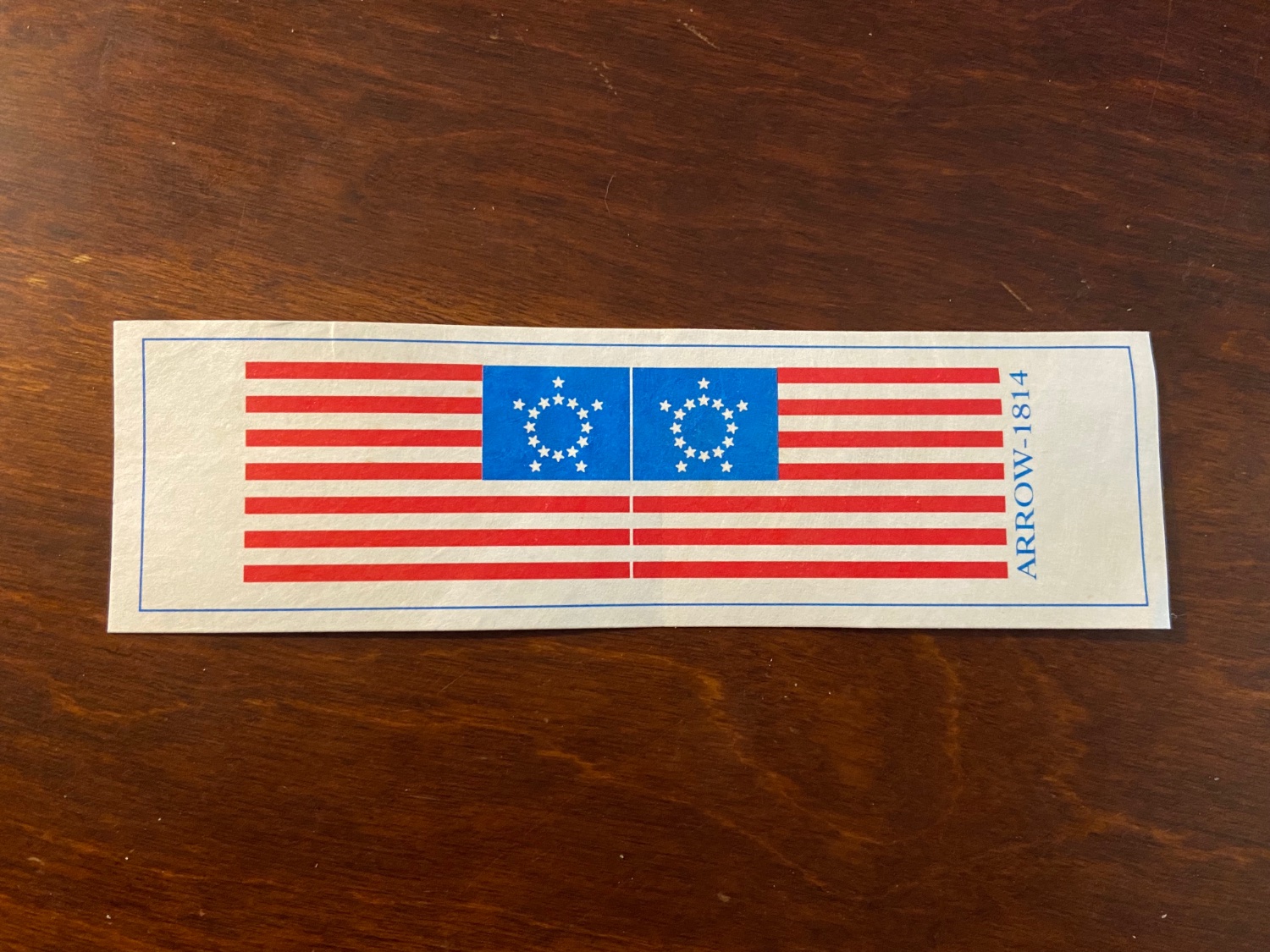
You’ve probably seen the "Star-Spangled Banner" hanging in the Smithsonian. It’s massive. It’s also kinda beat up. But if you look closely at that specific american flag in 1812, you’ll notice something that looks totally "wrong" by modern standards. It has 15 stripes. Not 13. 15.
History is messy.
Most of us were taught that the flag always had 13 stripes to represent the original colonies, but for a weird window of time during the War of 1812, the United States was actually adding stripes for every new state. It was a literalist approach to design that almost ruined the flag's aesthetic. If they hadn't stopped that practice, our flag today would be a dizzying mess of 50 thin red and white lines.
The story of the american flag in 1812 isn't just about a piece of fabric surviving a bombardment at Fort McHenry. It’s about a young country trying to figure out its visual identity while literally under fire from the world’s most powerful navy.
The 15-Stripe Mistake That Stuck
Back in 1794, Congress passed the Second Flag Act. This was a response to Vermont and Kentucky joining the Union. The logic was simple: new state, new stripe, new star. Simple, right?
By the time 1812 rolled around, the "official" flag was this 15-star, 15-stripe version. It’s the only version of the flag in U.S. history to have more than 13 stripes. This is the flag that Francis Scott Key saw. Honestly, it’s a miracle the design didn't become a complete eyesore. Imagine trying to sew 20 or 30 stripes onto a ship’s ensign. It would look like a barcode from a distance.
Mary Pickersgill was the woman tasked with making the famous flag for Fort McHenry. She didn't just sit in a parlor and sew a small decoration. This was industrial-scale labor. Major George Armistead wanted a flag so big that the British would have "no difficulty in seeing it from a distance."
Pickersgill and her team—including her daughter, two nieces, and an African American indentured servant named Grace Wisher—worked in a brewery floor because no other space was big enough. They used about 400 yards of wool bunting. The stars? Each one was nearly two feet across. When you think about the american flag in 1812, you have to picture this 30-by-42-foot monster of a textile. It was heavy. It was expensive. It cost $405.90, which was a small fortune in 1813.
Why the British Were Actually Confused
We think of the flag as this universal symbol of "America," but in 1812, flags were functional tools for communication. If you were a British captain in the Chesapeake Bay, seeing a massive flag over a fort meant one thing: "We are still here, and we aren't quitting."
The bombardment of Fort McHenry lasted 25 hours.
The British fired over 1,500 iron shells. They used Congreve rockets—which were basically giant, unpredictable bottle rockets that screamed through the air. It was terrifying. But the american flag in 1812 that Key saw "by the dawn's early light" wasn't actually the big one. Not at first.
During the storm and the heavy rain of the night, the fort flew a smaller "storm flag." It was only when the rain stopped and the British retreated that the soldiers raised the massive 42-foot Garrison Flag. That's the one Key saw from his position on a truce ship. It was a psychological middle finger to the British Navy.
The Stars Weren't Aligned Like You Think
If you look at the 1812-era flags, the star patterns are all over the place. There was no "official" blueprint for how the stars should be arranged.
- The Great Star Pattern: Some makers arranged stars into one giant star shape.
- Staggered Rows: This is what Pickersgill used for the Fort McHenry flag.
- Circular Patterns: Often used by the Navy.
- Random Scattering: Sometimes they just fit them where they could.
This lack of standardization shows how decentralized the country was. You had different makers in Philadelphia, Baltimore, and Boston all producing their own interpretations of the american flag in 1812. It wasn't until much later that the government got strict about the geometry.
Realities of the Wool and the Dye
Let’s talk about the fabric. This wasn't soft cotton. It was English wool bunting.
Yes, the Americans were using British fabric to make the flags they flew while shooting at the British. Irony is a constant in history. Wool was preferred because it was light enough to catch a breeze but tough enough to handle the salt air and the wind.
The blue was dyed with indigo. The red came from madder root or sometimes cochineal insects. These dyes weren't perfect. Over time, the "blue" would fade to a dusty grey, and the "red" would turn into a brownish-pink. If you saw the american flag in 1812 today in its original condition, the colors would feel much more "earthy" than the vibrant nylon flags we see at gas stations today.
The Missing Pieces of History
The flag at the Smithsonian is missing a huge chunk. Why? Because people in the 19th century were obsessed with "souvenirs."
The Armistead family, who kept the flag for decades, used to cut off little snips of the flag to give to honored guests or veterans. It was seen as a way to share the "glory" of the relic. One entire star is missing. We don't know who has it. It’s likely sitting in a trunk in someone’s attic or was lost to a house fire a hundred years ago.
This "vandalism" is actually why the flag is so fragile today. Every time someone cut a piece off, they weakened the structure of the weave. When you look at the american flag in 1812 through a modern lens, you’re looking at a survivor of both war and autograph seekers.
The War of 1812 wasn't a "Second Revolution"
People love to call the War of 1812 the "Second War of Independence." That's mostly marketing.
The war was actually a chaotic mess. The U.S. tried to invade Canada (it failed). The British burned Washington D.C. (the White House didn't fare so well). The flag became a focal point because the land war was going so poorly for the Americans. They needed a win. They needed a symbol to rally around because, frankly, the country was deeply divided about the war in the first place. New Englanders actually talked about seceding because the war was ruining their trade.
The american flag in 1812 became the "Star-Spangled Banner" because Francis Scott Key was a lawyer who happened to be a decent poet. His words turned a defensive stalemate at a fort into a spiritual victory. Without that poem, the flag might have remained just another military ensign.
How to Spot a Genuine 1812-Era Flag
If you ever find yourself at an estate sale or a museum, here is how you tell an 1812-period flag from a later reproduction:
- Count the Stripes: If it has 13 stripes but more than 13 stars, it’s probably post-1818.
- Check the Stitching: Everything should be hand-sewn with linen thread. Machine stitching didn't exist yet.
- The Stars: Look for "fat" stars. The points were often wider than modern, sleek stars.
- The Material: It should be wool bunting. If it feels like heavy canvas or light cotton, it might be a regimental flag or a later 19th-century version.
What Happened After 1812?
By 1818, Congress realized they had a problem. Five more states had joined (Tennessee, Ohio, Louisiana, Indiana, and Mississippi).
The idea of a 20-stripe flag was ridiculous. Captain Samuel Reid of the U.S. Navy suggested a compromise that saved the design: go back to 13 stripes for the original colonies, but keep adding stars for every new state. That’s the rule we still follow today.
But for that brief moment during the "dawn's early light," the american flag in 1812 stood as a 15-stripe anomaly. It represented a country that was literally growing too fast for its own clothes.
Actionable Takeaways for History Buffs
- Visit the Smithsonian: If you want to see the real deal, go to the National Museum of American History in D.C. They have a custom-built chamber for the flag that keeps it in near-total darkness to prevent further fading.
- Research the "Storm Flag": Everyone talks about the Garrison Flag, but the Storm Flag is the one that actually took the brunt of the 1814 bombardment. It's much rarer to find details on its survival.
- Check Local Archives: Many 1812-era flags were local or state-based. They don't all look like the national flag. If you’re in the Northeast, local historical societies often hold "colors" from local militias that have wild, unique designs.
- Study the Textile Science: Understanding the transition from natural dyes to synthetic ones is the best way to date historical flags. Indigo-dyed wool has a specific "bite" to the color that modern replicas can't quite hit.
The american flag in 1812 wasn't just a symbol; it was a massive, expensive, hand-made piece of equipment that signaled a refusal to give up. It survived the British, it survived the "souvenir" hunters, and it survived a design flaw that would have made it unrecognizable today. Next time you see a flag with 13 stripes, remember the short-lived 15-stripe version that actually inspired the national anthem.