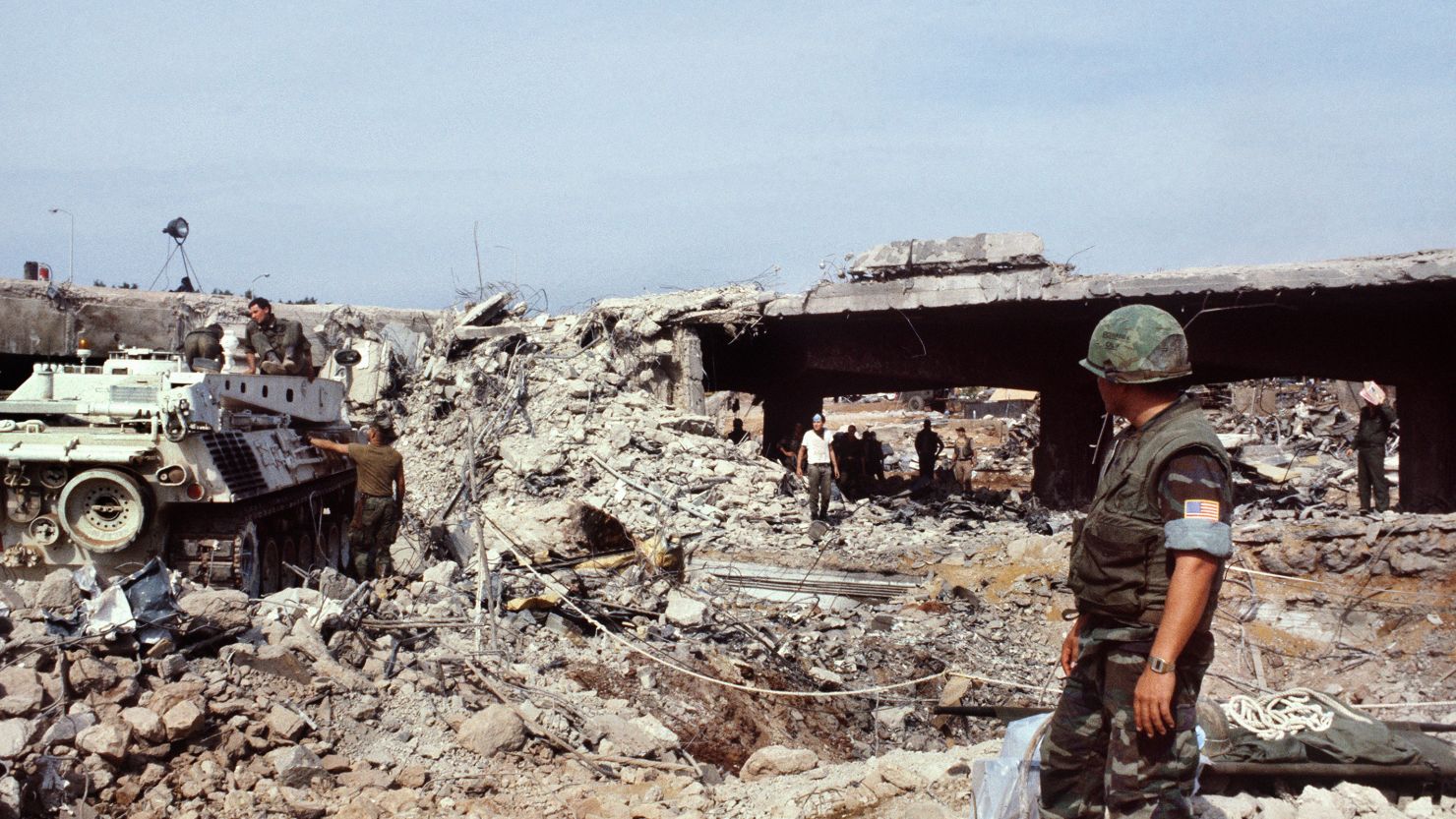
October 23, 1983. It was a Sunday. Most of the Marines at the Beirut International Airport were still asleep. They were part of a Multinational Force, a peacekeeping mission that honestly felt like it was stuck in the middle of a blender. Lebanon was tearing itself apart, and the U.S. was trying to keep a lid on a pot that had already boiled over. Then, at 6:22 a.m., a yellow Mercedes-Benz stake-bed truck didn't slow down at the gate. It accelerated. It crashed through the barbed wire, past the sentries who weren't even allowed to have magazines in their weapons, and into the lobby of the four-story "Batallion Landing Team" building.
The explosion was massive. We're talking 12,000 pounds of TNT equivalent. It didn't just break windows; it lifted the entire building off the ground before the concrete floors pancaked. 241 American service members died in an instant. Seconds later, another suicide bomber hit the French paratroopers' barracks a few miles away, killing 58 more. It remains the deadliest single-day death toll for the U.S. Marine Corps since the Battle of Iwo Jima.
Why the 1983 Beirut barracks bombing changed everything
People usually think of the "War on Terror" starting in 2001. That's wrong. You've got to look at 1983 to see where the modern playbook for suicide terrorism actually began. Before this, the idea of a truck laden with explosives being used as a precision-guided missile was almost unheard of in Western military circles. It caught the Reagan administration completely flat-footed.
The tragedy wasn't just the loss of life; it was the realization that "peacekeeping" in a civil war is a nightmare scenario. The Marines were there to provide a "presence." But what does that even mean? They were in a static position, sitting ducks in a massive concrete target. Commanders on the ground like Colonel Timothy J. Geraghty faced an impossible task. They had "Rules of Engagement" so restrictive that sentries couldn't respond to threats in real-time. It was a recipe for disaster.
The political mess behind the scenes
Washington was divided. Secretary of State George Shultz wanted a strong U.S. presence to support the Lebanese government. On the other side, Secretary of Defense Caspar Weinberger was incredibly skeptical. He didn't want the military involved in "mission creep" without a clear objective. This internal friction meant the Marines on the ground had a vague mission. They weren't there to fight, but they were in a combat zone. It’s a distinction that cost 241 lives.
The blast itself was a feat of horrific engineering. The FBI later determined it was the largest non-nuclear explosion they had ever investigated. The gas-enhanced device was designed specifically to maximize the collapse of the reinforced concrete structure. It wasn't just a bomb; it was a statement.
Who was actually responsible?
For years, there was a lot of finger-pointing. But the trail led back to a fledgling group that would eventually become Hezbollah. Supported by Iran and Syria, these militants wanted the Western powers out of Lebanon. A group calling itself "Islamic Jihad" claimed responsibility, which was basically a front name used to provide plausible deniability for the sponsors.
In 2003, a U.S. District Court judge, Royce Lamberth, officially ruled that Iran was responsible for the attack. This wasn't just a guess; it was based on intercepted communications and testimony from former intelligence officers. The order to carry out the attack reportedly came from the Iranian embassy in Damascus. This event basically set the stage for decades of proxy wars in the Middle East.
The failures of intelligence and security
It's easy to look back now and say, "Why weren't there more barriers?" or "Why were the guns empty?" But at the time, the threat profile was different. The airport was supposed to be a neutral zone. The Marines were interacting with the locals, playing soccer with kids, trying to look like the "good guys." Putting up massive concrete walls felt like it would defeat the purpose of being a "peacekeeping" force.
The Long Commission, which investigated the bombing, was pretty brutal. It found that the security was "seriously inadequate." It pointed out that the decision to house so many troops in one building—basically "concentrating the target"—was a massive tactical error. If the troops had been spread out, the death toll wouldn't have been so catastrophic.
The long-term fallout and the "Weinberger Doctrine"
After the bombing, the U.S. eventually pulled out of Lebanon in early 1984. Reagan called it a "redeployment" to ships offshore, but everyone knew it was a retreat. This exit taught groups like Hezbollah and Al-Qaeda a dangerous lesson: if you kill enough Americans in a high-profile way, the U.S. will leave. Osama bin Laden actually cited the 1983 withdrawal as proof that the U.S. was a "paper tiger."
This failure led directly to the Weinberger Doctrine, which was later refined into the Powell Doctrine. Basically, it said the U.S. should only go to war if there's a clear national interest, a defined objective, and a plan to win. No more "vague presence" missions. We see the echoes of Beirut every time a politician argues against "forever wars" or small-scale interventions today.
Misconceptions about the Beirut bombing
A lot of people think the U.S. was there to fight Israel's war. Not exactly. While the Israeli invasion of Lebanon in 1982 triggered the crisis, the Multinational Force was initially brought in to oversee the evacuation of the PLO (Palestine Liberation Organization). Once the PLO left, the mission shifted to "stabilizing" the Lebanese government. The problem was that the government was seen as a factional player by the Muslim population, so the U.S. stopped being seen as a neutral peacekeeper and started being seen as an enemy.
Another myth is that the Marines were totally unprepared. They knew things were getting hot. In the months leading up to October, they had already taken sniper fire and mortar rounds. They just weren't prepared for this level of escalation. A suicide truck bomb was a black swan event in 1983.
Lessons that still matter for today
The 1983 Beirut barracks bombing is a case study in what happens when diplomacy and military strategy aren't aligned. You can't put soldiers in a hole and tell them not to dig. You can't ask them to keep the peace where there is no peace to keep.
If you want to understand the modern Middle East, you have to start here. You have to understand the trauma of the 1/8 (1st Battalion, 8th Marines). Even today, the motto "They Came in Peace" is etched into memorials across the country, particularly at Camp Lejeune. It’s a reminder of a mission that was doomed by its own ambiguity.
Actionable steps for further understanding:
- Read the Long Commission Report: If you're into military history, the "Report of the DoD Commission on Beirut International Airport Terrorist Act" is a masterclass in how institutional failure happens. It’s dry, but it’s honest.
- Visit the Memorials: If you’re ever near Jacksonville, North Carolina, the Beirut Memorial is a somber, beautiful place. It lists every name. Seeing them all in one place changes how you think about "statistics."
- Study the ROE: Look into how "Rules of Engagement" have changed since 1983. Modern force protection—the way bases are built today with serpentine entrances and massive blast walls—is a direct result of the lessons learned in blood at the Beirut airport.
- Analyze the Iranian Connection: Research the 2003 Lamberth ruling. It provides a fascinating, if terrifying, look at how state-sponsored terrorism was managed in the early 80s through the Iranian Ministry of Intelligence and Security (MOIS).
The tragedy of Beirut wasn't just a moment in time. It was the end of one era of warfare and the violent beginning of another. It taught the world that a single motivated individual with a truck could change the foreign policy of a superpower. We are still living with the consequences of that realization.