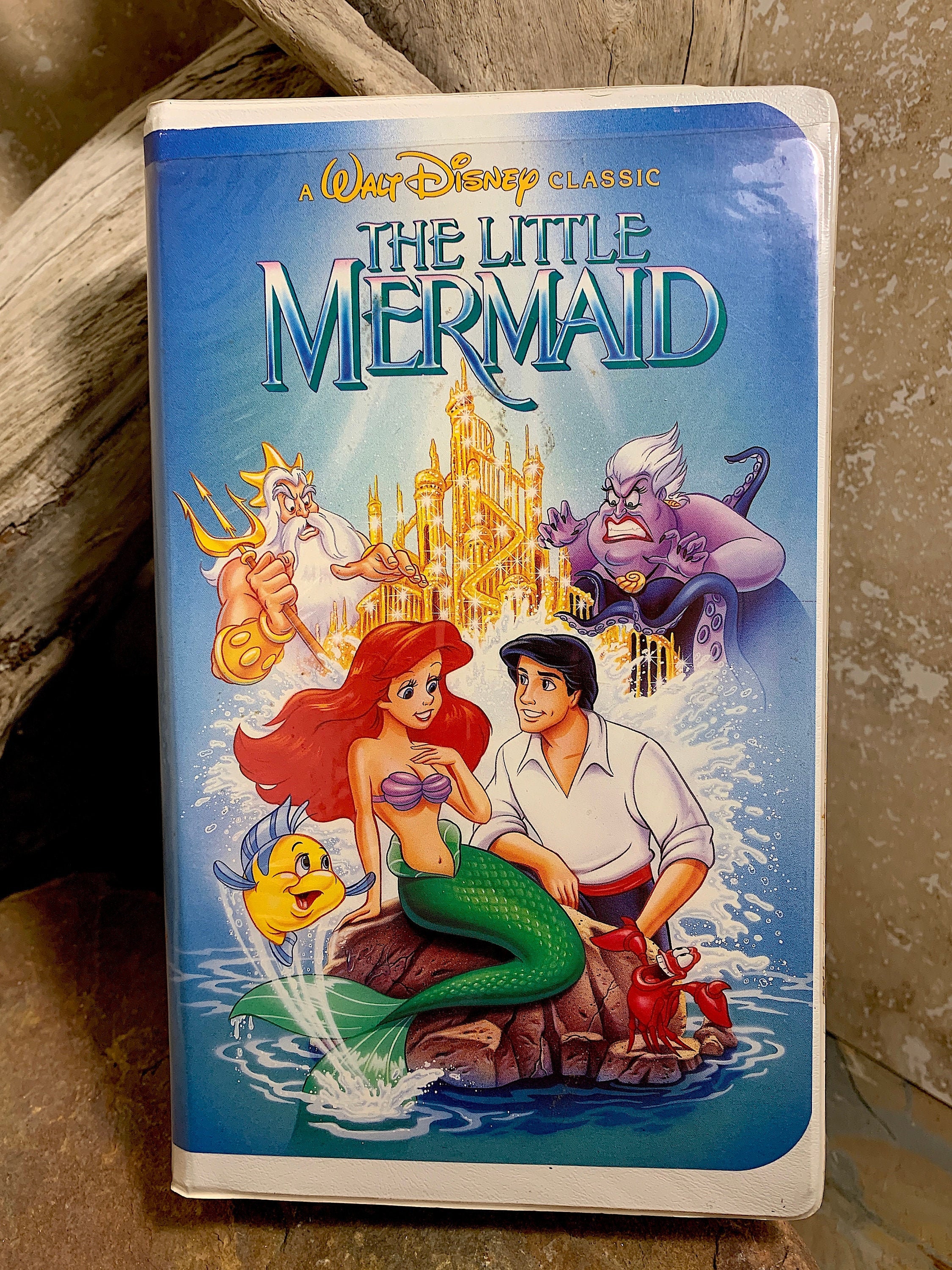
You probably remember the white plastic clamshell case. If you grew up in the nineties, it was a staple of the living room floor, right next to the tangled cords of a Sega Genesis. But the 1990 VHS The Little Mermaid isn't just a nostalgic piece of plastic. It is the center of one of the weirdest, most persistent urban legends in Disney history.
People swear they see things.
Specifically, they see a certain architectural detail on King Triton’s castle that looks... well, inappropriate. It’s the "banned" cover. The "penis" cover. Whatever you want to call it, that specific 1990 VHS release became a lightning rod for parents' groups and conspiracy theorists who were convinced a disgruntled Disney artist was trying to sneak a fast one past the censors.
Honestly, the reality is way more boring, but the market for these tapes today is anything but.
The "Banned" Cover Art Controversy
Let's get into the weeds on this castle. If you look at the 1990 VHS The Little Mermaid original release—the one under the "Walt Disney Classics" line with the diamond logo—the golden palace in the background has a lot of spires. One spire in the dead center is noticeably different. It’s smooth, flesh-toned, and shaped in a way that launched a thousand rumors.
The story goes that an artist at Disney was about to be fired and decided to leave a parting gift. Some versions say he was already fired and did it out of spite.
It’s a great story. It's also totally false.
The artist responsible was actually a freelance illustrator named Beth Logan. She wasn't even a Disney employee at the time; she was working for an outside agency. In later interviews, she explained she was just working under a massive time crunch. It was late at night. She was drawing spires. One of them ended up looking a bit phallic because of the way the light and shadow hit the gold leafing. Nobody at Disney noticed. Nobody at the agency noticed.
Then the tapes hit the shelves.
By the time the "Black Diamond" edition was in millions of homes, the phone calls started coming in. Disney didn't do a massive, public recall—that would have been a PR nightmare and insanely expensive—but they did quietly swap the artwork for subsequent pressings. If you find a version where that middle spire is just a flat, non-descript tower or is covered by a character, you’ve got a later print.
Why the 1990 VHS The Little Mermaid Isn't Worth $10,000
If you go on eBay right now, you will see some absolutely unhinged listings. You'll see "RARE BLACK DIAMOND LITTLE MERMAID BANNED COVER" listed for $5,000, $10,000, or even $25,000.
Don't buy it. Please.
There is a massive misconception about the value of these tapes. People see a high "asking price" and assume that’s what the item is worth. It’s not. To find the real value, you have to filter by "Sold Items." When you do that, the facade crumbles.
Most copies of the 1990 VHS The Little Mermaid sell for about $5 to $25. Even the "banned" cover. Why? Because Disney produced millions of them. "Rare" implies scarcity. There is nothing scarce about a movie that was in every single minivan in North America for a decade.
The only way a VHS copy of this movie is worth real money is if it is professionally graded (like by IGS or VGA) and factory sealed. A mint-condition, never-opened 1990 release might fetch a few hundred or even a thousand dollars to a very specific type of niche collector who cares about "corner dings" and "overlap seals." But that dusty copy in your attic with the cracked plastic case and the "Property of Smith Family" written in Sharpie? It’s basically a coaster.
Technical Oddities of the 1990 Release
Watching the movie on a 1990 VHS is a fundamentally different experience than watching the 4K UHD Blu-ray available today.
First off, there’s the aspect ratio. The original film was shot in 1.85:1. To make it fit your old square tube TV, Disney used "Pan and Scan." This basically means they cropped the sides of the image. You’re literally missing about 30% of the artwork in every frame.
Then there’s the color. The 1990 VHS The Little Mermaid has a very specific, soft color palette. Modern digital restorations have cleaned up the "grain" and brightened the colors so much that some fans feel it looks "too digital" or "sterile." The VHS has a certain warmth. Or maybe that’s just the magnetic tape degrading over thirty years.
The "Part of Your World" Scuff
If you own an original 1990 tape, listen closely during Ariel's big solo. Because these tapes were played on loop by toddlers, certain sections often show more wear than others. The "tracking" usually goes haywire right around the time Ursula appears. This isn't a manufacturing defect; it's just the physical reality of a medium that relies on a spinning head touching a delicate strip of plastic.
The Cultural Shift and the End of the "Classics"
The 1990 release was part of the Walt Disney Classics collection. You can tell by the "The Classics" logo—a diamond with a Sorcerer Mickey inside it—on the spine of the case.
This era was the peak of Disney’s "Vault" strategy. They would release a movie like The Little Mermaid for a limited time, then "put it back in the vault" for seven years. This created a false sense of urgency. It’s the reason your parents rushed to the mall to buy it. They thought if they didn't get it in 1990, you'd never see it.
The Little Mermaid was actually a huge turning point for the studio. It saved Disney Animation. Before 1989, the department was struggling. The Great Mouse Detective did okay, and Oliver & Company was a hit, but they weren't "events." The Little Mermaid changed that. It brought Broadway-style songwriting (thanks to Howard Ashman and Alan Menken) to the screen.
The 1990 VHS was the first time that "Disney Renaissance" magic entered the home. It wasn't just a movie; it was a trophy of the era.
How to Spot an Original 1990 Pressing
If you're digging through a thrift store bin, here is exactly how to identify if you're holding a first-pressing 1990 VHS The Little Mermaid:
- The Diamond Logo: Look for the "The Classics" diamond on the spine. If it says "Masterpiece Collection," it's a much later, less "notorious" version.
- The Castle Spires: Look at the golden castle behind Ariel and Eric. If the central spire looks like a... well, you know... then you have the original Beth Logan artwork.
- The Case: It should be a white "clamshell" case that smells slightly of old vinyl and disappointment.
- The Label: The sticker on the actual black tape should have the "The Classics" logo and the catalog number 913.
Keeping the Magic (and the Tape) Alive
If you actually want to watch your 1990 VHS The Little Mermaid today, you need to be careful. Analog media is dying.
VCRs are getting harder to find, and "VCR/DVD combos" from the early 2000s are notorious for "eating" tapes. If you value the tape, don't just shove it into a dusty machine you found at a garage sale. Clean the heads first.
Also, check for mold. If you see white, fuzzy spots on the reel of the tape through the clear window, do not put it in your VCR. It will spread mold spores to the machine and ruin every other tape you own. Mold happens when tapes are stored in damp basements or garages.
Actionable Steps for Collectors and Nostalgia Seekers
If you’ve got a copy or want one, don't get caught up in the internet hype. Follow these steps to handle your piece of 1990s history:
- Verify the Artwork: Use a magnifying glass to check the castle spire. It’s a fun conversation piece, even if it’s not a gold mine.
- Price Check Properly: Go to eBay, search for "Little Mermaid VHS Black Diamond," and then click the "Sold" filter. You’ll see the real market price is usually under $30.
- Check for "The Point": In some very early versions, there is a "Proof of Purchase" tab on the back of the cover insert. If that’s still there and hasn't been cut out for a mail-in rebate, the value goes up slightly.
- Storage Matters: Keep your VHS tapes upright, like books. Stacking them flat can cause the tape inside to sag and warp over years of gravity.
- Digital Backup: If you love the specific look of the 1990 release, consider using a USB capture card to digitize it. It won't look "good" by modern standards, but it will preserve that specific 1990 color timing before the tape eventually disintegrates.
The 1990 VHS The Little Mermaid is a weird artifact of a time when a single illustrator's mistake could end up in 10 million homes before anyone noticed. It’s a symbol of the Disney Renaissance and a masterclass in how urban legends can inflate the perceived value of everyday objects. Keep it for the memories, not for the retirement fund.