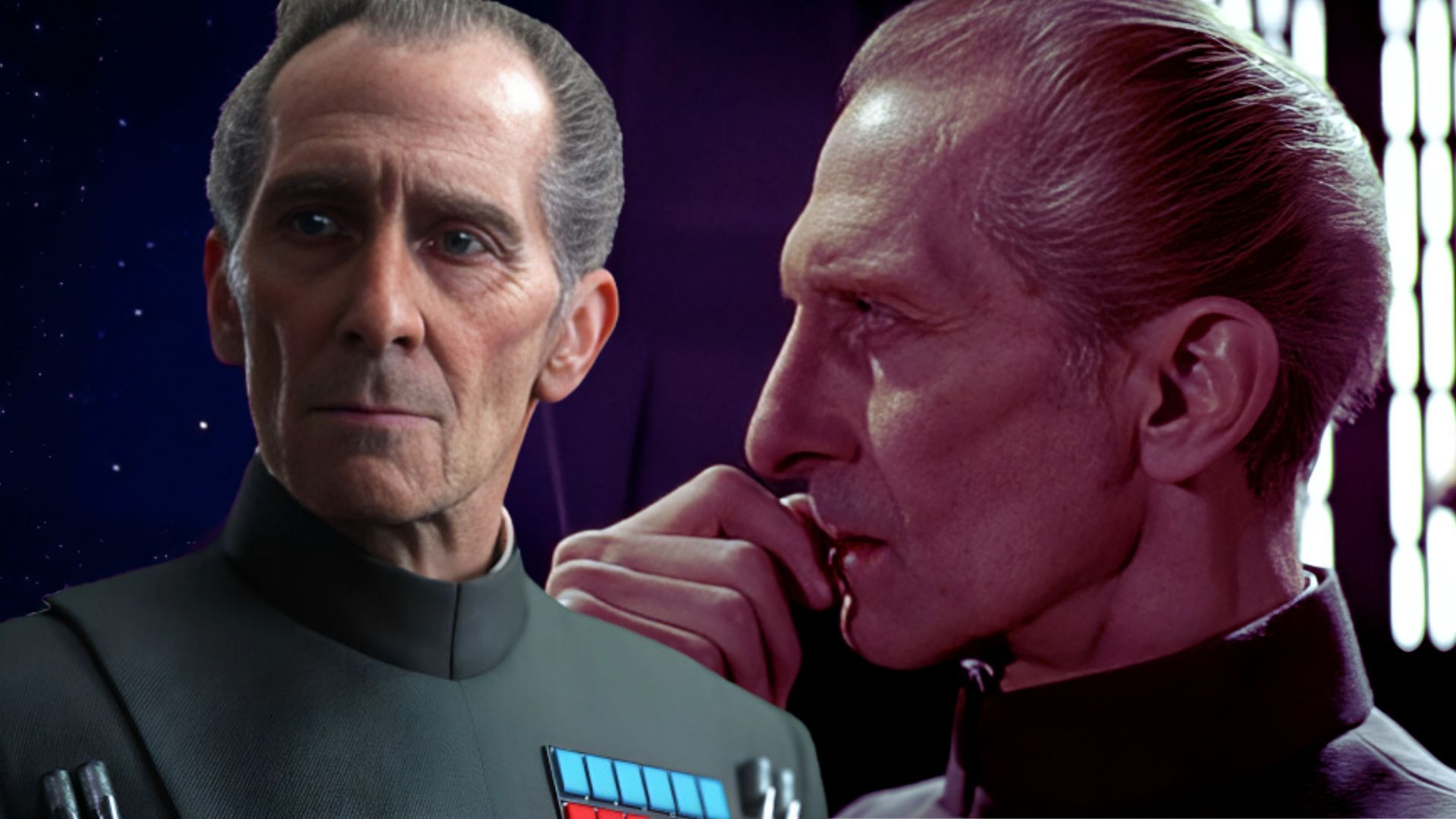
Honestly, the first time you see him, it’s a total jolt. You’re sitting there in the dark, watching Rogue One, and suddenly, there he is. Not a lookalike. Not a guy in a wig. It’s him. Peter Cushing. Or at least, the digital ghost of him. Tarkin in Rogue One remains one of the most daring—and polarizing—creative choices in the entire Star Wars franchise.
It wasn't just a cameo. It was a statement. But why does it still feel so weird years later?
Most movies would’ve just recast. They did it with Mon Mothma. They did it with Han Solo. But for Wilhuff Tarkin, the "Grand Moff" himself, Lucasfilm decided to play God with pixels. They didn't just want the character; they wanted the soul of a man who had been dead since 1994.
The "Zombie" in the Room
Let's be real: the technology is incredible, but it's also kinda creepy. This is what experts call the "Uncanny Valley." Basically, when something looks almost human but not quite, our brains scream "wrong!"
In Rogue One, Tarkin is everywhere. He’s standing in the light. He’s arguing with Director Krennic. He’s staring out of Star Destroyer windows with those cold, sunken eyes. Industrial Light & Magic (ILM) spent 18 months on this. They didn't just slap a texture on a face. They used a British actor named Guy Henry as the "base."
Henry wore a motion-capture rig. He had to study Cushing’s every tick. The way he sneered. The way his upper lip barely moved when he spoke. Then, ILM artists took a digital scan of a "life mask" Cushing had made for the 1984 movie Top Secret! and mapped it over Henry’s performance.
It was a frame-by-frame battle. If the lighting was off by a fraction, he looked like a wax figure. If the skin didn't "jiggle" right when he talked, the illusion shattered.
Why not just hire a new actor?
It’s a fair question. Why go through all that stress?
The producers argued that Tarkin is the face of the Death Star. You can’t tell the story of the station’s birth without the guy who eventually pulls the trigger on Alderaan. To them, a new actor would have felt like a "fake" Tarkin. They wanted the continuity to be seamless. They wanted you to be able to watch Rogue One and A New Hope back-to-back without a hiccup.
But honestly? It also felt like a tech demo. Disney wanted to see if they could do it.
The Legal Drama You Didn't Hear About
You’d think getting permission from the estate would be the end of it. It wasn't.
While the Peter Cushing estate gave their blessing (and reportedly received a payout of around $36,000), a massive legal battle erupted later. A producer named Kevin Francis, a friend of Cushing’s, claimed he had a 1993 agreement that prohibited the use of Cushing’s likeness without his consent.
This went all the way to the High Court. Just recently, in late 2025, judges were still weighing in on whether Disney had the right to "resurrect" him. It brings up a massive ethical point: Who owns your face after you die? ### Was it actually "Evil"?
Some fans hated it. They called it "digital grave robbing."
Others loved it. They saw it as a tribute to a legendary actor. Guy Henry himself was nervous. He almost turned it down because he didn't want to "play" Peter Cushing; he wanted to be Tarkin.
In the story, Tarkin's role is actually pretty brilliant. He’s the ultimate middle-manager from hell. He lets Krennic do all the hard work of building the Death Star, then shows up at the last second to steal the credit. When he uses the superlaser on Scarif at the end of the film, he isn't just killing rebels. He’s "cleaning house." He’s erasing Krennic’s failures—and Krennic himself—to ensure his own seat at the Emperor's right hand.
What we learned from the experiment
Since Rogue One, we’ve seen more of this. Young Luke in The Mandalorian. Princess Leia in the same film. But the industry has shifted slightly.
Now, there’s a move toward "de-aging" living actors rather than resurrecting dead ones. It feels a bit less like a séance.
Tarkin in Rogue One was a pioneer, for better or worse. It showed us that death is no longer a barrier to a Hollywood career. But it also proved that just because we can do something, doesn't mean it won't keep us up at night.
How to watch it now with fresh eyes
If you're going back to rewatch the film, don't just look at the CGI. Look at the performance.
- Watch the eyes: Notice how they rarely blink. That was a Cushing trademark.
- Listen to the voice: Guy Henry nailed the "posh but deadly" tone, even if he felt he sounded more like Peter O'Toole at first.
- Check the lighting: The scenes in the shadows work way better than the ones in the bright command deck.
The real takeaway here is that technology can bridge a gap, but it can't replace a human soul. Tarkin in Rogue One is a masterpiece of math and art, but the "real" Tarkin will always be the man who walked onto a set in 1977 wearing slippers because his boots hurt.
Next Step: To see how the technology has evolved, compare the Tarkin model to the Luke Skywalker "Deepfake" in The Book of Boba Fett—you'll notice a massive leap in how skin textures and mouth movements are handled.