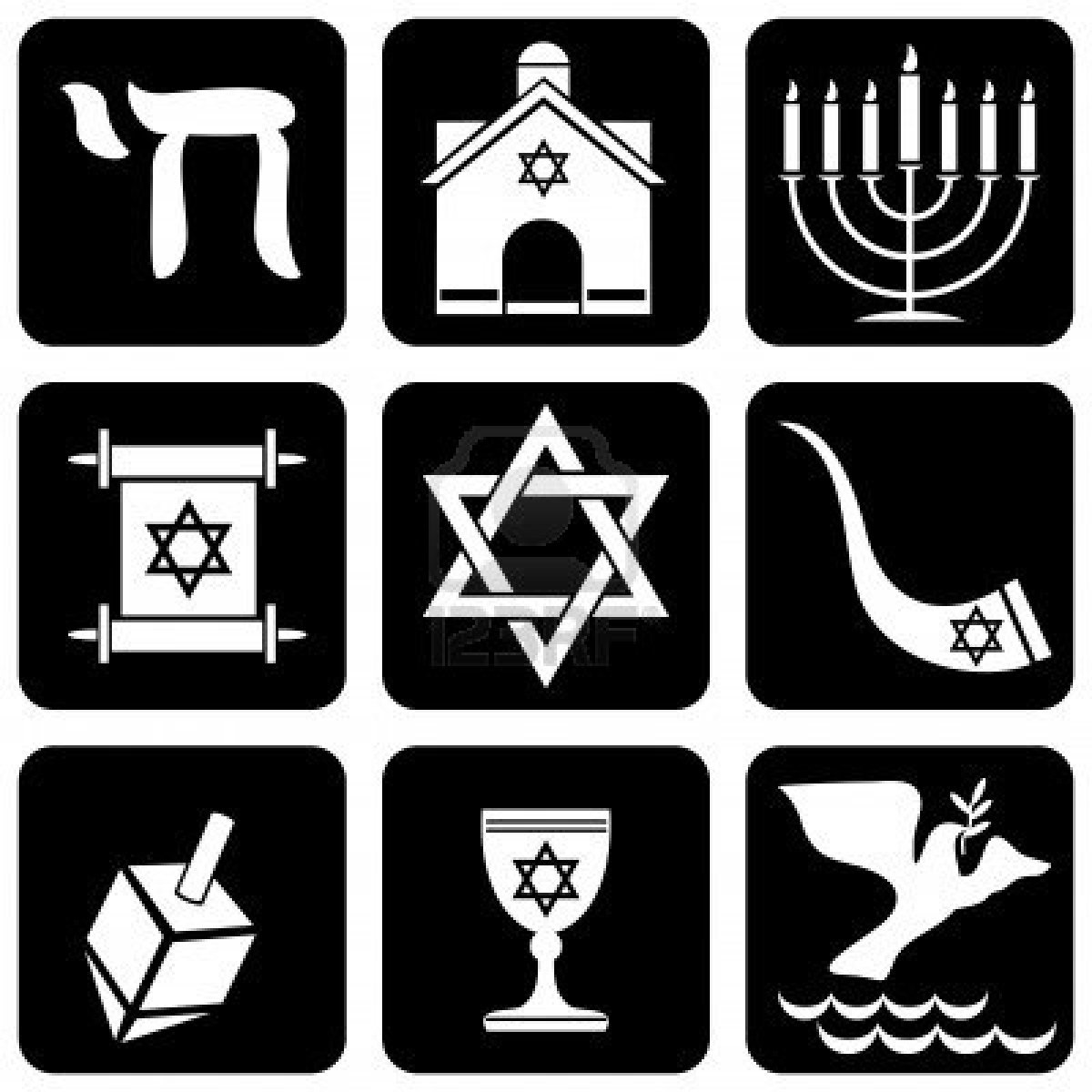
You’ve seen them everywhere. On necklaces, in windows, and etched into old stone buildings. Most people instantly recognize the six-pointed star, but if you ask what it actually signifies or what the other symbols of Judaism are, things get a bit fuzzy. It’s not just about branding an ancient religion. It’s about a visual language that has survived thousands of years, migrations across every continent, and more than a few attempts to wipe it out.
Actually, it’s kinda fascinating. These aren't just decorative.
Jewish symbols serve as a shorthand for a incredibly complex history. Some are biblical, literally described in the Torah with specific blueprints. Others are relatively new, adopted by the community as a way to say "we are here" during times of intense persecution. If you want to understand the culture, you have to look past the gold jewelry and see the theology hiding in plain sight.
The Star of David: It's Not as Ancient as You Think
Let’s start with the big one. The Magen David, or the "Shield of David." Most people assume this star has been the primary symbol of Judaism since King David was walking around Jerusalem 3,000 years ago.
Honestly? Not really.
While the hexagram appears in ancient synagogue ruins, it wasn't uniquely Jewish for a long time. It was a common architectural motif used by many cultures in the Middle East. It didn't become the "official" face of the faith until the Middle Ages, and even then, it was mostly used on magic amulets or in kabbalistic texts. It wasn't until the 17th century in Prague that the Jewish community started using it as a formal emblem on their flag. By the time the Zionist movement adopted it in 1897, it was cemented.
The shape itself—two interlocking triangles—is often interpreted as the relationship between God and humanity. One triangle points up toward the heavens; the other points down toward the earth. They interweave. They’re inseparable. It’s a visual representation of the covenant. Some scholars, like Gershom Scholem, have noted that its rise in popularity was actually a response to the Christian cross. Jews needed a symbol that could compete visually in a crowded European landscape. It’s practical. It’s iconic. It’s also a heavy reminder of the yellow badges forced upon Jews during the Holocaust, a symbol of shame that was reclaimed as a badge of pride and statehood.
The Menorah: The Real O.G.
If the Star of David is the modern face, the Menorah is the soul.
When you ask a historian about symbols of Judaism, they’ll usually point you here first. The seven-branched candelabrum is the oldest continuous symbol of the Jewish people. We’re talking about a design that was supposedly dictated by God to Moses on Mount Sinai. It stood in the Tabernacle and later in the Temple in Jerusalem.
Don't confuse the seven-branched Menorah with the nine-branched Chanukiah used during Hanukkah. The original Menorah was lit daily with pure olive oil. It represented eternal light and the presence of the Divine. You can see it carved into the Arch of Titus in Rome, depicting the Romans carrying it away as loot after destroying the Temple in 70 CE. That image is heartbreakingly famous. It shows the moment a nation was sent into exile. Interestingly, when the State of Israel was founded in 1948, they chose the seven-branched Menorah—not the Star of David—as their official state emblem. It was a way of saying the light that was taken to Rome had finally come home.
Mezuzah: The Guard at the Door
Walk into any Jewish home, or even a hotel room in Israel, and you’ll see a small slanted case on the doorpost. That’s the Mezuzah.
Basically, it’s a security system for the soul.
Inside that case is a hand-written parchment called a klaf. A trained scribe, known as a sofer, writes specific verses from the Book of Deuteronomy (the Shema). It’s not just a decoration. It’s a physical reminder of the commandment to keep God’s words "on the doorposts of your house." There’s a specific way to hang it, too. In the Ashkenazi tradition, it’s tilted inward. Why? Because medieval rabbis couldn’t agree if it should be vertical or horizontal, so they compromised. It’s a beautiful bit of Jewish logic: when in doubt, find the middle ground.
The Chai and the Power of Numbers
You’ve probably seen the "Chai" symbol on necklaces. It looks like two Hebrew letters: Chet (ח) and Yud (י). Together, they spell Chai, which means "Life."
In Judaism, life is everything. The religion is famously focused on the "here and now" rather than the "hereafter." Every letter in the Hebrew alphabet has a numerical value (Gematria). Chet is 8. Yud is 10. Together, they equal 18. This is why you’ll see Jews giving gifts or donations in multiples of 18. It’s a way of wishing someone a long, vibrant life. It’s a positive, upbeat symbol that focuses on survival and vitality. If you’re at a wedding or a Bar Mitzvah, you’ll hear the toast "L'chaim!"—to life. It’s more than a drink; it’s a theological stance.
Other Visual Markers You Should Know
It isn't just about stars and lamps. Some symbols are worn, while others are eaten or held during prayer.
- Tallit and Tzitzit: The prayer shawl. The real symbol here isn't the cloth, but the knotted fringes (tzitzit) on the corners. They represent the 613 commandments (mitzvot). They’re a physical tether to a moral code.
- Hamsa: That hand-shaped amulet. While shared with Islamic culture, in Judaism, it’s often called the Hand of Miriam. It’s a protection against the "Evil Eye." It’s become a massive staple in modern Jewish art and jewelry.
- The Shofar: A ram’s horn. It’s one of the few symbols you can hear. It’s used on Rosh Hashanah and Yom Kippur to "wake up" the soul. It’s raw, primal, and sounds like a literal alarm clock for your conscience.
- The Lion of Judah: Representing the tribe of Judah (and by extension, the Jewish people), you’ll often see two lions flanking the Ten Commandments above the Ark in a synagogue. It’s about strength and sovereignty.
Why These Symbols Still Matter in 2026
Symbols change. They evolve. A few hundred years ago, the Star of David was a niche mystical diagram. Today, it's on a flag and millions of people's skin.
What’s interesting is how these symbols of Judaism have shifted from purely religious tools to ethnic and cultural identifiers. You don’t have to be a regular at the synagogue to wear a Chai necklace. For many, it’s about heritage. It’s about signaling to the world that you belong to a lineage that has outlasted empires. In an era where identity is often digital and fleeting, these ancient anchors provide a sense of "long time" that is hard to find elsewhere.
There's also the "Kippah" or "Yarmulke." It’s a small head covering that serves as a constant reminder that there is something above you. It’s an act of humility. While it’s technically a garment, it has become a powerful visual symbol of Jewish identity in the public square.
Common Misconceptions
People get things wrong all the time.
For one, Judaism doesn't really do icons. You won't find statues of Moses or paintings of God in a traditional synagogue. The "Second Commandment" forbids "graven images," which is why Jewish symbolism is so focused on geometric shapes (the star), functional objects (the menorah), and letters (the Chai). The symbol is the message.
Also, some people think the "Evil Eye" (Nazar) is a Jewish symbol. It’s actually a Mediterranean folk belief that many Jews adopted over centuries of living in North Africa and the Middle East. It's "Jewish-adjacent," but not rooted in the Torah.
Actionable Steps for Exploring Further
If you’re looking to connect with these symbols or simply understand them better, don’t just look at pictures online. Go see them in their natural habitat.
Visit a Jewish Museum: If you're in a major city like New York, London, or Jerusalem, the local Jewish Museum will have artifacts dating back centuries. Seeing a Menorah from the 1400s is a very different experience than seeing a clip-art version.
Observe the Architecture: Next time you pass an old synagogue, look at the stonework. You’ll often find the Lion of Judah or intricate vine patterns (vines and grapes are also major biblical symbols representing the people of Israel).
Learn the Alphabet: Since so much of Jewish symbolism is tied to the Hebrew language, learning the 22 letters of the Aleph-Bet opens up a whole new layer of meaning. Every letter has a story, a number, and a mystical "personality."
Support Jewish Artists: Modern Judaica is a thriving field. Contemporary artists are constantly reimagining these symbols—turning the Hamsa into street art or the Menorah into minimalist sculpture. It’s a way to see how an ancient tradition stays relevant in a modern world.
Understanding these symbols isn't just an academic exercise. It's a look into how a group of people has used art, light, and language to keep their story alive for four millennia. Whether it’s a tiny scroll on a doorpost or a star on a flag, these markers are the threads that hold a global community together.
To deepen your understanding of the tangible elements of the faith, look into the specific rituals of Shabbat. The two candles lit on Friday night are perhaps the most intimate and recurring symbols of the entire tradition, representing the dual commandments to "remember" and "keep" the day of rest. Observing how these symbols move from the public sphere into the private home provides the clearest picture of how they function in daily life.