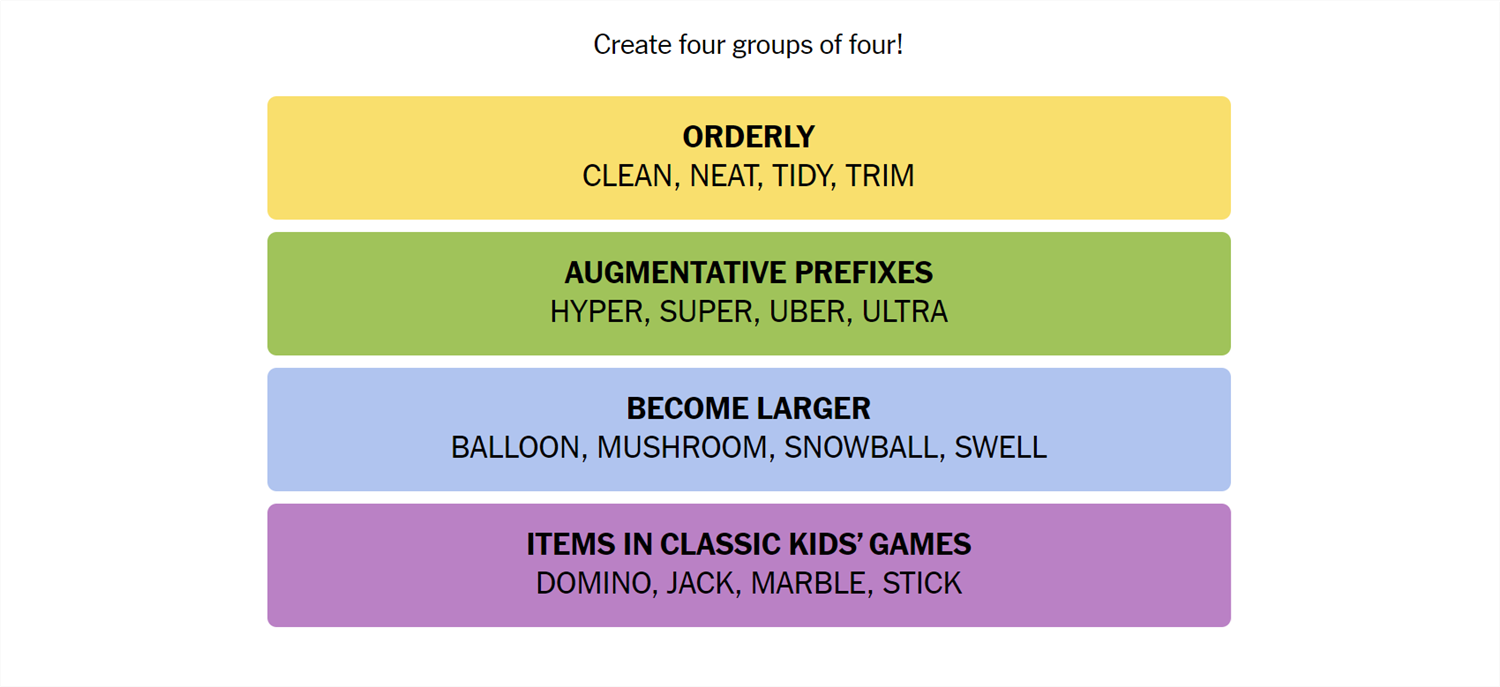
Look, we’ve all been there. You open the New York Times app, your coffee is still steaming, and you think today is the day you’ll breeze through the grid without a single mistake. Then you see the words. They don’t make sense. You stare at the screen for five minutes, and suddenly, the April 29 NYT Connections puzzle feels like a personal attack.
Connections is a game of lateral thinking. It’s not just about what words mean; it’s about how they hide. The editor, Wyna Liu, is famous (or maybe infamous) for those "red herrings." You know, the words that look like they belong together but are actually just bait to make you waste your guesses.
If you're struggling with the April 29 puzzle, don't worry. I've broken down the logic, the traps, and the actual answers so you can keep your streak alive. Honestly, some of these groupings are a bit of a stretch, but that's the beauty of the game.
Understanding the April 29 NYT Connections Hints
Before we dive into the deep end, let's talk strategy. The difficulty in Connections scales from Yellow (easiest) to Purple (tricky). Usually, the Yellow category is a straightforward group of synonyms. Green and Blue require a bit more specific knowledge—maybe pop culture or slightly more obscure definitions. Purple? Purple is almost always about wordplay, like words that follow a certain prefix or words that fit into a specific phrase.
For the April 29 NYT Connections hints, you need to look for themes related to movement, specific objects, and maybe some classic Americana.
Sometimes the best way to solve a tough grid is to ignore the words that seem obvious. If you see four words that all relate to "dogs," be careful. It’s often a trap where three of those words belong together, but the fourth is the key to a completely different group.
The Yellow Category: Smooth Sailing
This group is generally the most "on the nose." You’re looking for things that share a very clear, physical purpose. Think about objects you might find in a specific room or items used for a single task.
For the April 29 puzzle, the Yellow group revolves around things that hold or support. If you see words like Cradle, Base, or Mount, you're on the right track. These are all things that provide a foundation or a resting place for something else. It's the kind of category that feels easy once you see it, but when it's mixed in with a dozen other words, it can get lost in the noise.
The Green Category: Action and Movement
Green usually steps up the complexity by using verbs or descriptors that aren't perfectly synonymous but share a vibe. In this specific puzzle, we're looking at ways things move or are moved.
Think about the word Flick. Or Flip. These are quick, jerky motions. If you see other words that imply a sudden change in position or a quick toss, you've found your Green group. It's about that specific physical action.
The Blue Category: A Bit More Specific
Blue is where things get interesting. You might need a little bit of niche knowledge here. For the April 29 NYT Connections, the Blue category leans into things that have a very specific "look" or a shared naming convention.
Without giving it all away just yet, think about things you might find in a specific type of shop or perhaps things related to a certain hobby. If you’re seeing words that sound like they belong in a specialized catalog, group them together.
The Trap: Red Herrings to Watch Out For
The April 29 puzzle is notorious for its overlaps. You might see a word like Jack. Now, Jack could be a name. It could be a tool for a car. It could be a playing card. It could even be part of a phrase like "Jack of all trades."
This is where people get stuck. They see Jack and King (if it were there) and immediately think "cards." But Wyna Liu loves to put a "card" word in there when the actual category has nothing to do with games. Always check if a word fits better in a more "abstract" category before locking it in.
Deep Dive into the Purple Category
Purple is the "Aha!" moment. Usually, it's "Words that start with [Blank]" or "Words that follow [Blank]."
For April 29, the theme is actually quite clever. It involves things that follow a specific word that describes a certain... state of being. Or perhaps a color. Think about the word Blue. What words go after blue? Blue Jays. Blue Jeans. Blue Cheese.
If you see a word like Cheese or Jay, don't just think about food or birds. Think about what word could possibly precede all of them to make a common phrase. That is the secret to cracking the Purple code every single time.
Detailed Breakdown of the Groups
If you're still hitting a wall, let's look at the actual groupings for the April 29 NYT Connections.
Group 1: Support Structures (Yellow)
These are the basics.
- Base
- Foot
- Mount
- Rest
These all function as a support or a bottom part for an object. It's a very physical, literal category.
Group 2: Quick Toss (Green)
This is about that sudden movement I mentioned earlier.
- Cast
- Chuck
- Fling
- Toss
Notice how they all mean "to throw," but they have slightly different connotations? A Cast is a bit more formal (like a fishing line), while a Chuck is casual. But they all fit that "throw" umbrella perfectly.
Group 3: Slang for "Zero" (Blue)
This one catches people off guard because these words have so many other meanings.
- Jack
- Love
- Nada
- Squat
"I have jack squat" means I have nothing. "Love" is the score for zero in tennis. This is a classic Blue category because it requires you to pull from different areas of knowledge—sports, slang, and Spanish.
Group 4: [Blank] Fish (Purple)
And here is the kicker. The words themselves seem totally unrelated until you add the word "Fish."
- Clown (Clownfish)
- File (Filefish)
- Monk (Monkfish)
- Sun (Sunfish)
Honestly, File is the one that usually trips people up here. Most people don't think of a filefish immediately, whereas clownfish is common knowledge thanks to Finding Nemo.
Why Connections is So Addictive
There's a psychological reason we keep coming back to this game. It taps into our "pattern recognition" brain. When you finally click those four words and they turn purple, your brain releases a hit of dopamine. It’s a small victory to start the day.
But it’s also about the community. On April 29, social media is usually flooded with people sharing their color grids—sometimes full of green and yellow, other times a sea of red "guesses remaining" markers. It's a shared experience of frustration and triumph.
Mistakes Even Experts Make
- Rushing the first guess. People see "Cast" and "Clown" and think "Entertainment." They click and lose a life. Always wait until you have at least two potential groups before you submit anything.
- Forgetting the "Fish" rule. Purple is almost always "Word + Word" or "Word + [Blank]." If you have four words that seem to have nothing in common, try adding a common word like "Box," "Man," "Water," or "Fish" to them.
- Ignoring the category colors. If you've already solved Yellow and Green, and you're stuck on the last eight words, remember that one group will be "Blue" (medium-hard) and one will be "Purple" (wordplay). This can help you narrow down the logic.
Actionable Tips for Tomorrow's Puzzle
To get better at Connections, you have to diversify your mental dictionary.
- Read more broadly. The puzzles often reference theater, classic literature, and 80s pop culture.
- Think in phrases. When you see a word, don't just think of its definition. Think of what it's usually paired with. If you see "Paper," think "Weight," "Trail," "Clip," "Thin."
- Say the words out loud. Sometimes hearing the word helps you realize it's a homophone for something else. "Flower" could be the plant, or it could be something that "flows" (like a river).
- Use the Shuffle button. It’s there for a reason. Sometimes the way the NYT arranges the grid is a psychological trick. Shuffling the tiles can break your brain out of a false pattern and help you see a fresh connection.
The April 29 NYT Connections puzzle is a great example of why this game works. It challenges your vocabulary, your cultural knowledge, and your ability to spot a "toss" in a sea of "fish." Once you realize that "Love" isn't about romance and "File" isn't about office supplies, the whole thing falls into place. Keep practicing, and don't let a few "One Away" messages get you down.
If you want to keep your streak going, start by looking for the most literal synonyms first. Once the easy ones are out of the way, the complex wordplay in the Purple and Blue categories becomes much easier to manage. Keep a list of common "Purple" themes—like animals, body parts, or colors—to check against the grid when you're truly stumped. Over time, you'll start to anticipate Wyna Liu’s tricks before you even make your first click.