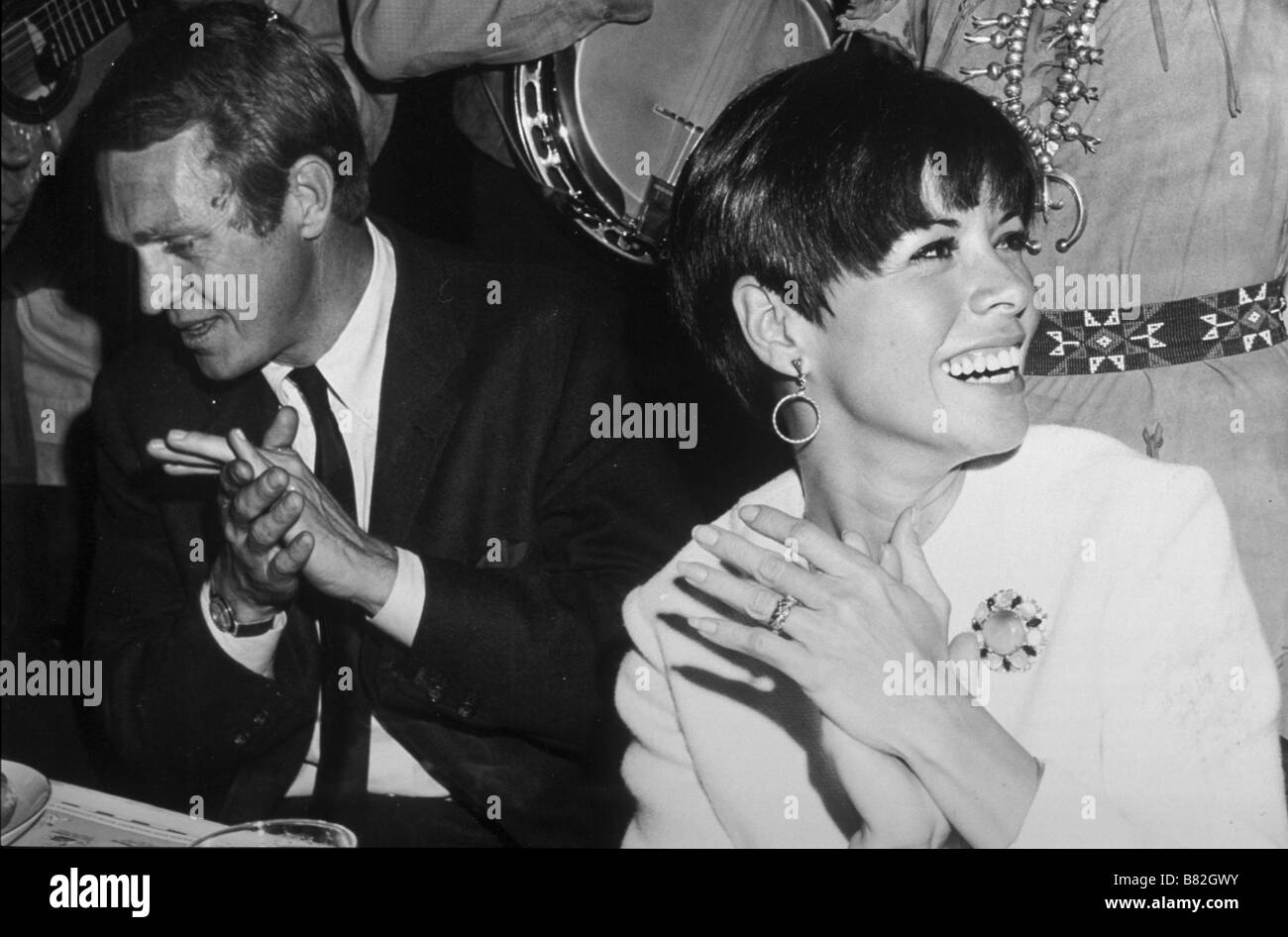
The image is burned into the collective consciousness of Hollywood: Steve McQueen, the "King of Cool," leaning against a fast car with that detached, icy-blue stare. He looked like a man who didn't need anyone. But if you dig into the actual history—not the PR fluff—you find a different story. You find Neile Adams.
She wasn’t just "the wife." Honestly, when they met in 1956, she was the star and he was the struggling actor with a chip on his shoulder the size of a Hollywood billboard.
Most people think McQueen just arrived fully formed as an icon. Wrong. Neile Adams, a Filipino-American dancer and Broadway powerhouse, was the architect of the McQueen we know. She’s the one who pushed him to take the role in The Blob. She’s the one who navigated the shark-infested waters of agents and studios while he was busy being, well, Steve.
Their marriage lasted 16 years. In Hollywood time, that’s an eternity. But it wasn't a fairytale. It was a high-speed collision of two people who survived horrific childhoods only to find that love doesn't actually fix everything.
The Broadway Star and the Biker
Neile was 23 and headlining on Broadway when she literally ran into Steve. He was three years older, broke, and about to get fired from a play.
She had a contract with MGM. He had a motorcycle and a massive amount of trauma.
They both grew up abandoned. Neile had survived the Japanese occupation of Manila during World War II; Steve had been bounced between a distant mother and a reform school. That shared "outsider" DNA created an instant, visceral bond. Neile recently recalled that Steve told her almost immediately, "I will always take care of you."
And for a while, he did. But the power dynamic shifted fast. As Neile used her influence to get him into the right rooms—introducing him to her agents at William Morris—Steve’s star began to eclipse hers.
When the "King of Cool" Became the King of Chaos
Success didn’t make Steve McQueen easier to live with. It made him more dangerous.
By the mid-60s, they were the "It" couple. They lived in a castle-like estate in Brentwood. They had the cars—the Ferraris, the Porsches, the Jaguars. But inside that house, things were falling apart.
Steve was a man of extremes. When he was good, Neile says he was "adorable." When he was bad? He was a nightmare fueled by a cocktail of paranoia and insecurity. He started demanding she stop working. He wanted a traditional wife, even though he was anything but a traditional husband.
The double standard was staggering. Steve cheated constantly. He had "flings" with co-stars and "flower children." Neile knew. She tolerated it for years, basically because she understood his brokenness.
But then came 1970.
While filming Le Mans in France, the atmosphere turned toxic. Steve’s drug use—specifically cocaine—had ramped up. During a moment of drug-fueled paranoia, he suspected Neile had finally stepped out on him to get even.
He was right. She had.
The reaction was explosive. In her memoir, My Husband, My Friend, Neile details a terrifying night where Steve held a loaded gun to her head, demanding she name the man. He hit her. It was a breaking point. For 14 years, he hadn't been physical, but once that line was crossed, the marriage was effectively dead.
The Ali MacGraw Factor
We can't talk about Steve McQueen and Neile Adams without mentioning The Getaway.
By 1971, the marriage was a ghost. Then Ali MacGraw entered the frame. The chemistry between Steve and Ali was "chemical," as Ali herself later described it. Neile saw the writing on the wall.
She filed for divorce in 1972.
Steve married Ali shortly after, but he repeated the same patterns. He forced Ali to quit acting. He cheated. He obsessed over control. It turns out the common denominator in Steve's failed relationships wasn't the women—it was the man who couldn't escape his own ghosts.
What Most People Get Wrong About Neile Adams
The biggest misconception is that Neile was a victim who just faded away.
Far from it.
Even after the divorce, she and Steve stayed connected. They shared two children, Terry and Chad. They shared a history no one else understood. On his deathbed in 1980, struggling with mesothelioma, Steve reportedly apologized to her. He told her, "It was always you."
Neile went on to have a successful second act. She remarried (to Alvin Toffel), returned to her love of cabaret, and became the matriarch of a Hollywood dynasty. Her grandson, Steven R. McQueen, became a star in his own right on The Vampire Diaries.
She didn't stay bitter. She wrote her book to explain the man, not to bury him. She understood that Steve McQueen was a "haunted man" who used "cool" as a shield to keep the world from seeing how much he was hurting.
Why Their Story Still Matters
If you're looking for a lesson in the McQueen-Adams saga, it's about the cost of the "Great Man" myth.
We celebrate the rebels. We put the guys in the leather jackets on posters. But Neile’s story reminds us that behind every "rebel" is often a woman who sacrificed her own career to keep the engine running.
She was the one reading his scripts. She was the one picking his projects. Without Neile Adams, Steve McQueen might have just been another guy with a motorcycle who couldn't keep a job.
Real Talk: Insights for Today
If you find yourself fascinated by this era of Hollywood, here is how to look at it through a modern lens:
- Look past the "Cool": Insecurity often masquerades as detachment. Steve's legendary "cool" was a coping mechanism for a man who never felt safe.
- Acknowledge the Labor: Success is rarely a solo act. Neile's role as a "manager-wife" was common in the 50s and 60s, but it's a role that often led to the erasure of the woman's own talent.
- Understand the Trauma Loop: Abused children often grow into volatile adults. Steve’s behavior wasn't an excuse, but it was a predictable outcome of his early life.
Neile Adams is still with us, a legendary figure who outlived the man who thought he would "take care of her." She ended up being the strong one.
Take a moment to watch Neile’s performance in the Alfred Hitchcock Presents episode "Man from the South." You’ll see the two of them together on screen at the height of their power. It’s electric, uncomfortable, and a perfect capsule of a love that was, quite literally, too hot to last. You can also track down a copy of her memoir, My Husband, My Friend, to get the story in her own unfiltered voice.