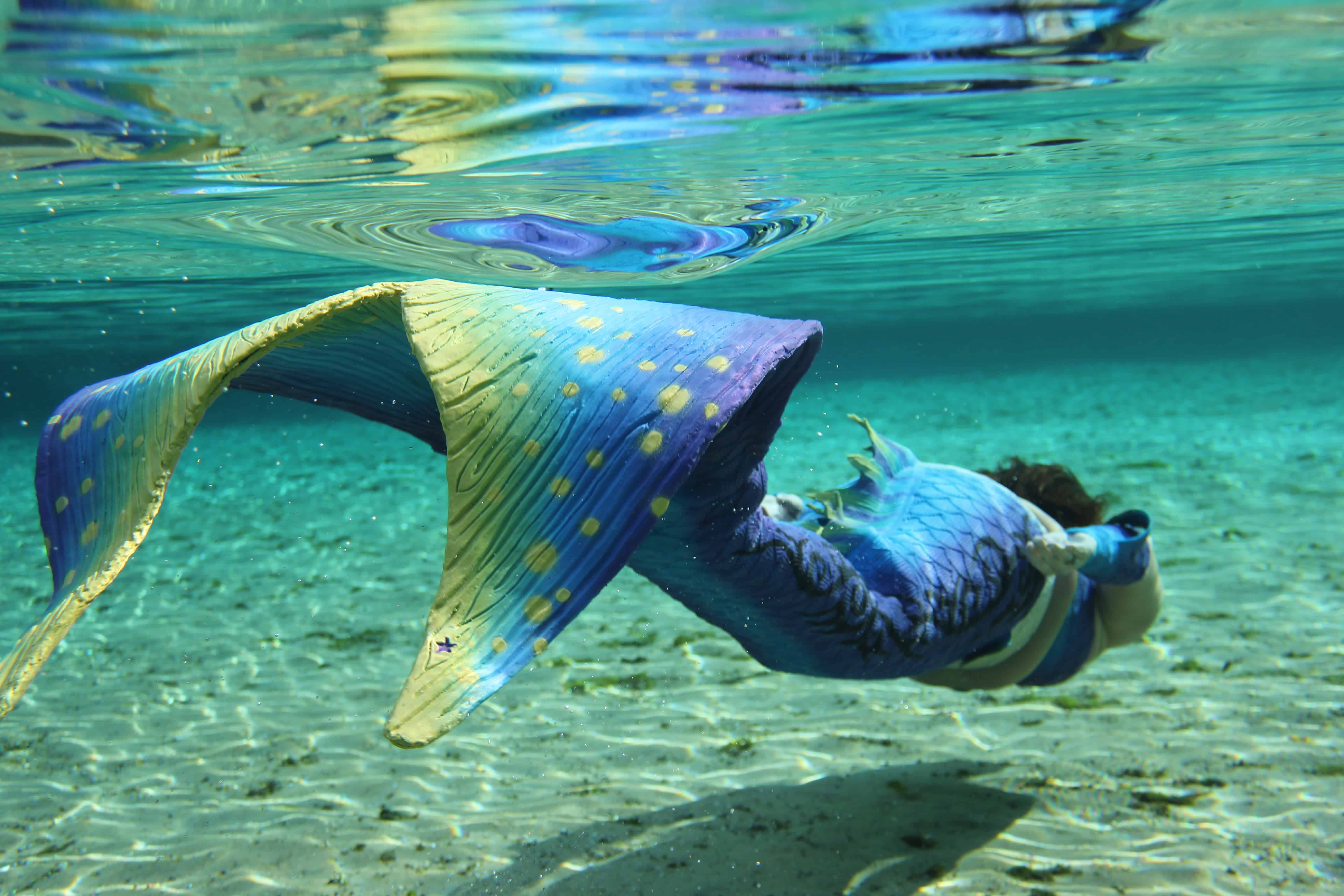
You’ve probably been there. Late night, scrolling through a rabbit hole on TikTok or YouTube, and you see a thumbnail that stops you cold. It’s a grainy, blue-tinted image of something with a tail draped over a rock in the middle of the ocean. You click it because you want someone to finally show me a picture of a real mermaid, but instead, you get a three-minute video of shaky camera footage and a digital zoom that turns everything into a pixelated mess. It’s frustrating.
We want them to be real. Honestly, there is something deeply human about the desire to find a hidden species in the 70% of our planet that we haven't fully explored yet. But if you’re looking for a biological, flesh-and-blood creature that matches the Ariel or Starbucks logo aesthetic, the reality is a bit more complicated—and arguably more interesting—than a simple hoax photo.
The Search for the One True Image
If you ask the National Ocean Service (NOS), they’ll give it to you straight: "No evidence of aquatic humanoids has ever been found." That’s the official line. Yet, every few years, a new "real" photo goes viral.
Most of these images fall into three categories. First, you have the "Fiji Mermaid" style taxidermy. These are gruesome. They aren't beautiful women with shimmering scales; they are the upper half of a juvenile monkey sewn onto the back half of a fish. Barnum made a fortune off one in the 1840s, and people still find these "mummified mermaids" in old temples in Japan. They are real objects, sure, but they aren't real organisms.
Then there are the movie props. Remember the Animal Planet "documentary" Mermaids: The Body Found? It used CGI and practical effects that looked so convincing the government actually had to issue a statement clarifying it was fiction. People still take screenshots of that show today and post them as "leaked" evidence.
Finally, we have the biological misidentifications. Manatees and dugongs are the classic culprits. Christopher Columbus famously wrote in his logbook in 1493 that he saw three mermaids off the coast of Haiti. He noted they "were not as beautiful as they are painted, although to some extent they have a human appearance in the face." He was looking at manatees. If you've ever seen a manatee nurse its young or bob its head out of the water in low light, you can almost see how a tired, scurvy-ridden sailor might get confused. Almost.
Why We Keep Looking (and Seeing)
Our brains are hardwired for something called pareidolia. It's the same reason you see a face in a grilled cheese sandwich or a man in the moon. When we look at the chaotic, shimmering surface of the ocean, our brains desperately want to find a pattern. A dolphin's tail flipping at a weird angle? Mermaid. A large piece of kelp tangled around a buoy? Mermaid.
The Deep Sea Reality
The ocean is terrifyingly deep. The Mariana Trench goes down about 36,000 feet. At those depths, the pressure would crush a human ribcage like a soda can. If a "real" mermaid existed, it wouldn't look like a supermodel. It would likely have pale, translucent skin, no hair (hair is a drag in the water), and huge, bulbous eyes to catch what little light exists. Or, it would be bioluminescent.
Think about the "Sea Monk" or the "Sea Bishop" of the 16th century. These were historical accounts of mermaid-like creatures caught by fishermen. Modern naturalists, like Steenstrup in the 1850s, looked at those old drawings and realized they were likely Giant Squids. When a squid is pulled out of the water, its mantle can look like a monk's hood, and its tentacles can look like legs or a tail.
The Cultural Mirror
Every culture has a version. The Scottish have Selkies—seals that shed their skin to become human. The Nigerians have Mami Wata. The Greeks had Sirens, though those started out as half-bird, not half-fish. We keep creating these images because they represent our relationship with the water. The ocean gives life, but it also takes it away. Mermaids are the personification of that duality: beautiful but dangerous.
How to Spot a Fake Mermaid Photo
When you're searching for that one definitive "picture of a real mermaid," you have to be a bit of a detective. Digital manipulation has made it nearly impossible to trust your eyes. Here is how you can debunk most of the stuff you see online:
- Check the lighting. If the "mermaid" is perfectly lit but the water around it is dark or murky, it’s a composite image. Light behaves differently underwater; it scatters and loses red tones very quickly.
- Look for the "uncanny valley." If the face looks too human—like it has makeup or a specific facial structure common in 21st-century humans—it’s probably a CGI model or a person in a silicone tail.
- The "Professional Mermaid" Industry. This is a huge thing now. There are people who make a living as professional mermaids. They wear $5,000 silicone tails that move realistically and can hold their breath for minutes at a time. Many "real" sightings are actually just freedivers practicing their craft.
- Reverse Image Search. If you see a photo that looks too good to be true, right-click it and search Google Images. Nine times out of ten, it’ll lead you to a Pinterest board for a fantasy photographer or a concept artist’s portfolio.
The Evolutionary Argument
Could a mermaid actually evolve? Biologically, it's a nightmare. Mammals need to breathe air. If a mermaid is a mammal, it has to come to the surface constantly. If it has gills, it’s a fish, which means it wouldn't have a human-looking upper body because human anatomy (lungs, heavy bones, horizontal diaphragm) is built for gravity and air, not buoyancy and water.
There is a fringe idea called the "Aquatic Ape Hypothesis." It suggests that our ancestors spent a period of time living in semi-aquatic environments, which explains why we have subcutaneous fat, less body hair, and can hold our breath. Even this theory, though, doesn't suggest we turned into fish-people. It just suggests we were really good at wading.
What to Do Instead of Searching for Photos
If you want the "mermaid experience" without the hoax, look at the real wonders of the ocean. There are creatures that look more alien and magical than any mermaid.
- Watch footage of a Siphonophore. They look like glowing, underwater ribbons that can grow longer than a blue whale.
- Look up the Glaucus Atlanticus. It’s a tiny sea slug known as the "Blue Dragon." It looks exactly like a legendary creature.
- Visit a Manatee Sanctuary. Seeing these "sea cows" in person helps you understand the history of mermaid sightings. They are gentle, curious, and have a strangely soulful presence.
- Study the Ama Divers. These are Japanese women who have been diving for pearls and seafood for 2,000 years, often without oxygen tanks. They are the closest thing to real-life merfolk we have.
The ocean doesn't need to hide a half-human hybrid to be mysterious. The truth is that we’ve only mapped about 25% of the sea floor with high resolution. There are millions of species yet to be discovered. While a "real mermaid" might not be one of them, something equally strange is likely swimming down there right now, completely indifferent to our cameras.
Stop looking for the grainy hoaxes. Start looking at the high-definition footage coming from ROVs (Remotely Operated Vehicles) in the midnight zone. That’s where the real magic is happening. The images there are verified, terrifying, and 100% real. When you see a Magnapinna squid or a Barrel-eye fish, you realize that nature's imagination is way more vivid than ours.
To satisfy the itch for the mythical, support digital artists who specialize in creature design. They use real anatomy to create "what if" scenarios that look more real than any clickbait thumbnail. Understanding the science of why mermaids can't exist actually makes the folklore much more fun to study. You aren't looking for a monster; you're looking for a story we've been telling ourselves for thousands of years.