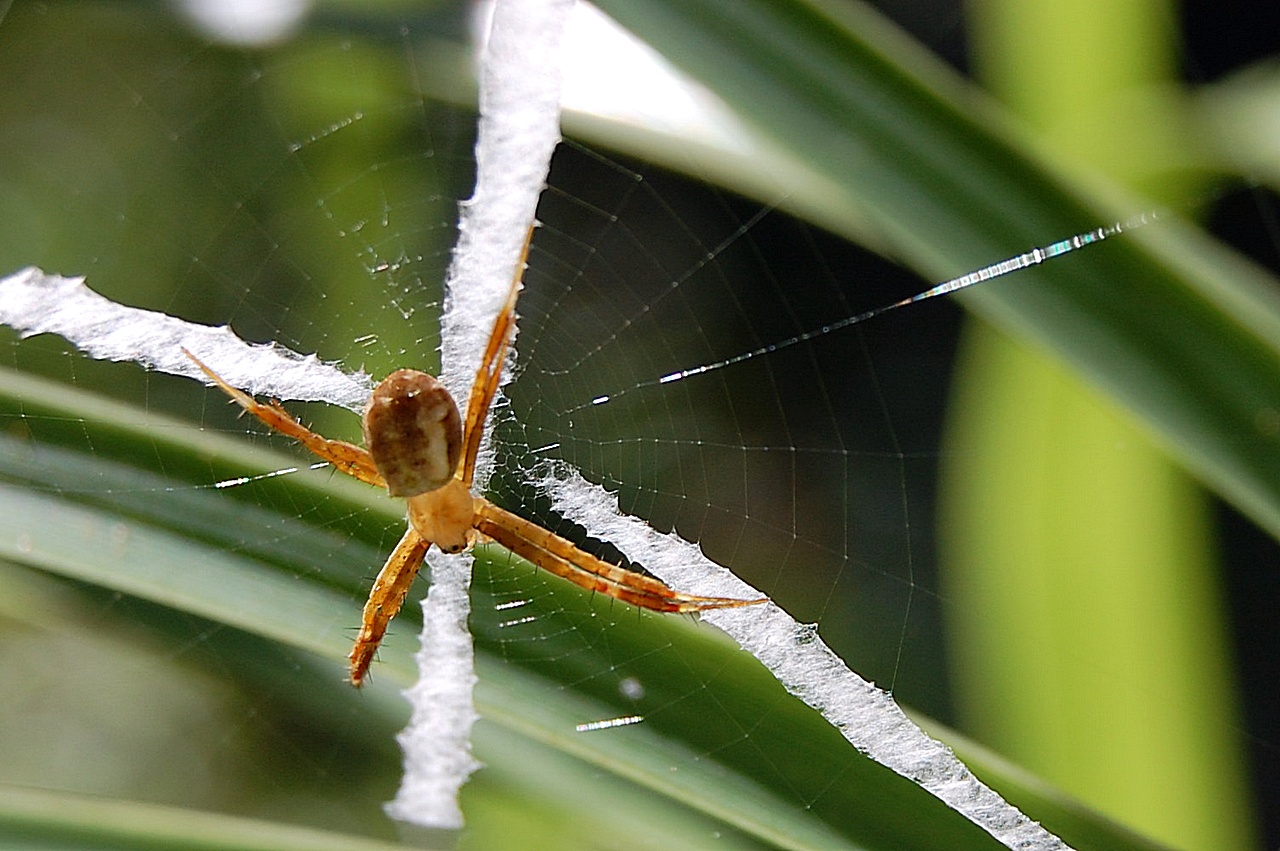
You’re walking through a garden in Sydney or maybe Brisbane, minding your own business, when you see it. A massive, orb-shaped web with a spider that looks like it’s posing for a heavy metal album cover. It’s sitting right in the middle, legs paired up to form a perfect "X," and there are these thick, zigzagging white ribbons of silk radiating out from the center. Most people freak out. They think it’s a warning sign or a "stay away" signal from one of Australia's many deadly residents.
But here’s the thing about the Saint Andrews Cross spider. It’s actually one of the chillest neighbors you could ask for.
Biologically known as Argiope keyserlingi, these spiders are architectural geniuses. They aren't just building a home; they’re building a multi-functional trap that uses physics, light manipulation, and a bit of psychological warfare. If you’ve ever wondered why they bother with that weird cross shape—called a stabilimentum—the answer is a lot more complex than "it looks cool."
What’s Actually Going on With the "X"?
For a long time, scientists were honestly stumped by the cross. If you're a spider, you usually want to stay hidden so birds don't eat you and bugs don't see the trap. Building a giant, bright white neon sign in the middle of your web seems like a bad evolutionary move.
Some researchers thought it was for structural support. Hence the name "stabilimentum." They figured it stabilized the web. It doesn't.
Others thought it was a warning to birds: "Hey, don't fly through my house, you'll break it." While that's a nice side effect, it’s not the primary reason.
The real secret lies in UV light.
Bees, flies, and many other insects see in the ultraviolet spectrum. To them, those white silk ribbons on the Saint Andrews Cross spider web glow like a blue-white light. They look remarkably like the UV-reflective patterns found on many flowers that are full of nectar. Essentially, the spider is catfishing the local insect population. The bug thinks it’s headed for a snack, but it ends up being the snack.
Interestingly, it also helps with defense. If a predator like a wasp or a bird gets too close, the spider doesn't just sit there. It grabs the web and shakes it violently. Because of that bright white cross, the spider’s outline blurs into a shimmering mess. The predator can't tell where the spider starts and the web ends. It’s a low-budget invisibility cloak.
Identifying the Saint Andrews Cross Spider Without the Panic
Not every spider in a big web is an Argiope. You’ve got to look at the details.
The females are the stars of the show. They’re large—usually about 10 to 16 millimeters in body length—and they have these striking horizontal stripes of yellow, silver, black, and red across their abdomen. They look exotic. They look dangerous.
They aren't.
The males? They’re pathetic. Honestly, you might not even notice them. They’re tiny, brownish, and lack the flashy colors of the females. They usually hang out on the outskirts of the web, waiting for the right moment to approach the female without getting eaten. It’s a tough life.
Are They Dangerous? (Short Answer: No)
Let’s clear this up because Australian spiders get a bad rap.
Yes, a Saint Andrews Cross spider can bite you. No, it won’t send you to the hospital. Their venom is considered "low toxicity" to humans. If you’re unlucky enough to get bitten—usually because you walked face-first into a web or tried to pinch the spider—you might get some local pain, a bit of redness, or a small bump. It feels like a bee sting, maybe even less intense.
Unless you have a specific allergy to spider venom, you’re fine. They are notoriously non-aggressive. You can get your camera an inch away from them, and they’ll just sit there or do the "wobble" thing to try and scare you off.
The Weird Sex Life of Argiope Keyserlingi
Spiders have some of the most bizarre mating rituals in the animal kingdom, and the Saint Andrews Cross spider is no exception.
The tiny male has to be incredibly careful. He’ll sit on the edge of the large female’s web and literally "pluck" the silk threads like a guitar. He’s trying to send a specific vibration that says, "I am a boyfriend, not a cricket." If he gets the rhythm wrong, she’ll wrap him in silk and eat him before he even says hello.
Even if he succeeds, things aren't great. In many Argiope species, the male’s palps (the organs he uses to transfer sperm) actually break off inside the female. This acts as a "mating plug" to prevent other males from swooping in. It’s a one-and-done situation for him.
Where You’ll Find Them and Why They Matter
These guys love the East Coast of Australia. They’re big fans of urban gardens, shrubbery, and the edges of forests. If you have a garden with plenty of sun and some sturdy plants for web anchors, you’ve probably got one nearby.
They are massive contributors to natural pest control. A single Saint Andrews Cross spider can catch dozens of flies, mosquitoes, and moths in a single week.
Think of them as a free, organic bug zapper that doesn't use electricity.
Sometimes you'll notice the "X" isn't a full "X." Younger spiders often build a circular pattern or just a few random zigzags. As they mature, they get better at the geometry. It’s almost like they’re practicing their craft.
How to Handle Them in Your Yard
If you find one in your garden, the best thing to do is nothing. Leave it there.
If it’s built a web across your front door and you’re tired of eating silk every time you go to work, you can relocate it. Just use a broom or a long stick to gently catch the silk anchors and move the whole mess to a nearby bush. The spider will usually just hang on for the ride and rebuild its home overnight.
Don't use pesticides. You'll kill the spider, but you'll also kill the bees and butterflies you actually want in your garden. Plus, without the spider, your fly population is going to skyrocket.
Quick Tips for Coexisting with Argiope Spiders:
- Watch the web at night: They often repair or rebuild their webs in the evening. It’s a fascinating process to watch with a flashlight.
- Check the stabilimentum: Notice how it changes. If the spider is stressed or has just eaten a large meal, the cross might look different.
- Keep your distance: Not for your safety, but for theirs. If you bump the web too much, the spider might drop to the ground (a defense mechanism called "mating"), and it takes them a lot of energy to climb back up and start over.
- Identify the "Sac": Look for pear-shaped, greenish-silken egg sacs nearby. The female hides these in the foliage to keep them safe from parasitic wasps.
The Saint Andrews Cross spider is a perfect example of why we shouldn't judge a book by its cover. It looks like a tropical villain, but it’s really just a quiet, hardworking weaver that keeps your backyard from being overrun by flies. Next time you see that bright white "X," take a second to appreciate the physics and the biological trickery at play. It’s a tiny piece of evolutionary genius hanging right there in the bushes.
Actions to take today:
If you have a resident spider, grab a magnifying glass or use the macro lens on your phone to look at the "X." You can actually see the different types of silk used—the structural threads are thin and translucent, while the cross is made of thick, multi-strand "acinate" silk.
Identify your garden’s "fly zones" and see if you can spot where the spiders have strategically placed their webs. They aren't random; they’re placed in wind tunnels and light gaps where insects are most likely to travel.
Avoid clearing away "dead" webs immediately unless they are an eyesore. Many spiders, including the Saint Andrews Cross, will actually eat their own silk to recycle the proteins before building a new one. Cleaning it for them actually wastes their energy.