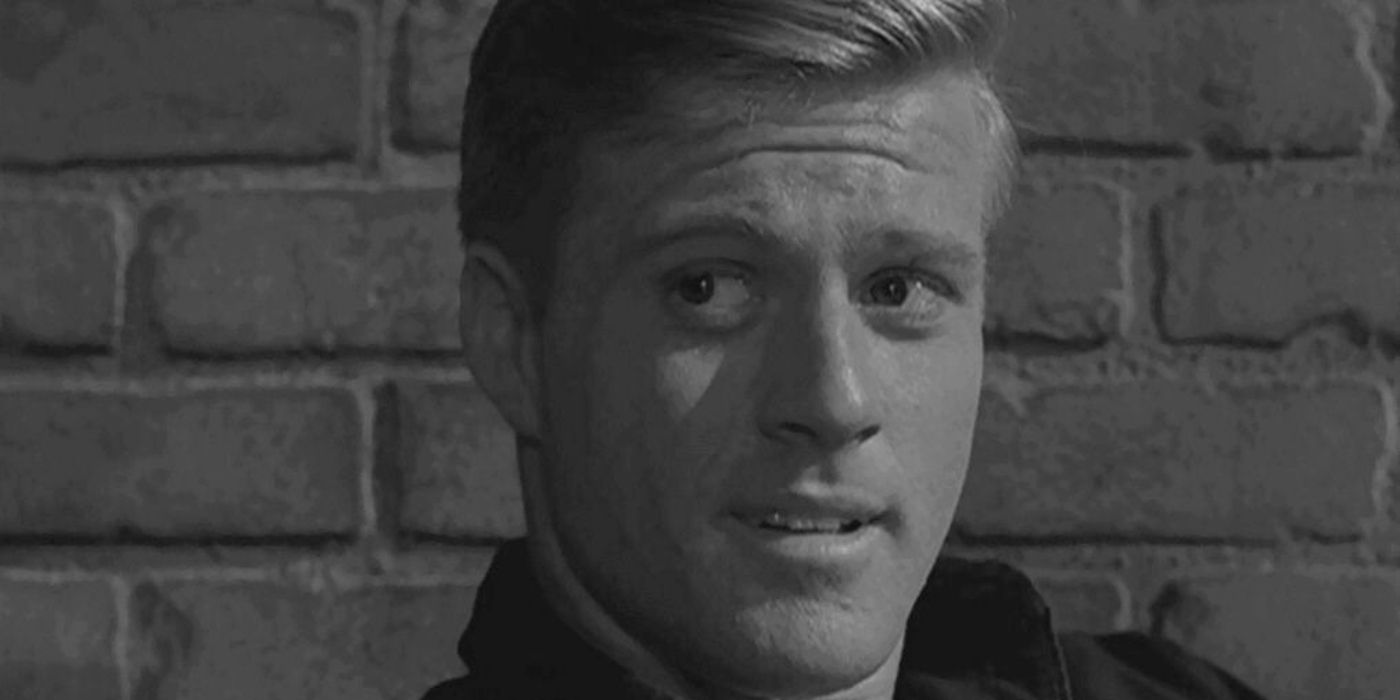
Before he was Sundance. Before he was Gatsby. Before he was the guy who basically invented the modern independent film scene with Sundance, Robert Redford was just a young, blonde actor from Santa Monica trying to find a job that didn't involve a surfboard. It's funny looking back now. You see that iconic face and you think "movie star," but in 1962, he was just another name in the credits of a black-and-white television show. But not just any show. He landed a role in Rod Serling’s The Twilight Zone, specifically an episode titled "Nothing in the Dark." Honestly, if you haven't seen it lately, it holds up better than almost anything else from that era. It’s quiet. It’s claustrophobic. And it features a version of Redford that feels strangely vulnerable before he became the "Golden Boy" of Hollywood.
Why Robert Redford in The Twilight Zone Still Hits Different
Most people remember the twist endings. You know the ones—the broken glasses, the "To Serve Man" cookbook, the talking doll. But the Robert Redford Twilight Zone appearance is different because it isn't trying to trick you with a jump scare or a massive "gotcha" moment. It’s an allegory. Redford plays Harold Beldon, a wounded policeman who collapses on the doorstep of an old woman named Wanda Dunn, played by the incredible Gladys Cooper.
Wanda is terrified. She hasn't left her basement apartment in years because she’s convinced that "Mr. Death" is coming for her. She thinks that if she doesn't touch anyone or let anyone in, she can live forever. Then comes Redford. He's bleeding. He's charming. He's begging for help.
The tension in the episode doesn't come from monsters. It comes from the question of whether this handsome young man is actually a killer, a cop, or something much more metaphysical. It's a masterclass in minimalist acting. Redford doesn't have much to do other than lie on a cot and talk, but you can see the seeds of his future stardom right there. The way he uses his eyes. That slight, lopsided grin. He’s playing a character that is simultaneously comforting and terrifying.
The Casting of a Legend
Rod Serling was known for finding talent right before they exploded. Think about it. William Shatner, Burt Reynolds, Dennis Hopper—they all cycled through the Zone. But Redford brought a specific kind of "all-American" gravity that the show usually lacked. Director Lamont Johnson specifically wanted someone who looked like the picture of health to contrast with the frail, paranoid Wanda Dunn.
At the time, Redford was mostly doing stage work and bit parts in shows like The Untouchables and Route 66. He wasn't "Robert Redford" yet. He was just a guy with great hair and a decent SAG card. But "Nothing in the Dark" changed the trajectory. It showed he could carry a heavy, philosophical narrative without relying on action. The episode was filmed in late 1960 but didn't actually air until January 5, 1962, due to some scheduling shifts at CBS. By the time it hit the airwaves, people were already starting to whisper about this kid from California.
The Twist Everyone Remembers
If you’re worried about spoilers for a sixty-year-old episode of TV, look away. But honestly, the ending is why we’re still talking about the Robert Redford Twilight Zone legacy. After Wanda finally trusts him and lets him into her life, she realizes the truth. Harold Beldon isn't a cop. He isn't a victim of a street shooting.
He is Death.
But he’s not the Grim Reaper with a scythe. He’s not a skeleton. He’s Robert Redford.
"See? No shock. No pain," he tells her. It’s one of the most beautiful lines in the entire series. It recontextualizes the entire concept of the "end" from something to be feared into something that is just another transition. Serling was obsessed with the idea of the afterlife and the "middle ground" between light and shadow. By casting someone as physically striking as Redford, the show made a profound point: death isn't always a monster. Sometimes, it’s a friend.
Behind the Scenes of Nothing in the Dark
The set was tiny. It was basically one room filled with junk and old newspapers. Gladys Cooper, who was a legend of the British stage, reportedly found Redford to be a very "serious" young man. He wasn't there to goof off. He was method before it was cool to be annoying about it.
- Production Date: Filmed in November 1960.
- Episode Number: Season 3, Episode 16.
- Writer: George Clayton Johnson (the guy who wrote Logan's Run and Ocean's Eleven).
- The "Look": The high-contrast cinematography was designed to make Redford look almost angelic, which makes the reveal more impactful.
One thing that often gets lost in the trivia is that George Clayton Johnson didn't originally write the role for a "Redford type." He wanted a more ambiguous figure. But the chemistry between the veteran Cooper and the rookie Redford was so palpable that the producers leaned into the "handsome stranger" trope. It worked. It really worked.
The Impact on Redford's Career
You can trace a direct line from this episode to Redford's later roles. There is a specific kind of quietness he employs here that shows up again in Jeremiah Johnson and The Horse Whisperer. He learned early on that you don't have to shout to be the most interesting person in the room.
Critics at the time were actually surprisingly kind to the episode. Usually, The Twilight Zone was dismissed as "kid stuff" or "pulp fiction" by the high-brow TV critics of the early 60s. But "Nothing in the Dark" was different. It felt like a play. It felt like Beckett or Sartre, but for people in Ohio eating TV dinners.
The episode basically served as Redford's unofficial screen test for Hollywood. Shortly after, he started getting leading man offers. He did Barefoot in the Park on Broadway, then the movie version, and then the world belonged to him. But he never quite shook that "supernatural" calm he displayed in the Zone.
Why This Episode Matters in 2026
We live in an era of CGI and multiverses. Everything is loud. Everything is explained. The Robert Redford Twilight Zone episode is the exact opposite. It’s about two people talking in a dark room about the one thing we all fear: the end.
It’s also a reminder that "Star Power" isn't just about marketing. You can see it in this episode before the PR machines ever got a hold of him. There is an innate charisma that can't be taught. When Redford reaches out his hand to Gladys Cooper at the end of the episode and tells her it's time to go, you actually believe her fear would vanish.
If you're a film student or just a fan of classic TV, this is required viewing. It’s not just about seeing a young celebrity. It’s about seeing a perfect marriage of writing, acting, and theme.
Real-World Takeaways for Fans
If you want to dive deeper into this specific era of television, here is what you should actually do:
- Watch the Remastered Version: Don't watch the grainy YouTube clips. Find the Blu-ray or high-def streaming versions. The lighting in this episode is essential to the story, and you lose the nuance in low resolution.
- Compare with "The Hitch-Hiker": If you want to see how The Twilight Zone handled death differently, watch the episode "The Hitch-Hiker" right after. It’s the darker, more traditional take on the same theme, and it makes the Redford version seem even more radical.
- Read George Clayton Johnson’s Original Script: You can find copies of the script in various Twilight Zone companion books. Notice how much of the "character" was actually Redford's own interpretation versus what was on the page.
- Look for the "Death" Archetype: Notice how many modern movies (like Meet Joe Black) essentially stole the "Death as a handsome man" trope directly from this specific performance.
The episode proves that the best sci-fi and fantasy aren't about the special effects. They are about the human condition. Robert Redford just happened to be the perfect vessel to deliver that message. He played a character who was literally timeless, and in doing so, he made sure his own career would be exactly the same.
To truly appreciate the nuance of 1960s television, you have to look past the black-and-white film. Look at the blocking. Look at the way Redford stays still. Most young actors are twitchy; they want to be noticed. Redford's power was in his stillness. That’s why he’s a legend. That’s why we’re still writing about a twenty-five-minute episode of television sixty years after it aired. It’s not just nostalgia. It’s just damn good storytelling.
Next Steps for Enthusiasts:
- Locate the Episode: Stream "Nothing in the Dark" on Paramount+ or Freevee to see the performance firsthand.
- Research the Writer: Look into the works of George Clayton Johnson, specifically his contributions to Star Trek (the episode "The Man Trap"), to understand the DNA of 1960s speculative fiction.
- Analyze the Cinematography: Pay attention to the use of "chiaroscuro" lighting in the basement scenes, which was a direct influence from German Expressionism brought into American living rooms.
The legacy of Robert Redford in the Twilight Zone isn't just a trivia point. It's the moment the world met a new kind of leading man—one who wasn't afraid to play the ultimate shadow.