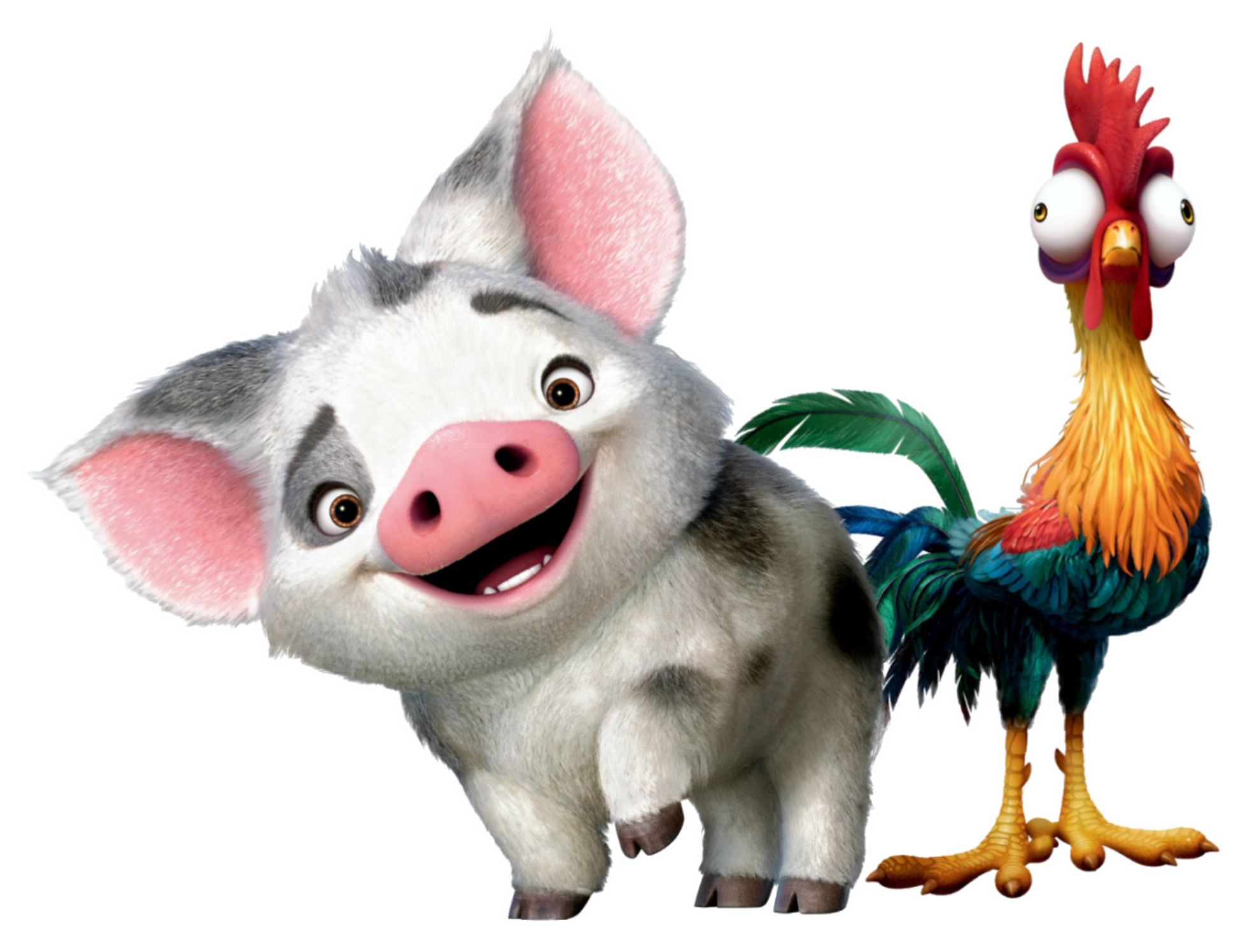
Disney fans are still a little salty about it. You know exactly what I’m talking about. In the 2016 hit Moana, we were introduced to two of the most adorable animal companions in modern animation: Pua, the sweet, loyal pig, and Hei Hei, the... well, let’s just say "intellectually challenged" rooster. But then something weird happened.
The boat left.
Pua stayed on the beach, looking sad. Hei Hei ended up as a stowaway. For years, people have wondered why Disney chose to leave the fan-favorite pig behind while the chicken got to see the world. It wasn't just a random coin toss by the writers. There’s actually a pretty fascinating mix of storytelling mechanics, production hurdles, and cultural context that explains why Pua and Hei Hei had such wildly different journeys.
The Pua Problem: Why the Pig Stayed Home
Honestly, it feels like a betrayal. Pua was marketed as Moana's best friend. He was on the posters. He was the plush toy everyone bought at the Disney Store. So why did he get less than ten minutes of screen time?
The directors, Ron Clements and John Musker, have been pretty open about this over the years. Originally, Pua was supposed to go on the mission. In early drafts of the script, the pig was Moana’s primary companion throughout the entire ocean voyage. But as the story evolved, the writers realized something important: if Moana has a supportive, sweet best friend like Pua on the boat, she isn't really "alone" in her struggle.
To make her journey feel truly difficult, she needed to be isolated.
Leaving Pua behind served a narrative purpose. It represented the safety of the island that she was sacrificing. When Pua gets scared of the water early in the film, it’s a grounded, realistic reaction. It highlights how dangerous the ocean actually is. If Pua had gone, he would have just been another voice of support, and the directors wanted Moana to find her own strength without a cuddly safety net.
Plus, let's be real—pigs are heavy. From a purely logical standpoint, having a full-grown pig on a small voyaging canoe is a logistical nightmare. Hei Hei, on the other hand, is basically a featherweight distraction.
Hei Hei: The Rooster Who Almost Didn't Exist
It’s hard to imagine Moana without the chaotic energy of Hei Hei. However, the version of the rooster we see today—the one voiced by Alan Tudyk—was nearly cut from the film entirely.
Early in production, Hei Hei wasn't a "village idiot" character. He was actually quite smart, a bit cranky, and sort of a watchdog for Moana’s father, Chief Tui. He was designed to be judgmental and a bit of a killjoy. The crew hated it. They felt the character wasn't adding anything unique to the story.
With the deadline looming, the story team had a meeting to decide if they should just delete the bird from the movie. According to the "Making of" documentaries, screenwriter Jared Bush and the animation team took 48 hours to save the character. Their solution?
They dropped his IQ to zero.
By making Hei Hei completely oblivious to his surroundings, he became a "complication" rather than a companion. He wasn't there to help Moana; he was there to be an obstacle she had to keep alive. This created a much-needed layer of physical comedy. It also gave Maui someone to interact with that didn't require complex emotional dialogue.
Cultural Symbolism and the Pacific Islands
There is a deeper reason why Pua and Hei Hei represent more than just comic relief. When the "Disney Story Trust" traveled to the Pacific Islands (including Fiji, Samoa, and Tahiti) to research the culture, they saw how integral these animals were to daily life.
- Pigs (Pua): In many Polynesian cultures, pigs are highly valued assets. They represent wealth, sustenance, and domestic stability.
- Roosters (Hei Hei): Chickens are everywhere in the islands. They are scavengers, survivors, and a constant part of the landscape.
By including both, Disney was trying to ground the fantasy of Motunui in the reality of the Pacific. Using the name "Pua" is also a nod to the word for "flower" or "blossom" in many Polynesian languages, while "Hei Hei" can translate to "disturbance" or "commotion" in Maori—which is frankly the most accurate character description in cinematic history.
The Visual Contrast of Moana’s Companions
The design of these characters is a masterclass in visual storytelling. Pua is all soft curves, large expressive eyes, and "squishability." He embodies the "Aww" factor.
Hei Hei is all sharp angles, bug-eyes, and jerky, unpredictable movements.
This contrast is vital for the pacing of the movie. When the story gets heavy—like when Moana is dealing with the weight of her ancestors' expectations—the movie needs a "break." Hei Hei provides that break by doing something nonsensical, like trying to eat a rock. Pua, being a more emotionally resonant character, would have made those scenes feel too crowded with feelings. Sometimes you just need a chicken to fall off a boat to reset the mood.
The Moana 2 Shift: Will They Finally Reunite?
With the 2024 sequel taking Moana back to the sea, the conversation around Pua and Hei Hei has reignited. Fans have been vocal: we want the pig on the boat.
The trailers for the sequel have already hinted that the dynamic is shifting. Moana is older, more experienced, and has a larger crew this time around. This opens the door for Pua to finally get his sea legs. It’s a smart move by Disney to respond to the "Justice for Pua" sentiment that has existed since 2016.
However, don't expect Hei Hei to change. His role as the resident chaos agent is too valuable to mess with. He remains the ultimate survivor, proving that you don't need to be the smartest person (or bird) in the room to make it across the ocean. You just need to be lucky.
What You Can Learn from the Pua vs. Hei Hei Debate
If you're a storyteller, an artist, or just a hardcore Disney fan, the saga of these two animals offers some pretty practical insights into how big-budget movies are made.
- Kill your darlings: Even if a character (like Pua) is adorable and marketable, you have to leave them behind if they stall the protagonist's growth.
- Pivot when things aren't working: Hei Hei went from a boring "jerk" character to a legendary comedic icon because the team was willing to completely reinvent his personality at the last minute.
- Function over form: Sidekicks aren't just there to look cute; they serve a specific mechanical purpose in the plot—whether that's emotional grounding or slapstick relief.
Next Steps for the Moana Fan
If you want to dive deeper into the world of Motunui, your next move should be to check out the "Voice of the Islands" featurettes on the Blu-ray or Disney+ extras. They go into detail about the "Oceanic Trust," the group of cultural advisors who ensured that everything from the tattoos to the livestock was handled with respect.
Also, keep an eye on the specific animation techniques used for Hei Hei’s eyes; the animators actually had to desynchronize them to make him look as vacant as possible. It’s a tiny detail that makes a world of difference in his performance.
Finally, if you're planning a Moana watch party, remember the golden rule: Pua belongs on the couch for cuddles, but Hei Hei belongs on the screen for the laughs. Just don't let the chicken near the snacks.