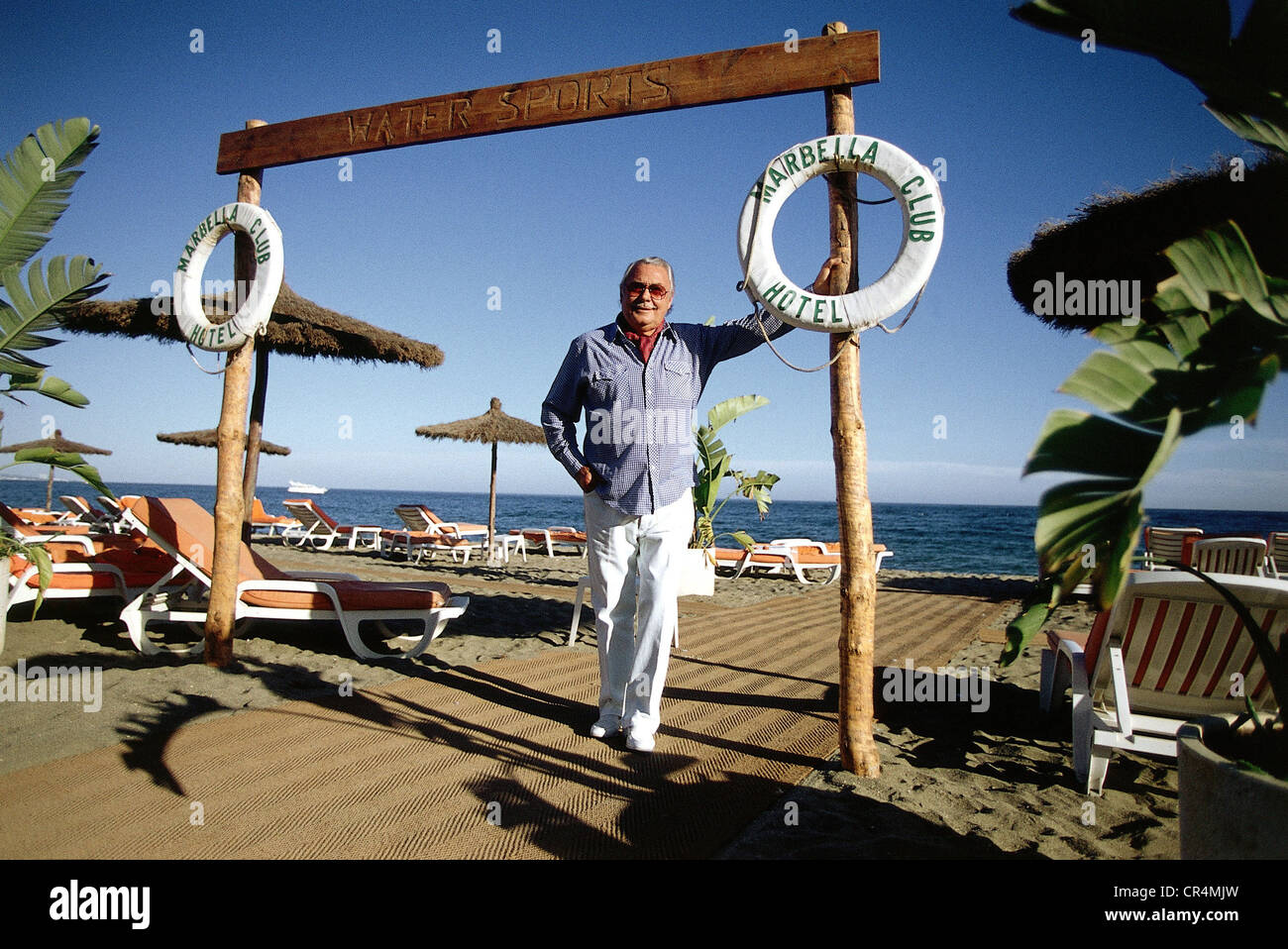
If you’ve ever walked down the Golden Mile in Marbella, you’ve stepped into the dream of one man. It wasn’t a corporate developer or a government planning committee that turned a dusty, malaria-ridden Spanish fishing village into the playground of the global elite. It was Prince Alfonso of Hohenlohe-Langenburg.
He was a prince without a country, a businessman with a restless soul, and honestly, a bit of a risk-taker who didn't mind getting his hands dirty if it meant creating something beautiful. People today see Marbella as this glitzy, sometimes gaudy, hub of super-yachts and designer boutiques. But back in 1946, when Alfonso first rolled into town in a charcoal-burning Rolls-Royce, it was nothing.
Seriously. Nothing.
No electricity in most places. Dirt roads. A few goats. But Alfonso saw the light—that specific, golden Andalusian light—and he saw the potential for a Mediterranean Eden.
Why Prince Alfonso of Hohenlohe-Langenburg Matters Today
Most "influencers" today try to manufacture lifestyle brands out of thin air. Alfonso did it before the internet existed, using nothing but his address book and a relentless sense of hospitality. He didn't just build a hotel; he built a culture of "barefoot elegance."
The Marbella Club, which he opened in 1954, wasn't originally meant to be a commercial juggernaut. It was his private residence, Finca Santa Margarita. He just happened to have so many famous friends—Princes, Hollywood stars, industrial titans—that he eventually had to start charging them for the rooms.
Think about that for a second. The birth of one of the world's most famous luxury destinations happened because a German-Spanish aristocrat had too many houseguests.
He was the bridge between the old world of European royalty and the new world of jet-set celebrity. Without him, the Costa del Sol would likely be just another stretch of high-rise apartments and budget resorts. He insisted on low-slung buildings, lush gardens, and a respect for the landscape that, unfortunately, many later developers ignored.
The Early Years: From Bohemia to Mexico
Alfonso wasn't just a "beach guy." His background was incredibly complex. Born in Madrid in 1924, his godparents were King Alfonso XIII and Queen Victoria Eugenia of Spain. You can't get much more "inner circle" than that. But the Spanish Civil War and World War II made his family's vast estates in Central Europe basically vanish behind the Iron Curtain.
He became a man of the world out of necessity.
He spent time in the United States and Mexico. In fact, he was a pioneer for Volkswagen in Mexico during the 1950s. He had this weird, brilliant mix of aristocratic breeding and a very American "get it done" business sense. He wasn't afraid to sell cars or pitch land deals.
When he bought the initial 18 hectares of land in Marbella for about 150,000 pesetas, his father, Prince Maximilian, thought he was crazy. It was a farm with olive and fig trees. But Alfonso knew that the weather in Marbella was a microclimate—warmer in winter and cooler in summer than the rest of the coast.
The Marbella Club and the "Jet Set" Myth
We use the term "jet set" constantly now, but Alfonso lived it.
The Marbella Club became the center of the universe for a specific type of person. We’re talking about Brigitte Bardot, Guy de Rothschild, Audrey Hepburn, and Gunther Sachs. It was a place where you could be a billionaire or a movie star but still walk around in a simple linen shirt and espadrilles.
He hated the idea of "stuffy" luxury.
Alfonso’s genius was in the informality. He didn't want a Ritz-style palace; he wanted a "motel" (his words) that felt like a private club. He used to say that he wanted to create a place for people who were tired of the formality of the French Riviera.
What People Get Wrong About His Success
A lot of people think he just got lucky because he was a Prince.
That's a huge oversimplification. He was a tireless promoter. He spent decades traveling the world, basically acting as a one-man tourism board for Spain. He’d show up at parties in New York or Paris and spend the whole night telling people they had to come to this little village in Andalusia.
And they came.
By the 1960s and 70s, Marbella was the "it" spot. But Alfonso started to lose control of the vision as the 80s hit. The era of "big money" and massive concrete developments arrived, and it broke his heart a little bit. He eventually sold his shares in the Marbella Club, though he remained its spiritual father until he passed away in 2003.
The Marriage to Ira von Fürstenberg
You can't talk about Alfonso without mentioning his personal life, specifically his marriage to Princess Ira von Fürstenberg.
It was the "wedding of the century" in 1955. She was 15; he was 31. By today's standards, it’s deeply controversial, but in the aristocratic circles of the 1950s, it was a massive media event in Venice that lasted sixteen days. They had two sons, Christoph and Hubertus.
The marriage didn't last—they divorced in 1960—but it cemented his status as a permanent fixture in the global gossip columns. His second marriage to Jocelyn "Jackie" Lane, a British actress, was more stable, lasting many years.
He was always surrounded by beautiful people and high drama. His son, Christoph, died tragically in a Thai prison in 2006, a few years after Alfonso’s death, under circumstances that are still debated by family friends. It’s a reminder that even for a Prince who lived in paradise, life wasn't always a postcard.
Architecture and Environmentalism
Something most people ignore: Alfonso was an early environmentalist, in his own way.
He fought against the "Benidorm-ization" of Marbella. He hated the high-rise buildings that blocked the sea breeze and ruined the skyline. He pushed for "pueblo style" architecture—white walls, terracotta tiles, and lots of bougainvillea.
If you look at the older parts of the Marbella Club or the Puente Romano, you see his thumbprint. It’s intimate. It’s human-scale. He understood that luxury isn't about how high your building is; it's about how much space and greenery you have around you.
He was obsessed with trees. He imported exotic species and made sure every villa was tucked away in a mini-forest. He understood that privacy was the ultimate luxury for the people he was trying to attract.
How to Experience the Alfonso Legacy Today
If you want to actually see what Prince Alfonso of Hohenlohe-Langenburg built, you can't just look at the high-rises of Puerto Banús. You have to go to the source.
1. Visit the Marbella Club Hotel
Don't just go for a room; go to the beach club for lunch. Look at the photos on the walls. It’s a museum of 20th-century glamour. You can still feel that "house party" vibe if you look past the modern amenities.
2. Explore the Golden Mile
Take a walk from the Marbella Club toward the city center. Notice the height of the buildings. The ones that are low and surrounded by old-growth trees are the ones that respect Alfonso’s original vision.
3. Read "The Prince of Marbella"
If you can find a copy, his memoirs (and the books written about him) offer a wild look at a world that doesn't really exist anymore. It’s a world of 48-hour parties and hand-shake land deals.
4. Look at the Gardens
Alfonso’s real gift to the city was the botany. He turned a dry landscape into a lush oasis. Even the public spaces in Marbella often reflect his preference for Mediterranean flora mixed with tropical accents.
Final Insights on a Life Lived Large
Prince Alfonso of Hohenlohe-Langenburg was a man of contradictions. He was an aristocrat who worked as a car salesman. He was a socialite who valued the quiet of a garden. He was a visionary who saw a city where others saw a swamp.
He proved that "place-making" is an art form. It’s not just about building structures; it's about curating a feeling. Marbella exists because one man decided he wanted to live in a specific way and had the charisma to convince the rest of the world to join him.
When he died in 2003, a specific era of European history died with him. But every time someone sits under a palm tree in Marbella with a glass of wine, enjoying that specific microclimate he discovered, his legacy continues.
To truly understand the Costa del Sol, you have to look past the neon signs and see the quiet, elegant bones of the paradise Alfonso tried to build. He wasn't perfect, and he certainly wasn't a saint, but he was exactly the kind of character the 20th century needed to make life a little more interesting.
Actionable Steps for the Modern Traveler
If you're planning a trip to see Alfonso's Marbella, skip the peak season of July and August. Alfonso loved the "shoulder seasons." Go in May or September when the light is at its best and the crowds have thinned. Stay in the smaller, older bungalows of the Marbella Club if you can—they are the closest you'll get to his original Finca Santa Margarita. Finally, take a drive up to Ronda; Alfonso loved the rugged interior of Andalusia just as much as the coast, and it provides the necessary context for why he chose this specific corner of the world.