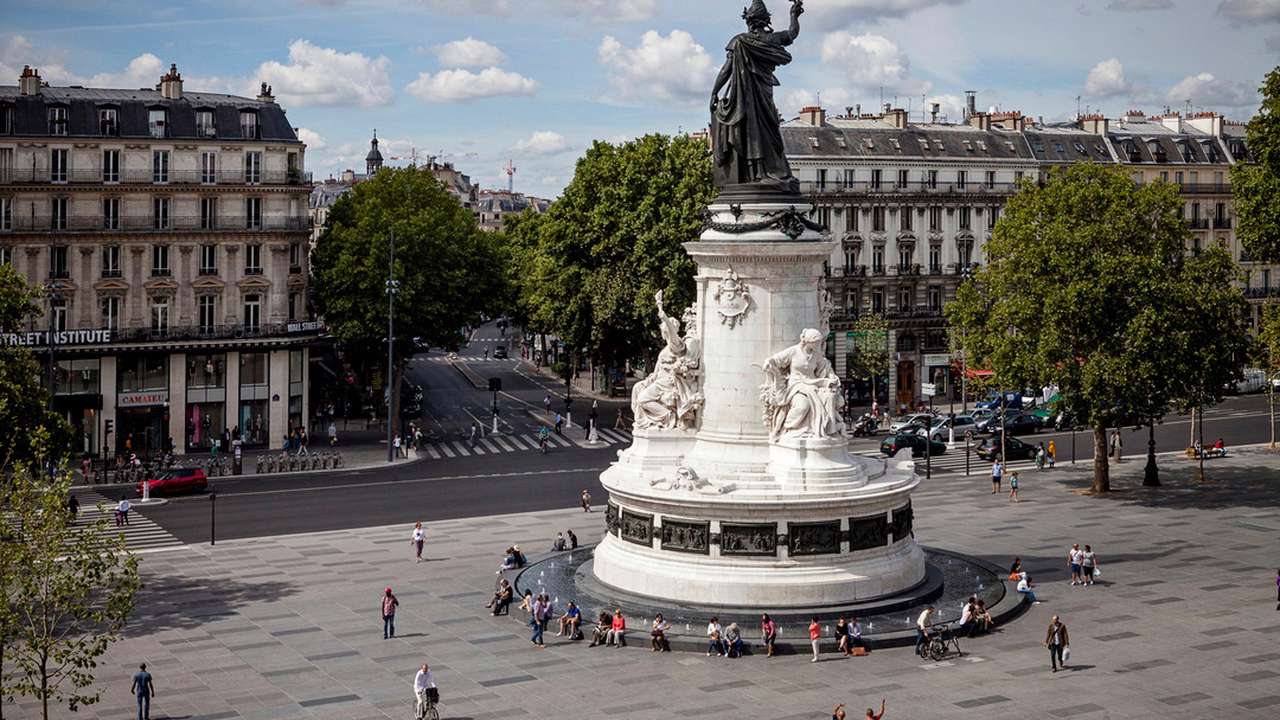
If you want the postcard version of Paris, you go to the Trocadéro. You stand there, dodge a few selfie sticks, and look at the Eiffel Tower. But if you want to see where Paris actually breathes, breathes hard, and sometimes screams, you head to Place de la République. It’s huge. It’s loud. Honestly, it’s kinda messy.
Spanning 3.4 hectares, it’s one of the largest pedestrian spaces in the city, but size isn't the point. This is the lungs of the Right Bank. It’s the border where the 3rd, 10th, and 11th arrondissements collide in a chaotic mix of skateboards, protest banners, and expensive coffee.
Most tourists just pass through the République metro station because it’s a massive transit hub connecting five different lines. Big mistake. If you don't come up for air, you’re missing the literal stage where French democracy performs its daily theater.
The Monument That Sees Everything
Right in the middle stands the Monument à la République. It's a massive bronze statue of Marianne, the personification of the French Republic. She’s holding an olive branch in one hand and the Tablet of the Rights of Man in the other.
She looks calm. The square around her? Not so much.
The pedestal is decorated with three stone statues representing Liberty, Equality, and Fraternity. Since 2015, this base has become a living memorial. Following the tragic attacks at Charlie Hebdo and the Bataclan, the stone was covered in graffiti, candles, and poems. While the city occasionally cleans it, the marks of grief and defiance always seem to find their way back. It’s not just a statue; it’s a bulletin board for the soul of the city.
It Wasn't Always This Open
Before 2013, Place de la République was basically a giant, fumes-choked traffic circle. It was miserable. You had to dodge cars just to get near the monument.
Then the city spent roughly 12 million euros to fix it. Architects TVK (Trévelo & Viger-Kohler) had a vision that was actually pretty controversial at the time. They wanted to kick the cars out. They turned the massive space into a multi-purpose granite plateau.
People complained. They said it would be a "desert of concrete."
They were wrong.
Today, that "concrete desert" is filled with kids on NorthFace-branded skateboards doing kickflips off the benches and parents drinking 5-euro lattes at the "Fluctuat Nec Mergitur" cafe. That name, by the way, is the motto of Paris. It means "tossed by the waves, but does not sink." It’s incredibly fitting for a square that has seen every major social movement in modern French history.
The Architecture of Protest
If something happens in French politics, it happens here first. It’s the starting point (or the ending point) for almost every major manifestation (protest).
Whether it's the Gilets Jaunes, climate strikes, or the Nuit Debout movement in 2016 where people literally camped out for weeks to talk about social reform, Place de la République is the default setting for dissent.
Why? Because the layout is intentional.
The vast, open space allows for massive crowds to gather without being easily trapped by police cordons—though the CRS (riot police) are a permanent fixture in the side streets. If you see several large blue vans parked near the Rue du Faubourg du Temple, don't worry. That’s just Tuesday in Paris.
Where to Actually Eat and Drink Nearby
You shouldn't eat on the square itself, unless you're grabbing a quick kebab. The real magic is in the veins of the streets bleeding out from the center.
- Rue de Lancry: Head here for some of the best independent boutiques and bakeries.
- Canal Saint-Martin: It's a five-minute walk away. Grab a bottle of wine and sit on the edge of the water like everyone else.
- Holybelly: If you want a breakfast that feels like Melbourne but looks like Paris, this is the spot on Rue de la Grange aux Belles.
- The Marais: Walk south down Rue de Turenne and you’re suddenly in the historic Jewish quarter and the heart of the LGBTQ+ district.
The diversity is jarring. You can buy a vintage leather jacket for 200 euros on one street and a bag of roasted corn from a street vendor for 2 euros on the next corner.
The Logistics: Getting There and Staying Safe
The République metro station is a beast. Lines 3, 5, 8, 9, and 11 all meet there.
Pro tip: If you are meeting a friend, do not just say "meet me at the République metro." There are over 10 exits. You will never find each other. Tell them to meet you at the statue of Marianne.
Is it safe? Generally, yes. It's busy 24/7. However, like any major urban hub, pickpockets love the crowds. And honestly, if you see a massive crowd with red flares and loud music, check the news. It’s probably a protest. While usually peaceful, they can get spicy if the police decide it’s time for everyone to go home.
Why You Should Care
We spend so much time looking for "authentic" Paris. Usually, that leads people to overpriced cafes in Saint-Germain-des-Prés where nobody speaks French.
Place de la République is the opposite of that. It’s where the city's youth culture, political fire, and immigrant heart all beat at once. It’s not always pretty. Sometimes there’s trash. Sometimes it’s too loud. But it is never, ever boring.
If you want to understand France, sit on the edge of the fountain for thirty minutes. Watch the old men playing chess near the trees. Watch the teenagers filming TikToks. Look at the flowers fading at the base of the monument.
That’s Paris.
Actionable Insights for Your Visit
- Timing is everything: Visit on a Sunday afternoon to see the square at its most vibrant with families and street performers.
- Check the schedule: Use sites like Cessera or local news to see if a major protest is planned; if you aren't looking for a political experience, avoid those days as the metro stations often close.
- Walk the perimeter: Don't just stay in the center. Explore Rue du Faubourg du Temple for incredible world food and cheap bars.
- Use the "Sortie" maps: Inside the metro station, look for the neighborhood map near the turnstiles to find the exit closest to your specific destination—it will save you ten minutes of walking underground.
- Go to the Cafe: The glass pavilion cafe on the square has free Wi-Fi and clean-ish public restrooms, which are a rarity in this part of town.