If you’re like most of us, your mental image of early America is a blurry montage of black hats, buckled shoes, and turkey dinners. We tend to lump everyone from the 1620s into one big "Colonial" bucket. But if you were to walk into a 17th-century tavern and call a Puritan a Pilgrim, you’d probably get a very long, very stern lecture—or worse. Honestly, the difference between pilgrims and puritans isn't just a matter of semantics. It was a massive theological and social chasm that shaped the very DNA of the United States.
One group wanted to burn the whole system down and start over. The other thought they could fix it from the inside. It’s the classic "reform vs. revolution" debate, just with more wool clothing and significantly higher stakes.
The Separation Anxiety: Why the Pilgrims Left Entirely
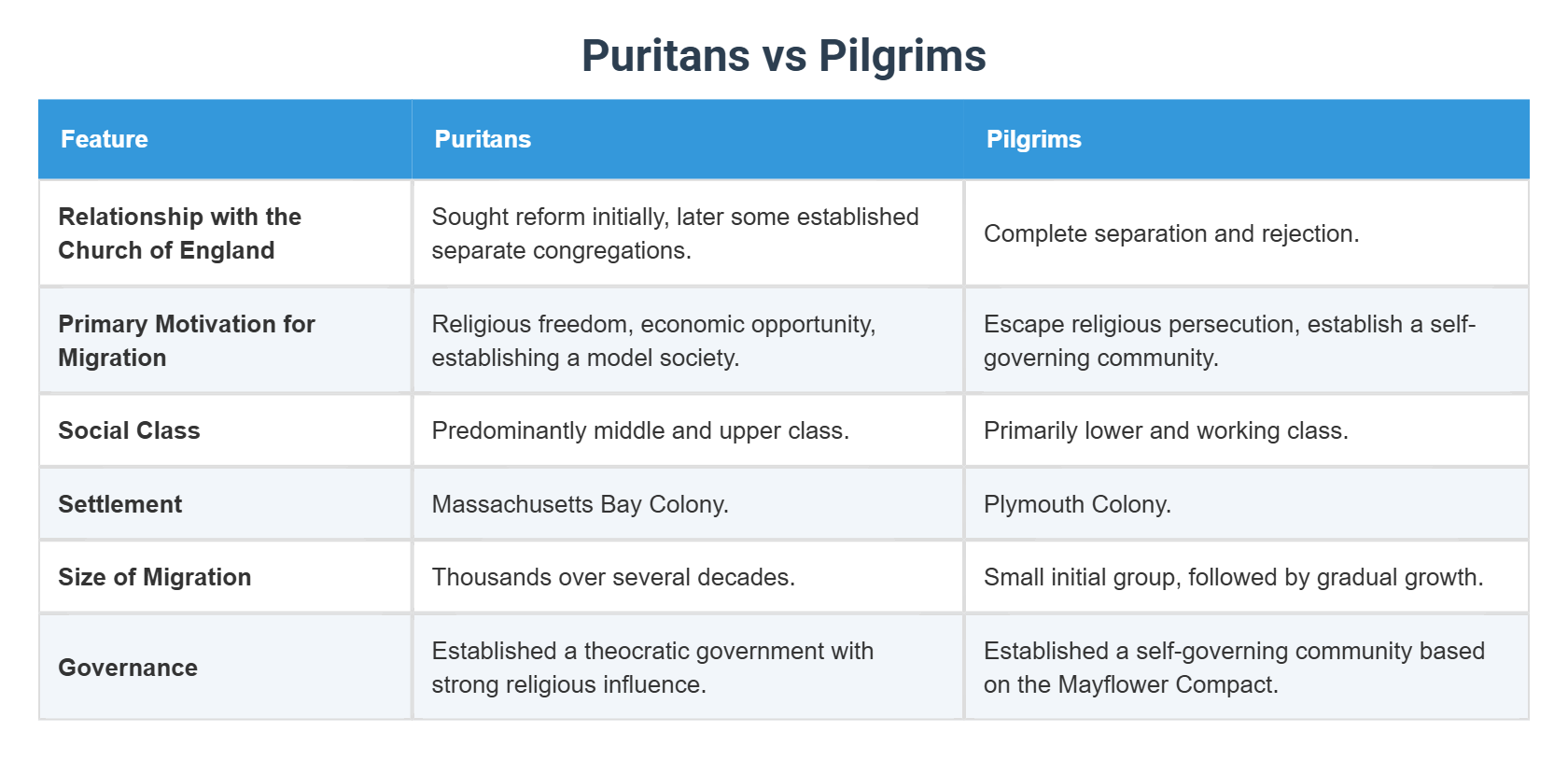
The Pilgrims were the radicals. Plain and simple. To understand them, you have to look at the Church of England in the early 1600s. King James I was in charge, and the church was, for lack of a better term, "Catholic Lite." It had the hierarchy, the rituals, and the fancy robes. The Pilgrims—who technically called themselves "Separatists"—looked at this and decided it was beyond saving. They believed the English Church was so corrupted by "popish" leftovers that any association with it was a sin.
They didn't want to argue. They wanted out.
This was illegal. In 1600s England, the King was the head of the church. Leaving the church was basically treason. That’s why the Pilgrims fled to Holland first. They spent about a decade in Leiden, enjoying the religious freedom but hating the fact that their kids were becoming "too Dutch" and losing their English identity. So, they hopped on the Mayflower. When they landed at Plymouth in 1620, they were a tiny, ragtag group of about 102 people. They were poor, they were desperate, and they were legally "separating" themselves from the only world they knew.
The Puritans: The High-Budget Reformers
Ten years later, the Puritans showed up. This is where the difference between pilgrims and puritans gets visually obvious. While the Pilgrims arrived on one leaky ship (the Mayflower), the Puritans arrived in 1630 with a fleet of 11 ships led by the Arbella. They brought 1,000 people. They brought livestock. They brought money.
Unlike the Pilgrims, Puritans didn't want to leave the Church of England. They wanted to "purify" it. They were the insiders—wealthy, educated, and influential. Their goal was to head to the New England coast, build a "City upon a Hill" (as John Winthrop famously put it), and show the folks back in London how a real godly society should look. They figured once the King saw how well they were doing, he’d realize they were right all along and change the church back home.
Think of it this way: the Pilgrims were the people who quit their corporate job to start a commune in the woods. The Puritans were the middle managers who stayed at the company but tried to rewrite the entire employee handbook from a remote office.
A Massive Difference in Scale and Success
Money talks. It’s a harsh truth, but it’s why the Massachusetts Bay Colony (the Puritans) eventually swallowed the Plymouth Colony (the Pilgrims).
The Pilgrims struggled for years. They nearly starved. Their survival was a fluke of luck and help from local Wampanoag individuals like Tisquantum (Squanto). They remained small and relatively quiet. The Puritans, however, hit the ground running. Because they had professional degrees, wealth, and a massive headcount, they built Boston almost overnight. By 1640, more than 20,000 Puritans had moved to New England in what historians call the Great Migration.
The social vibe was different, too.
- Pilgrims were mostly from the working class—weavers, tailors, and printers.
- Puritans were the elite. We’re talking lawyers, Oxford-educated ministers, and successful merchants.
Theological Nuances: It Wasn't Just About the Hats
You might think they believed the same things because they were both Calvinist. Mostly, you’d be right. Both groups believed in predestination—the idea that God already decided who was going to heaven. Both groups hated Christmas (they thought it was a pagan party with no biblical basis). Both groups lived strictly.
But the difference between pilgrims and puritans really manifested in how they viewed the "covenant." The Pilgrims believed the church was a voluntary group of believers. If you weren't "all in," you weren't part of the church. The Puritans, because they still saw themselves as part of the national Church of England, believed the entire society was bound together. This is why Puritan laws were so much more intrusive. If your neighbor was sinning, it wasn't just their problem—it was a threat to the entire "City upon a Hill" contract with God.
Did They Actually Wear All That Black?
No. Honestly, the "Pilgrim Outfit" is mostly a myth created by Victorian-era painters. While they wore dark colors for formal occasions, their everyday lives were actually quite colorful. Inventories of their estates show they owned red, blue, green, and purple clothing. Dyes were expensive, sure, but they weren't living in a black-and-white movie.
And those buckles? They didn't even come into fashion until much later in the 17th century. The classic "Pilgrim" look you see on Thanksgiving decorations is basically a costume mashup of several different decades that never actually happened at once.
The Long-Term Legacy: Why Does It Matter?
Why should you care about the difference between pilgrims and puritans today? Because these two groups created two different American archetypes.
The Pilgrims gave us the "rugged individualist" and the "outsider" narrative. They were the ones who said, "If I don't like the system, I’ll leave and build my own." That’s a very American sentiment.
The Puritans gave us our sense of "American Exceptionalism" and our obsession with education. Because they believed everyone needed to read the Bible to be saved, they founded Harvard just six years after they arrived. They also gave us the "busybody" streak in American politics—the idea that the government has a moral obligation to ensure the population is behaving "correctly."
Identifying the Differences at a Glance
If you're trying to keep them straight in your head, remember these quick distinctions:
- The Year: Pilgrims (1620) vs. Puritans (1630).
- The Location: Plymouth (Pilgrims) vs. Salem/Boston (Puritans).
- The Goal: Break away (Pilgrims) vs. Fix from within (Puritans).
- The Riches: Poor and humble (Pilgrims) vs. Wealthy and powerful (Puritans).
Eventually, the lines blurred. As the generations passed, the radical Separatism of Plymouth softened, and the "purifying" mission of the Massachusetts Bay Colony became more about local governance than fixing the Church of England. In 1691, the two colonies were officially merged into the Province of Massachusetts Bay. The Puritans basically bought out the Pilgrims.
Move Beyond the Myths
If you want to truly understand this era, stop looking at "Thanksgiving" as the starting point. Thanksgiving was a one-time event that wasn't even called Thanksgiving at the time; it was just a harvest festival.
To get a real handle on the history, you should look into the primary documents. Reading the Mayflower Compact shows you the desperate attempt of the Pilgrims to keep their small group from falling apart. On the flip side, reading John Winthrop’s A Model of Christian Charity reveals the staggering ambition—and the heavy pressure—the Puritans felt to be "perfect" in the eyes of the world.
It wasn't a monolith. It was a messy, high-stakes experiment in how to live. One group chose to hide from the world, and the other chose to try and rule it.
What to Do Next
- Check the Primary Sources: Don't take a textbook's word for it. Read Of Plymouth Plantation by William Bradford. It’s surprisingly readable and gives you the "boots on the ground" perspective of a Pilgrim leader.
- Visit the Real Sites: If you're ever in Massachusetts, skip the "Rock" (which is just a rock) and go to Plimoth Patuxet Museums. They have living history exhibits that show the stark difference between the humble Pilgrim dwellings and the more established Puritan settlements.
- Trace Your Genealogy: Millions of Americans are descended from these two groups. Use a service like American Ancestors (New England Historic Genealogical Society) to see if your family tree starts with a "Separatist" or a "Purifier."
Understanding the difference between pilgrims and puritans changes how you see American history. It moves the story from a quaint fable to a complex reality of religious fervor, economic ambition, and the timeless struggle between staying to fix a broken system or leaving to start a new one.