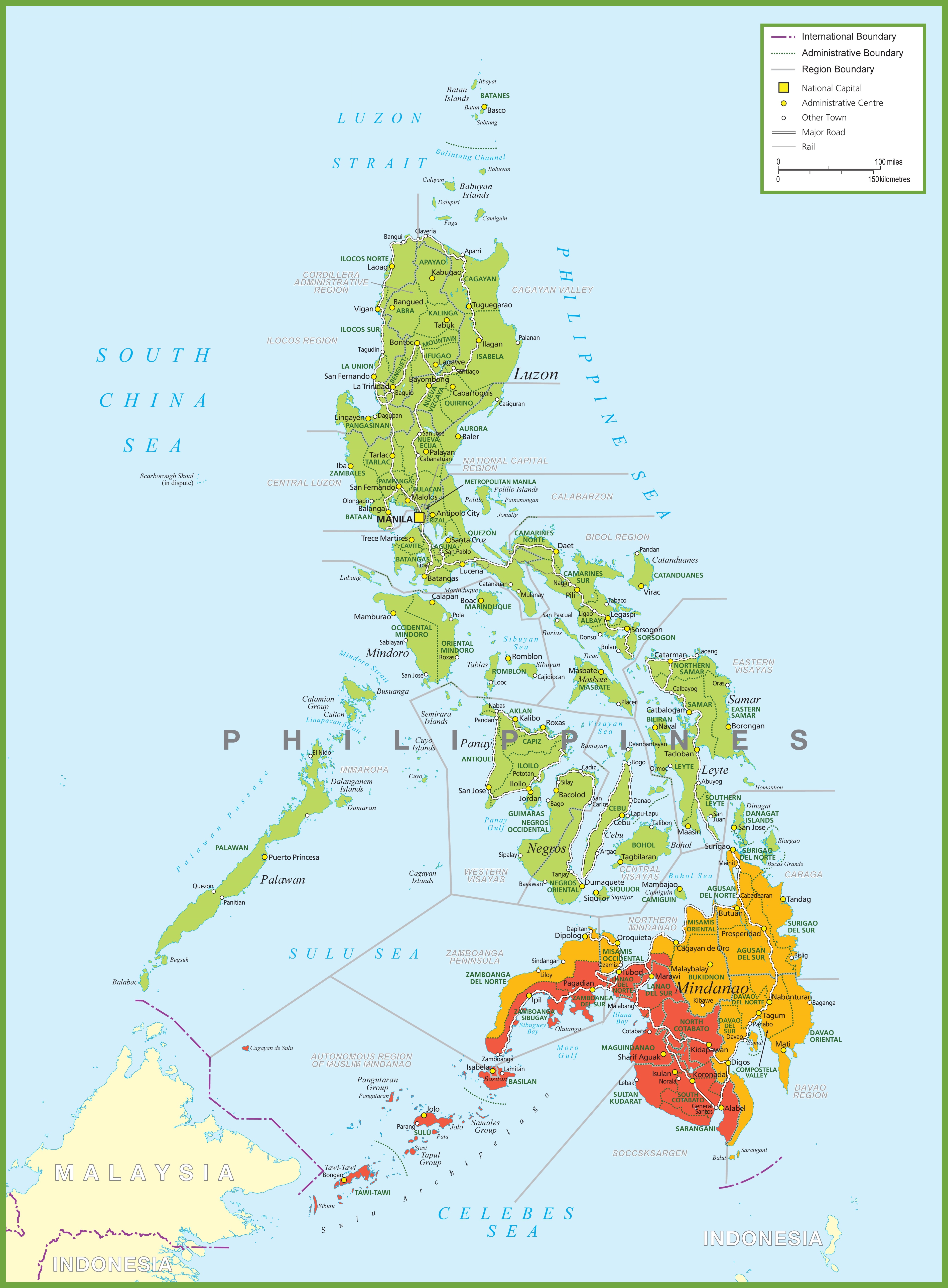
Finding the Philippines in world map is actually pretty easy if you know where to look, but it’s way more than just a cluster of dots in the Pacific. Honestly, most people just see a scattering of islands tucked between the South China Sea and the Philippine Sea. But if you zoom in, you’re looking at one of the most strategically significant spots on the planet.
It’s an archipelago. A massive one.
We’re talking about 7,641 islands. That number actually changed recently—it used to be 7,107—because better satellite tech found more landmasses hiding during low tide. Basically, the country is growing, or at least our ability to count it is.
Where Exactly Is It?
If you're staring at a globe, look at Southeast Asia. Go east of Vietnam and north of Indonesia. You’ll see a shape that looks a bit like a jumping horse or a seahorse, depending on how much coffee you’ve had.
The coordinates are roughly 13°N and 122°E. It’s sitting right on the Pacific Ring of Fire, which sounds cool until you realize it means lots of volcanoes and earthquakes. To the north, you’ve got the Bashi Channel separating it from Taiwan. To the south, the Celebes Sea sits between the Philippines and Indonesia.
It’s the edge of the world, in a way. Beyond the eastern coast, there’s nothing but the vast, deep Philippine Sea until you hit tiny islands like Palau or Guam.
The Big Three: Luzon, Visayas, and Mindanao
The country is split into three main chunks.
- Luzon: This is the big guy in the north. It’s where the capital, Manila, is located. It’s the political and economic heart.
- Visayas: The central cluster. Think white sand beaches, Cebu, and the famous Chocolate Hills in Bohol.
- Mindanao: The massive island in the south. It’s rugged, incredibly fertile, and home to Mount Apo, the highest peak in the country at 2,954 meters.
You’ve probably seen the Philippine flag. Those three stars? They represent these three regions.
Why the Location Matters in 2026
Geopolitics is a messy game, and the Philippines in world map is currently the most valuable piece on the board.
Why? Because of the South China Sea—or as the locals call it, the West Philippine Sea.
Manila is right in the middle of the "First Island Chain." This is a series of archipelagos that major powers use to project (or block) military force. Since the Philippines holds the Luzon Strait, it basically controls one of the most important gateways for global trade. If that strait closes, global shipping gets a massive, expensive headache.
As the ASEAN chair in 2026, the Philippines is currently balancing a tightrope between the U.S. and China. It’s a high-stakes drama. The U.S. is upgrading bases in Palawan—which is that long, skinny island pointing toward the disputed Spratlys—while the Philippine government tries to keep trade lines open with Beijing. It’s a lot of pressure for a country that just wants to enjoy its mangoes.
A Geographical "Galapagos Times Ten"
Biologist Lawrence Heaney once called the Philippines the "Galapagos times ten." That’s not hyperbole.
Because the islands were formed by volcanic activity and tectonic shifts rather than breaking off from the Asian mainland, life evolved here in total isolation. You have the Philippine Eagle, which is so big it eats monkeys. You have the Tarsier, a primate the size of your fist with eyes bigger than its brain.
The marine biodiversity is even crazier. The "Coral Triangle" centers right around here. If you dive in the Verde Island Passage, you’re in the most biodiverse spot in the world's oceans.
The Climate Reality
Being a bunch of islands in the open Pacific comes with a price. Typhoons.
The Sierra Madre mountain range on the eastern side of Luzon acts as a giant shield, soaking up the impact of storms coming in from the Pacific. Without those mountains, Manila would be underwater way more often than it already is.
Climate change is making the "where" of the Philippines even more critical. Rising sea levels aren't just a theory here; they're a daily reality for coastal "barangays" (villages). Some of those 7,641 islands might not be on the map in fifty years if we aren't careful.
Real-World Insights for Travelers and Techies
If you’re looking at the Philippines in world map for a trip, don't try to see it all at once. You can't.
- Connectivity: Manila and Cebu are tech hubs, but once you get into the mountains of northern Luzon or the islands of Palawan, the geography makes internet... let’s say "leisurely."
- Timing: Avoid the "wet" season (June to October) unless you like watching the rain from a hotel window. March to May is the sweet spot.
- The "High Tide" Factor: Remember how the island count changed? If you’re buying a "private island," make sure it doesn't disappear when the moon is full. Seriously.
The Philippines isn't just a destination; it's a physical barrier between the world's biggest ocean and the Asian continent. It's a biodiversity powerhouse. It's a geopolitical flashpoint.
Next Steps for You:
- Check the Season: If you're planning a visit, look up the specific "Amihan" and "Habagat" wind patterns for the month you want to go. It changes which side of the islands has the best beaches.
- Explore via Satellite: Use Google Earth to zoom into the Palawan region. Looking at the sheer number of tiny islets and reefs gives you a much better sense of why mapping this country is such a nightmare for cartographers.
- Monitor the News: Since the Philippines is the 2026 ASEAN Chair, keep an eye on maritime policy updates if you're involved in logistics or international trade. Decisions made in Manila this year will ripple across the entire world map.