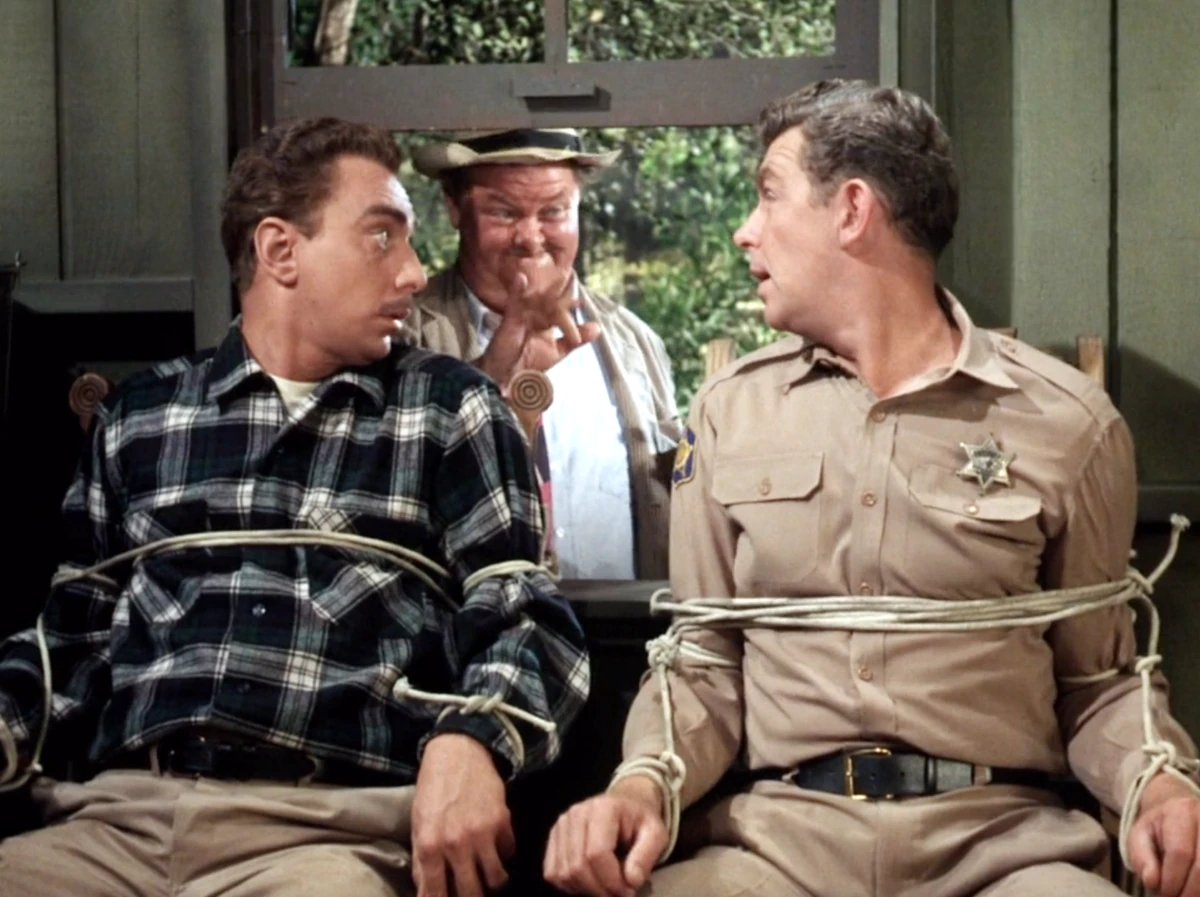
Hal Smith was a teetotaler. That’s the first thing you have to wrap your head around when talking about Otis and Andy of Mayberry. For eight years, Smith played the most famous functional alcoholic in television history, yet in real life, he rarely touched the stuff. He didn't need to. He had this uncanny ability to slur his speech just enough to be funny without being pathetic.
Mayberry was a weird place if you really think about it. It was a utopia, sure, but it was a utopia that had a "town drunk" who literally owned a key to his own jail cell.
Most people remember Otis Campbell as just a gag. He’d stumble into the courthouse, let himself into the cell, and sleep it off while Sheriff Andy Taylor looked on with a mix of pity and amusement. But the relationship between Otis and Andy was actually the moral compass of The Andy Griffith Show. It wasn't just about slapstick or "loaded" jokes. It was about how a community treats its most vulnerable, broken members without stripping them of their dignity.
The Unspoken Deal Between Otis and Andy
Andy Taylor wasn't a typical TV lawman. He didn't carry a gun, and he certainly wasn't interested in "rehabilitating" Otis in the way a modern social worker might. Instead, he practiced what we’d now call harm reduction.
He let Otis be Otis.
There’s a specific nuance to the way Otis and Andy of Mayberry interacted that you just don't see in sitcoms anymore. Andy knew Otis had a problem. He knew Otis had a wife, Rita, who was constantly fed up with him. But Andy also knew that throwing the book at Otis wouldn't fix the bottle. So, he provided a safe harbor. The jail wasn't a place of punishment for Otis; it was a sanctuary.
Honestly, it’s kind of profound.
In the episode "The Rehabilitation of Otis," a psychologist tries to come in and "cure" Otis using modern methods. It fails miserably. Why? Because the psychologist saw Otis as a case study, whereas Andy saw him as a neighbor. Andy’s "justice" was rooted in knowing the man's history, his family, and his heart. When Otis would wander in, "crocked" out of his mind, Andy’s reaction was usually a sigh and a "Well, hello there, Otis." It was acceptance.
Why Hal Smith Was a Genius
You can’t talk about this duo without acknowledging that Hal Smith was a voice-acting legend. If his voice sounds familiar beyond Mayberry, it’s because he was everywhere. He was Owl in Winnie the Pooh. He was various characters in The Flintstones. The man had range.
Playing a drunk is hard. Play it too heavy, and it’s depressing. Play it too light, and it’s fake. Smith hit that sweet spot of "lovable loser" that allowed the audience to laugh with him rather than at him.
He’d do this thing with his eyes—this glazed, wandering look—that made you believe he was seeing a totally different world than the one Andy was standing in. And Griffith? He was the ultimate straight man. Andy Griffith’s acting style was all about the reaction. He didn't need the punchline. He just needed to lean back in his chair, whittle a piece of wood, and look at Otis with that "here we go again" expression.
The Darker Side of the Comedy
Look, we have to be real here. By today's standards, the character of Otis Campbell is problematic. We view substance abuse differently now. We see the tragedy in it.
There were times when the show actually leaned into that. Think about the episode where Otis buys a car. It’s played for laughs, but the underlying tension is real: a man who can’t stay sober trying to navigate a world that requires sobriety. Andy eventually has to step in, not as a cop, but as a friend, to prevent Otis from hurting himself or others.
The show never solved Otis’s problem. He was still drinking in the final seasons. He was still drinking in the 1986 TV movie Return to Mayberry (though he had transitioned to being the town’s ice cream man—a clever nod to his "chilled" nature).
The writers knew that if they "fixed" Otis, they’d lose the tension that made the courthouse scenes work. Mayberry needed a floor, a baseline of human frailty, and Otis was it.
Otis and Andy: Behind the Scenes
The chemistry between Hal Smith and Andy Griffith wasn't accidental. Griffith was notoriously picky about his supporting cast. He wanted people who could improvise or at least handle the "rhythm" of Southern speech.
- Hal Smith was actually one of the most professional actors on set.
- He would show up, do his "drunk" bit perfectly on the first take, and then go home to his quiet life.
- Griffith reportedly loved Smith because he never "competed" for the spotlight; he just filled the space he was given.
There’s a famous story about the "suit of armor" episode. Otis gets drunk and winds up inside a decorative suit of armor. The physical comedy required Smith to be clunky and awkward while Griffith had to play it completely straight. It’s one of the highest-rated segments of the series because it perfectly encapsulates the dynamic: Otis creates the chaos, and Andy manages it.
The Departure of Otis
Eventually, the character of Otis was phased out. By the time the show transitioned to color and later became Mayberry R.F.D., the "town drunk" trope was starting to lose its luster with sponsors.
The temperance movement and groups concerned about the depiction of alcohol on TV began to put pressure on networks. It’s a shame, really. When Otis left, the show lost a bit of its soul. It became a little too polished, a little too "perfect."
Without Otis stumbling into that cell, Andy didn't have as many opportunities to show his grace. The jail became an office rather than a community center.
The Legacy of the Mayberry Jail
If you visit Mount Airy, North Carolina today—the real-life inspiration for Mayberry—you’ll find a replica of the courthouse. And what’s the first thing people want to see?
The cells.
They want to sit where Otis sat. They want to see the key hanging on the wall.
It’s a testament to the writing and the performances of Otis and Andy of Mayberry that a character defined by a vice became one of the most beloved figures in American fiction. We don't love Otis because he drank; we love him because Andy loved him despite it.
That’s the "secret sauce" of the show. It wasn't about a perfect town. It was about a town that knew how to live with imperfection.
What You Can Learn from Otis and Andy
If you’re a fan of classic TV, or just someone interested in the history of storytelling, there are a few "Otis-isms" worth remembering.
First, character depth doesn't always come from a "redemption arc." Sometimes, it comes from consistency. Otis was the same man in Episode 1 as he was in his final appearance. That consistency provided a bedrock for the show’s humor.
Second, the "straight man" is just as important as the comic. Andy Griffith’s restraint allowed Hal Smith to shine. If Andy had been a "wacky" sheriff, the show would have been a cartoon. Because Andy was grounded, Otis felt real.
Lastly, look at the way the show handled the "key" to the cell. It was a symbol of trust. Andy trusted Otis to jail himself. It’s a bizarre concept, but it speaks to a level of mutual respect that is rare in modern television.
Final Takeaways for Mayberry Fans
- Watch the eyes. In your next rewatch, pay attention to Hal Smith’s eyes. The way he avoids eye contact with Andy when he’s "guilty" is a masterclass in physical acting.
- Notice the silence. Some of the best Otis and Andy moments have no dialogue. It’s just Andy watching Otis hang up his coat and lie down.
- Check out the spin-offs. Hal Smith reprised the role in various formats, but nothing ever matched the original black-and-white chemistry he had with Griffith.
The relationship between Otis and Andy serves as a reminder that community isn't about fixing everyone. Sometimes, it’s just about making sure they have a warm place to sleep and a friend who doesn't judge them when they wake up. That’s the true spirit of Mayberry. It’s why we’re still talking about a fictional drunk and a small-town sheriff sixty years later.
To truly appreciate the craft, go back and watch "Otis the Artist" or "The Deputy." You'll see that while Otis was the one in the cell, the show was really about the man standing outside the bars, holding the door open.
To dive deeper into the history of Mayberry, start by tracking the episode transitions from the early black-and-white seasons to the later color years. You'll notice a distinct shift in how Otis is handled, moving from a central comedic figure to a more peripheral character as TV censorship standards changed in the mid-1960s. For a truly authentic experience, look for the unedited versions of the episodes, which often contain small character beats between Andy and Otis that were cut for time in modern syndication.