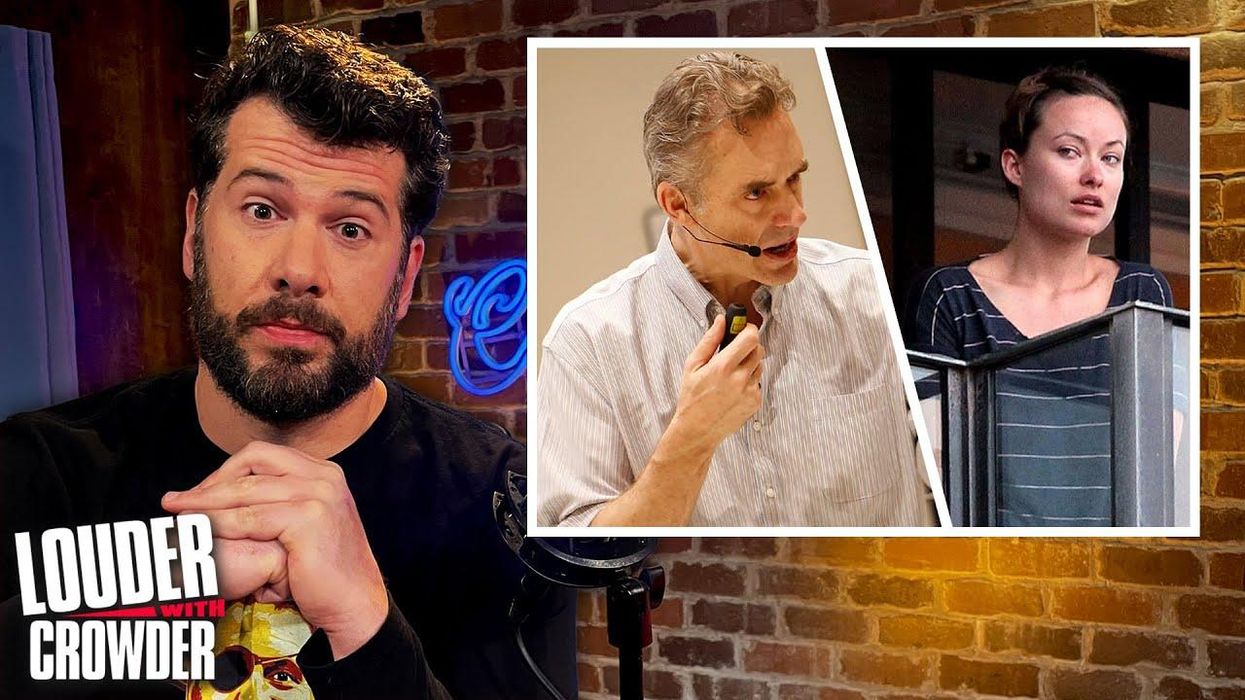
It was the "spit-gate" heard 'round the world, but while everyone was busy squinting at slow-motion footage of Harry Styles and Chris Pine at the Venice Film Festival, a much weirder, more ideological feud was brewing in the background. If you were online in late 2022, you probably remember the headlines. Olivia Wilde, the director of the stylish but polarizing thriller Don't Worry Darling, went on the record calling Canadian psychologist Jordan Peterson an "insane man."
She didn't stop there.
Wilde told Interview Magazine that the film's primary antagonist, Frank—a charismatic, cult-like leader played by Chris Pine—was directly modeled after Peterson. She described him as a "pseudo-intellectual hero to the incel community."
Naturally, the internet did what it does best: it exploded.
The Inspiration Behind the Victory Project
To understand why this hit such a nerve, you have to look at what Wilde was trying to do with her movie. Don't Worry Darling is basically a "feminist thriller" about a 1950s utopia called Victory. Everything looks perfect, but (shocker) it’s actually a simulation designed to keep women trapped in domestic bliss while their real-world, "incel" boyfriends keep them there against their will.
Wilde basically spent her entire press tour framing the movie as a critique of a specific kind of modern masculinity. She told Maggie Gyllenhaal that she did a deep dive into the "disenfranchised world of white men on the internet," specifically citing 4chan and the "incel" subculture.
According to Wilde, Peterson is the guy who "legitimizes" these men. She argued that because he’s a former professor who wears a suit, he gives a "real philosophy" to a group of men she described as believing they are "entitled to sex from women."
It was a bold move. Honestly, it was a move that felt designed for the 2022 zeitgeist. But it also backfired in a way that Wilde probably didn't anticipate.
Jordan Peterson’s Emotional Response
Most celebrities or public figures ignore this kind of thing. Or they send a snarky tweet. Jordan Peterson, being Jordan Peterson, went on Piers Morgan Uncensored and literally cried.
It was a surreal moment of television. When Morgan asked if he was indeed the "hero to the incel community," Peterson didn't get angry. He got emotional.
"Sure, why not?" he said, his voice cracking. "I thought the marginalized were supposed to have a voice."
He went on to defend the men Wilde was criticizing, calling them "lonesome" and "alienated." He argued that "everyone piles abuse on them" and that he was simply trying to provide an "encouraging word" to people who were "dying" for it.
The reaction to this was split right down the middle. One half of the internet saw a man showing genuine empathy for a demographic that society has largely written off. The other half saw a "pseudo-intellectual" playing the victim to distract from the more toxic elements of his fanbase.
Interestingly, Peterson also poked fun at the situation. He quipped that if he had to be played by someone, Chris Pine was "a very good-looking man." He even joked that he hoped Pine got his "fashion style choice right."
What the Movie Actually Got Wrong
Here’s the thing: if you actually watch Don't Worry Darling, the connection to the real Jordan Peterson is... kinda thin.
Chris Pine’s character, Frank, is a sleek, controlling mastermind who uses a smooth, hypnotic voice to convince men to join his simulation. He’s a cult leader. He’s calm. He’s calculated.
If you've ever watched a Peterson lecture, he’s usually the opposite of that. He’s intense, he’s frequently agitated, and his advice is usually about "cleaning your room" and "taking responsibility," not building a secret 1950s Matrix to enslave women.
A lot of critics—even those who don't like Peterson—pointed out that Wilde’s critique felt a bit shallow. It felt like she had taken a complex, controversial figure and flattened him into a 2D movie villain to make her film feel more "relevant."
As UnHerd pointed out at the time, Wilde’s description of the incel community as "mostly white" was also factually questionable based on internal surveys of those communities. It suggested that she might have been fighting a version of Peterson that exists in the media, rather than the man himself.
The Long-Term Fallout
So, who won?
Well, the movie did okay, but it didn't exactly set the world on fire. It’s mostly remembered now for the drama surrounding its production—the Shia LaBeouf firing (or quitting), the alleged feud between Wilde and Florence Pugh, and, of course, the Jordan Peterson connection.
Peterson, meanwhile, continues to be Peterson. He’s since launched his own "Peterson Academy" and continues to sell out venues worldwide. If anything, Wilde’s comments probably just galvanized his base. People who already loved him saw it as more "woke Hollywood" bullying; people who already hated him saw it as a necessary call-out.
Lessons from the Wilde-Peterson Feud
If there's any real takeaway from this whole messy saga, it's about the danger of using "straw man" versions of your opponents in art.
- Nuance matters. When you try to turn a real-life figure into a movie villain, you often lose the very things that make them influential in the first place.
- Context is king. Peterson’s defense of "incels" was focused on mental health and alienation, while Wilde’s critique was focused on misogyny and entitlement. They weren't even having the same conversation.
- Controversy sells, but it doesn't always help. The drama certainly got people talking about Don't Worry Darling, but it also overshadowed the actual film.
If you’re interested in how this cultural divide continues to shape entertainment, the best thing you can do is look at the sources yourself. Watch a Peterson lecture, then watch the movie. You'll likely find that the reality is much more complicated—and a lot less "perfect"—than either side wants to admit.
Take a look at the "Rule 1" of Peterson's 12 Rules for Life and compare it to Frank’s monologues in the film. You’ll see exactly where the inspiration starts and where the Hollywood dramatization takes over.