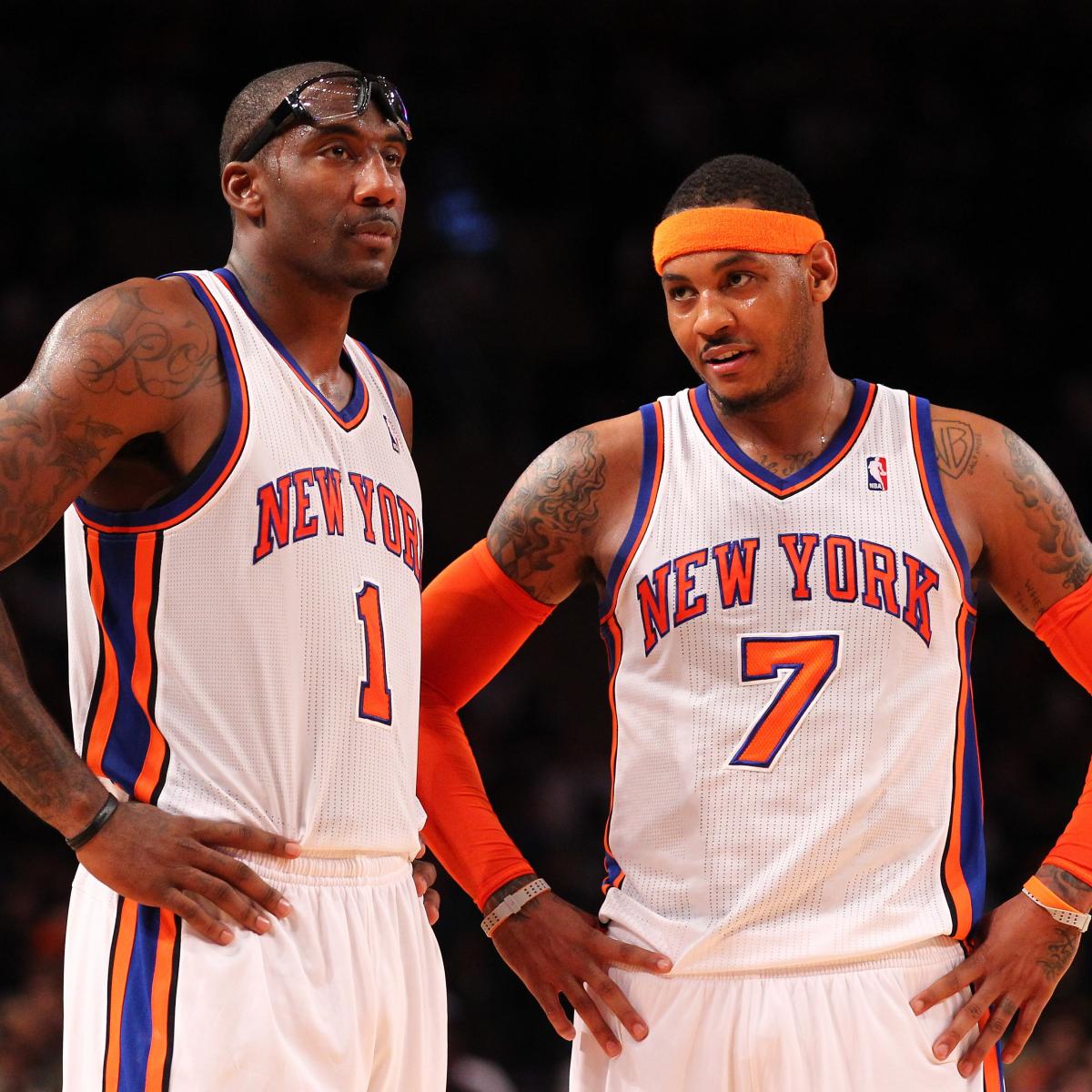
The 2014-15 season was supposed to be the start of something special. Phil Jackson, the "Zen Master" himself, had just arrived with his eleven championship rings to save the franchise. He hired Derek Fisher—fresh off his playing career—to install the legendary Triangle Offense. Honestly, looking back at that NY Knicks roster 2014, it felt like a weird fever dream. You had Carmelo Anthony at the peak of his powers, a bunch of leftovers from the 54-win team two years prior, and a handful of new faces that most fans had to Google.
It didn't go well. That’s an understatement. The team finished 17-65. It was, at the time, the worst season in the history of the New York Knicks.
The Names You Remember (And the Ones You Forgot)
Basically, the roster was a transition project that got stuck in the mud. Carmelo Anthony was the undisputed sun that everything orbited around. He averaged 24.2 points in 40 games before a knee injury finally ended his season in February. But who was actually playing next to him?
You had Amar'e Stoudemire, who was in the final year of that massive contract. His knees were essentially held together by hope and sports science at that point, yet he still managed to give the team some scoring punch before being bought out in February to join a contender. Then there was the trade that started it all: the Tyson Chandler deal. Phil shipped Chandler and Raymond Felton to Dallas for a package that defined the early part of the season.
- Jose Calderon: The veteran point guard who was supposed to run the Triangle.
- Samuel Dalembert: A center who was unfortunately way past his prime.
- Shane Larkin: A young, speedy guard who never quite found his footing in NYC.
- Iman Shumpert and J.R. Smith: The "dynamic" duo that was eventually shipped to Cleveland in a mid-season fire sale.
Why the NY Knicks Roster 2014 Failed So Fast
There’s this idea that the Triangle Offense is some magical system, but you need very specific players to make it work. The Knicks didn't have them. They had guys like Jason Smith and Quincy Acy—solid role players, sure, but not the versatile playmakers required for a complex read-and-react system.
The defense was even worse. When you trade away a Defensive Player of the Year like Tyson Chandler and replace him with Dalembert and a rotating door of young bigs, you’re going to give up points. They were 28th in the league in defensive rating. It was painful to watch.
Then came January.
Phil Jackson basically hit the "reset" button. He traded J.R. Smith and Iman Shumpert to the Cavaliers for basically nothing—a move that still stings for some fans considering those two went on to help LeBron James win a title. Suddenly, the NY Knicks roster 2014 was filled with 10-day contract guys.
The Rise of Langston Galloway
If there was one bright spot in that 17-win disaster, it was Langston Galloway. He was an undrafted guard from the Westchester Knicks (their G-League affiliate) who came in and played with more heart than half the veterans. He ended up making the All-Rookie Second Team. It was the kind of "started from the bottom" story that New York fans live for, even when the team is losing by 20 every night.
He wasn't the only one. You had guys like Lance Thomas and Lou Amundson joining the squad mid-season. They weren't stars, but they played hard. They became the "Junkyard Dogs" of a team that was clearly tanking for a high draft pick.
A Roster in Constant Flux
To understand the chaos, you just have to look at the transactions log. It’s a mile long. Phil Jackson was moving players like chess pieces, trying to clear cap space for a future that seemed perpetually two years away. Andrea Bargnani was still there, mostly injured or taking ill-advised threes. Tim Hardaway Jr. was a young spark plug, but he was inconsistent and eventually traded to Atlanta (before coming back later, because that’s just what the Knicks do).
By the end of the year, the starting lineup was unrecognizable compared to opening night.
- The Opening Night Hope: Calderon, Shumpert, Anthony, Stoudemire, Dalembert.
- The Mid-Season Gridded: Galloway, Hardaway Jr., Thomas, Amundson, Bargnani.
It was a total teardown. People forget that the 2014 roster was essentially a sacrificial lamb. Phil Jackson wanted to erase the previous era entirely. He wanted his own guys, his own culture, and his own draft picks.
The Silver Lining: Kristaps Porzingis
You can't talk about the 2014-15 roster without talking about what it led to. Because the team was so historically bad, they ended up with the 4th pick in the 2015 NBA Draft. That pick became Kristaps Porzingis. For a few years, it felt like the misery of 2014 was worth it. The "Unicorn" era gave fans hope that hadn't existed in the Garden for a decade.
Of course, we know how that ended too, but in the context of the NY Knicks roster 2014, the goal was achieved: they bottomed out and got a star.
Actionable Insights for Fans and Historians
If you’re looking back at this era to understand the modern Knicks, there are a few things to keep in mind. First, stability matters. The constant turnover of the 2014 roster is a "what not to do" manual for NBA front offices. Second, don't ignore the G-League. Finding a guy like Langston Galloway proved that there is talent hiding in plain sight if you actually scout it.
- Study the Triangle: If you want to see why it failed, watch tape of Jose Calderon trying to force entries into the post while the defense sagged off.
- Cap Management: That 2014 season was a masterclass in clearing bad contracts, even if it meant losing games on purpose.
- Perspective: Remember that even the worst seasons usually lead to the draft picks that define the next decade.
The 2014 Knicks weren't a good basketball team. They were a collection of veterans on their way out and young guys trying to prove they belonged in the league. But for those of us who sat through all 65 losses, they’re a reminder of how far the franchise has come since the days of Lou Amundson’s ponytail and Phil Jackson’s cryptic tweets.
Check the current Knicks rotation to see how different things look when you actually have a cohesive plan and a front office that isn't obsessed with an outdated offensive system. The lessons of 2014 were learned the hard way.