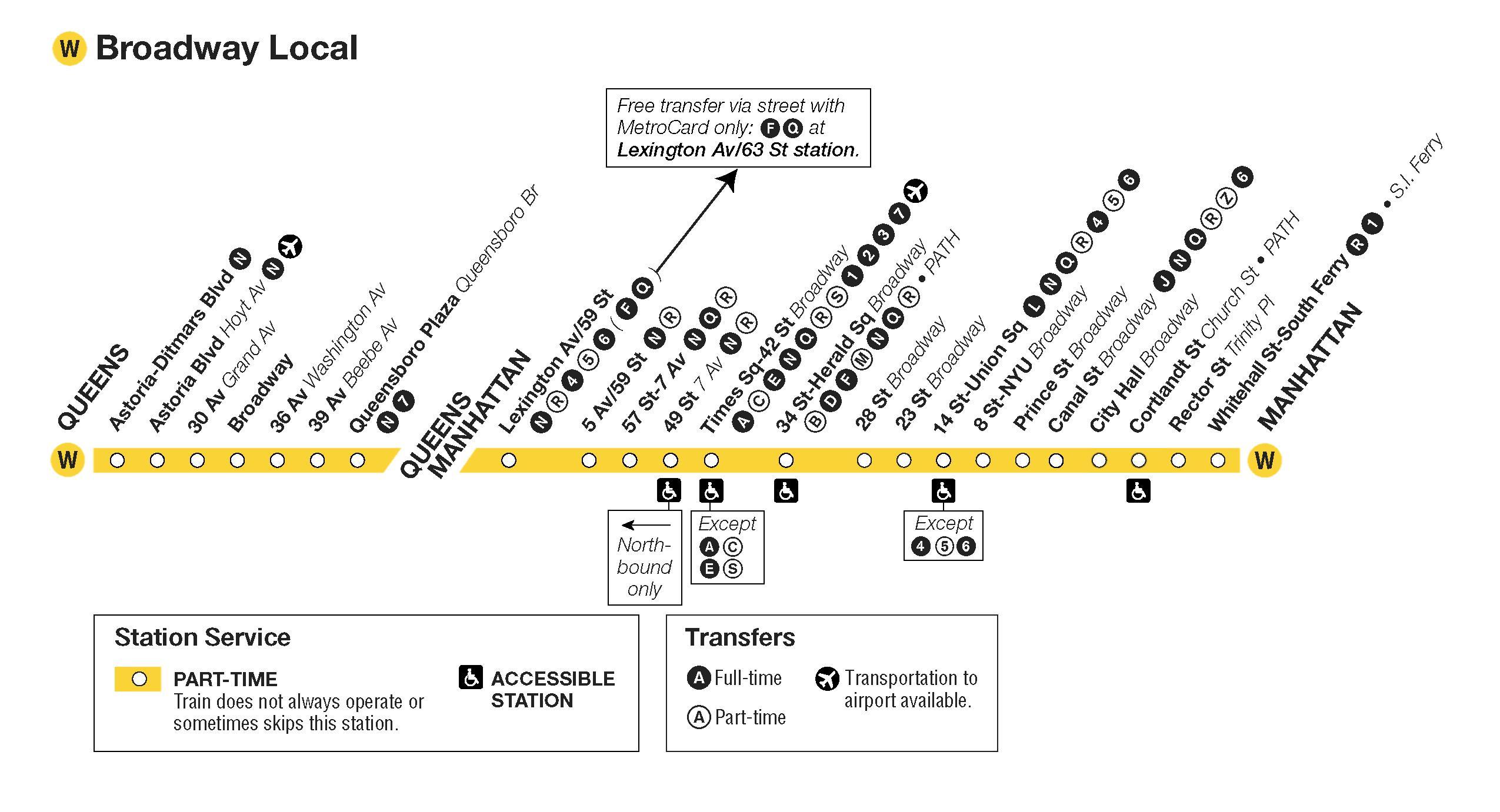
You're standing on a platform in Astoria, looking at the Manhattan skyline across the East River. The wind kicks up. Suddenly, a screeching sound echoes from the elevated tracks. It’s the N train. Most people call it the "Yellow Line," but that’s technically the BMT Broadway Line for the history buffs. If you've lived in New York long enough, you know the mta n train stops like the back of your hand, but for everyone else, this route is a chaotic, 45-stop journey that spans three boroughs and feels like three different railroads stitched together.
It starts at Ditmars Boulevard. It ends at Stillwell Avenue. In between? Pure New York.
The N is weird. Honestly, it’s one of the few lines that manages to be both an elevated scenic tour and a subterranean slog. One minute you’re looking at the graffiti on Queens rooftops, and the next, you’re plunged into the dark under 60th Street, headed for the luxury madness of Fifth Avenue. It's a lifeline for commuters, a tourist trap for those headed to Coney Island, and a frequent victim of the "weekend service changes" that make us all want to scream.
Why the Astoria Section is Iconic
Queens is where the N begins its life. The stops here—Ditmars Blvd, Astoria Blvd, 30th Av, Broadway, 36th Av, and 39th Av—are all elevated. You get that classic "movie version" of NYC where the train rattles right past people’s bedroom windows.
Astoria has changed. A lot. It used to be the Greek heart of the city, and while you can still find the best grilled octopus on the planet near the 31st Street stops, it’s now a hub for young professionals who can’t afford North Brooklyn anymore. The Astoria Blvd stop is a major one because it provides that crucial connection to the M60-SBS bus to LaGuardia Airport. If you’re trying to catch a flight and the N is lagging, you’re going to have a bad time.
Then the train dives. It’s a literal descent into the madness of Manhattan.
Navigating the Manhattan Gauntlet
Once the N crosses the 60th Street Tunnel, everything changes. The light disappears. The noise gets trapped. The mta n train stops in Manhattan are built for speed and volume. Lex-59th is the first big test. It’s a maze. You have people sprinting to catch the 4, 5, or 6, and the platform is often so crowded it feels like a safety hazard.
You’ve got the heavy hitters after that.
- 5th Avenue-59th Street (right by Central Park and the Apple Store).
- 57th Street-7th Avenue.
- 42nd Street-Times Square (the station that never sleeps and always smells like roasted nuts and regret).
Times Square is where the N becomes an express train during weekdays. This is a huge point of confusion. Newbies see the yellow circle and jump on, not realizing that on weekdays, the N skips a bunch of stops that the R or W might hit. If you’re trying to get to 28th Street or 8th Street-NYU, and you're on the N during rush hour, you’re going to fly right past your destination. You'll end up at 14th Street-Union Square looking confused. Don't be that person. Check the overhead signs.
The Canal Street Transition
Canal Street is the pivot point. It is perhaps the most confusing station in the entire MTA system. The N train stops here, but it shares space with the Q, R, and W, and the physical layout of the station is split across different levels and even different "sides" of the tracks.
If the N is running via the Manhattan Bridge, it’s a beautiful ride. You get that sweep of the harbor and the Brooklyn Bridge. If it’s running via the Montague Street Tunnel (usually late nights or during construction), you’re stuck in a dark tube for what feels like an eternity. Most regular commuters prefer the bridge. The cell service is better, and the view of the DUMBO waterfront is a nice mental break before the Brooklyn grind begins.
DeKalb Avenue and the Brooklyn "Merge"
Once you hit Brooklyn, the N stops are a different beast. DeKalb Avenue is the bottleneck of the entire New York City subway system. Seriously. It’s where the lines from the bridge and the tunnel all try to squeeze into the same few tracks. If your N train is "held momentarily by the train dispatcher," it’s almost certainly happening at DeKalb.
From there, the N heads toward Atlantic Av-Barclays Ctr. This is the ultimate hub. You’ve got the Long Island Rail Road (LIRR), the 2, 3, 4, 5, B, D, Q, and R. If you can’t get where you’re going from here, you’re probably lost in the wrong city.
The Long Road to Coney Island: South Brooklyn
The N train’s identity in South Brooklyn is defined by the Sea Beach Line. After it leaves the 4th Avenue corridor at 36th Street and 59th Street (Brooklyn, not Manhattan!), it strikes out on its own.
The stations here feel different. 8th Avenue, Fort Hamilton Parkway, New Utrecht Ave... they look like they haven’t been touched since the 1950s. Many of them are "open-cut" stations, meaning they are below street level but open to the sky. It’s quieter here. The pace slows down. You start seeing more families, more grocery bags, and fewer frantic tourists.
The New Utrecht Ave stop is a big one because it connects to the D train at 62nd Street. It’s a vertical transfer—you climb a bunch of stairs to get from the "trench" of the N to the "sky" of the D.
Then comes the end of the line: Coney Island-Stillwell Avenue.
This is one of the largest elevated terminals in the world. It’s a cathedral of glass and steel. When you step off the N here, you can smell the salt air and the Nathan’s Hot Dogs. You’re at the end of the world, or at least the end of the line. It’s a 45-minute to hour-long ride from Midtown, but on a hot July day, that N train ride is the bridge to the beach.
The "Late Night" Headache
Service changes. We have to talk about them.
The MTA loves to mess with the N train on weekends. Sometimes it runs on the D line. Sometimes it ends at 59th Street. Sometimes it skips Manhattan entirely and goes over the bridge like a Q. If you are looking at mta n train stops on a Saturday night, the official map is basically a lie.
Always, always check the MYmta app or the "Weekender" posters. The N is notorious for "Fastrack" repairs because the Astoria elevated structure and the Sea Beach open-cuts require constant maintenance.
Pro-Tips for the N Train Commuter
If you're going to survive this line, you need a strategy.
First, know your car. If you’re transferring at Union Square, stand at the north end of the platform at your starting stop. If you’re heading to the LIRR at Atlantic Avenue, the middle of the train is usually your best bet for the stairs.
Second, the N is an "N-type" or "R160" or "R211" car usually. The newer R211s have the digital maps that actually update in real-time. If you see one of those, get on it. The old R46 cars (the ones with the faux-wood grain interiors) are being phased out, but they still pop up. They’re nostalgic, sure, but the PA systems are usually broken, and you’ll have no idea what the conductor is mumbling about a "sick passenger at Prince Street."
Third, watch the express/local toggle. In Brooklyn, the N runs express on 4th Avenue during the day but goes local at night. If you’re trying to get to 45th Street or 53rd Street in Sunset Park, make sure the train you’re on is actually stopping there. On weekdays, the N will blow right past you and leave you stranded at 59th Street.
Actionable Steps for Your Next Trip
Before you swipe (or OMNY) your way through the turnstile, do these three things:
- Check the Live Map: Use the MTA Live Subway Map on your phone. It shows exactly where the trains are in real-time. It’s much more accurate than the countdown clocks on the platform which sometimes "ghost" trains.
- Verify the Route: Look at the side of the train car. If the "N" is in a yellow circle, you're good. If it’s a yellow diamond, it might be running a special express service (though diamonds are rare on the N nowadays, they still appear during major construction reroutes).
- Position Yourself: At Astoria-Ditmars, the train is empty. Sit on the left side (facing forward) for the best views of the Manhattan skyline as you cross into the city. It’s one of the best free views in New York.
The N train isn't just a way to get from point A to point B. It’s a cross-section of the city’s geography and its soul. From the Greek bakeries of Astoria to the luxury shops of 5th Ave, and down to the boardwalk of Coney Island, the stops on this line tell the story of New York. Just make sure you're on the right side of the bridge when the service changes hit.