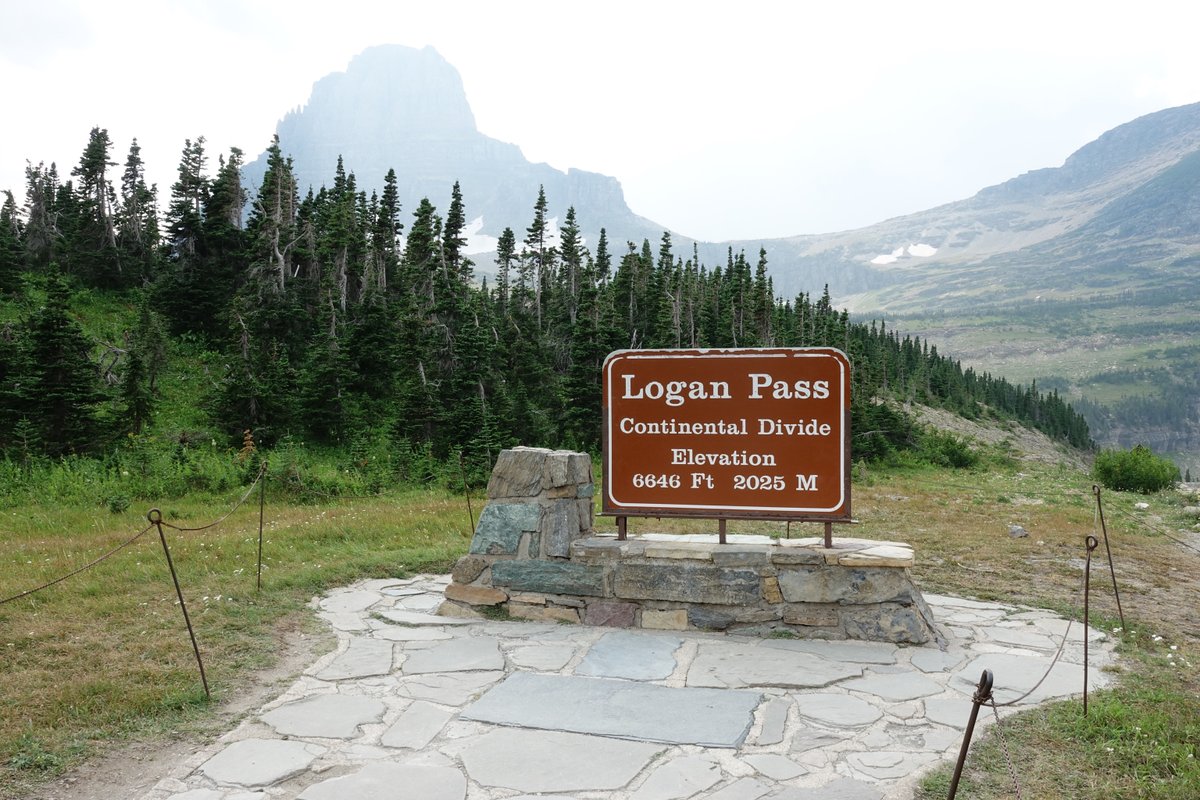
You’re driving up the Going-to-the-Sun Road, palms a little sweaty because the drop-offs are no joke, and you finally reach the crest. This is it. The Logan Pass Visitor Center. It sits at 6,646 feet, right on the Continental Divide, and honestly, it looks like something out of a Wes Anderson movie dropped into the middle of the Swiss Alps. But here is the thing: if you pull into that parking lot at 9:00 AM, you’ve already lost.
Most people think of a visitor center as a place to grab a map and use the restroom. At Logan Pass, it’s the gateway to the Highline Trail and Hidden Lake Overlook, which means it’s the most contested piece of real estate in Glacier National Park. The building itself is a classic piece of "National Park Service Rustic" architecture, finished in 1966. It blends into the landscape because it's built from local stone and timber, but the real star isn't the wood—it's the grizzly bears that occasionally wander through the parking lot.
Seriously.
The Parking Nightmare at Logan Pass Visitor Center
Let’s get the stress out of the way first. The lot at the Logan Pass Visitor Center is usually full by 7:30 AM during the peak season of July and August. Sometimes earlier. If you’re coming from the West Glacier side, you’re looking at a good 60 to 90-minute drive just to get there. Imagine driving all that way, seeing the jagged peaks of Garden Wall, feeling the crisp air, and then seeing a ranger holding a "Lot Full" sign. It's heartbreaking.
You have two real options here.
You can wake up at 5:00 AM, drink your coffee in the dark, and be one of the first cars in. Or, you can embrace the park's shuttle system. The shuttle is free once you’ve paid your entrance fee, and it lets you actually look at the mountains instead of staring at the bumper of the rental car in front of you. Plus, the shuttle drivers are basically walking encyclopedias. They’ll tell you about the 1967 "Night of the Grizzlies" or point out mountain goats while you're just trying to remember where you put your bear spray.
The pass is closed for most of the year. Snow can pile up thirty feet high here. The road crew (shoutout to the guys in the Big Drift) works for months just to plow the way through. Usually, the visitor center doesn't even open until late June or early July. If you show up in May, you aren't seeing the visitor center; you're seeing a massive wall of white.
Why the Highline Trail is Actually Worth the Hype
Directly across the road from the Logan Pass Visitor Center is the trailhead for the Highline. It is, quite simply, one of the best hikes in North America. But it’s not for the faint of heart. Within the first mile, you’re walking along a ledge that’s about four feet wide with a sheer 100-foot drop on one side. There’s a cable bolted into the rock for you to hold onto.
Is it scary? Kinda. Is it worth it? Absolutely.
The views of the McDonald Creek Valley are staggering. You’ll see wildflowers—yellow glacier lilies and white bear grass—that look like they belong in a Dr. Seuss book. Bear grass isn't actually grass, by the way. It’s a member of the lily family, and it only blooms every few years in a massive "mast" event. If you see them in full plume, you’ve hit the botanical lottery.
Hidden Lake: The "Easy" Hike That Isn't
Behind the Logan Pass Visitor Center, there’s a boardwalk leading to Hidden Lake Overlook. People call this the "easy" hike. It’s 1.5 miles one way.
Don't let the "boardwalk" part fool you.
It’s a steady uphill climb, and at this altitude, your lungs will feel it. The air is thinner up here. You’ll see families gasping for breath halfway up while mountain goats casually trot past them like they're on a Sunday stroll. These goats are famous. They’re salt-lickers. They will follow you if they think you’re sweaty (gross, but true). Keep your distance. A goat's horns are no joke, and the park rangers at the Logan Pass Visitor Center will tell you to stay at least 25 yards away from all wildlife. Except bears. Give them 100 yards.
The view at the overlook is the postcard shot: Hidden Lake tucked into a cirque with Bearhat Mountain looming over it. If you’re feeling spicy, you can hike down to the lakeshore, but remember—you have to hike all that way back up.
The Logan Pass Visitor Center Building Itself
If you actually make it inside the building, there are some cool exhibits about the geology of the park. Glacier is unique because of the Lewis Overthrust. Basically, older rock was shoved on top of younger rock. It’s upside-down geology. You can see the dark band of diorite—an igneous rock—cutting through the sedimentary layers on the nearby peaks.
The rangers here are some of the most knowledgeable in the system. Ask them about the "relict" populations of plants that survived the last ice age on "nunataks"—the peaks that poked out above the ice.
Surviving the Elements
Weather at the Logan Pass Visitor Center is chaotic. I’ve seen it go from 70 degrees and sunny to a freezing sleet storm in twenty minutes. Because it’s a high-alpine environment, there is no cover. No trees. Just you and the elements.
- Layers are mandatory. Even in July, bring a windbreaker.
- Water is key. You’re at nearly 7,000 feet. You will get dehydrated.
- Bear spray. Don't just buy it; know how to use it. If a grizzly comes around the corner on the Highline, you don't want to be reading the instructions.
The visitor center has restrooms and a small bookstore, but they don't sell food. If you arrive hungry, you're out of luck until you drive back down to Rising Sun or Lake McDonald. Pack a lunch. Eating a sandwich while looking out at the Reynolds and Clements Mountains is better than any five-star restaurant anyway.
The Continental Divide Reality
When you stand at the Logan Pass Visitor Center, you’re standing on the spine of the continent. Water falling on one side of the pass eventually hits the Pacific. On the other side? It heads toward the Atlantic (via the Gulf of Mexico) or even the Arctic Ocean via Hudson Bay. There is a specific spot nearby called Triple Divide Peak where the water literally splits three ways. It’s one of the few places on Earth where that happens.
It’s easy to get caught up in the "tourist" aspect of the pass—the crowded parking, the gift shop, the selfies. But if you take a second to walk just a few hundred yards away from the pavement, the silence is heavy. You can hear the wind whistling through the rocks and the occasional whistle of a hoary marmot. Those marmots are chunky, by the way. They spend all summer eating so they can survive the eight months of winter they spend buried under the snow.
Practical Steps for Your Visit
- Download the NPS App. Mark Glacier National Park for offline use. Cell service at the Logan Pass Visitor Center is basically non-existent.
- Vehicle Reservations. Check the current requirements for the Going-to-the-Sun Road. In recent years, you’ve needed a specific reservation just to drive the road during peak hours. If you don't have one, you aren't getting in before 3:00 PM.
- The "Twilight" Strategy. If you can’t get there at 6:00 AM, try going at 5:00 PM. The sun stays up late in Montana (sometimes until 10:00 PM in June). The crowds thin out, the light turns golden, and the animals come out to play.
- Footwear. Do not hike the Highline in flip-flops. I see people do it every year, and it’s a recipe for a twisted ankle or a very long helicopter ride.
- Check the Webcam. The park service maintains a live webcam at the Logan Pass Visitor Center. Check it before you leave your hotel or campsite to see if the pass is socked in with clouds. If you can't see the building on the camera, you won't see the mountains from the trail.
Standing at the top of the pass, looking out over the "Crown of the Continent," you realize why George Bird Grinnell fought so hard to protect this place. It’s raw. It’s fragile. The glaciers are melting—that’s a fact—and the landscape is changing. But for now, the Logan Pass Visitor Center remains the best seat in the house for watching the world from the top down.
Plan for the crowds, prepare for the weather, and get there early. It's the only way to do it right.
Actionable Next Steps
Before you head out, verify the current road status on the official Glacier National Park website, as snow removal or construction can change access overnight. Purchase your bear spray at a local shop in Kalispell or Columbia Falls rather than waiting for the park stores, as they often sell out during peak weeks. Finally, if you plan on using the shuttle, arrive at the Apgar Visitor Center or St. Mary Visitor Center at least 30 minutes before the first scheduled bus to ensure you get a seat. For those driving, ensure your gas tank is at least half full; there are no gas stations on the Going-to-the-Sun Road, and the climb to the pass consumes fuel much faster than flat-land driving.