It was New Year’s Eve, 2014. While most people were popping champagne or trying to figure out where they left their Uber, Kanye West decided to drop a song that sounded like nothing else in his catalog. Only One arrived with zero warning. No drums. No aggressive "Yeezus" distorted synths. Just a soft, slightly wobbly electric piano and Kanye’s voice, thick with Auto-Tune, singing from a perspective nobody expected.
He was singing as his late mother, Donda West.
Honestly, the track felt like a fever dream at first. You had the most controversial rapper on the planet collaborating with a literal Beatle. Paul McCartney was on the keys, yet his name wasn't even shouted out in a flashy way. It was just... there. It was a quiet moment in a career usually defined by noise.
What Really Happened in That Bungalow?
The making of Kanye West Only One isn't your typical studio story. This wasn't a sleek session at Electric Lady with fifty engineers. It started in a small bungalow in Los Angeles in early 2014. Kanye and Sir Paul McCartney just sat down to talk.
McCartney later told The Sun that the vibe reminded him of his time with John Lennon. They weren't "writing" in the traditional sense. McCartney was improvising on the keyboards—specifically a Rhodes-style electric piano—and Kanye was just "sketching" vocals. He was doing a stream-of-consciousness riff. Basically, he was humming and mumbling until words started to form.
When they played the recording back, Kanye had a moment that he’s described as almost supernatural. He was sitting with his daughter, North West, on his lap. He heard himself singing the line, "Hello, my only one."
The crazy part? Kanye didn't remember writing it. He didn't even remember singing it.
He realized that his mother, Donda, was speaking through him to his daughter. It’s a heavy concept. But for Kanye, it was a "channeling" experience. He later pointed out that his own name, Kanye, actually means "only one" in Swahili. The title wasn't just a sweet phrase; it was a bridge between three generations: Donda, Kanye, and North.
The McCartney Factor: Why "Only One" Sounds So Bare
If you look at the credits for Kanye West Only One, you’ll see some heavy hitters. Mike Dean is there. Noah Goldstein is there. Even Ty Dolla $ign is buried in the background vocals. But the skeleton of the song is Paul McCartney’s playing.
A lot of people at the time joked that Kanye "discovered" Paul McCartney. That was obviously a meme, but there was a real point behind the humor. Kanye used McCartney as a session musician. That’s a massive flex. Instead of a high-energy pop anthem, he took a rock legend and asked him to play a simple, soulful melody that sounds like a lullaby.
The production is incredibly "dry."
There’s no reverb to hide behind.
The Auto-Tune isn't used to make Kanye sound like a robot; it’s used to make his voice sound fragile. It cracks. It wavers. When he sings, "I know you're happy / 'Cause I can see it," you can almost hear the lump in his throat. It’s a far cry from the "I am a God" persona he’d been projecting just a year prior.
The Lyrics: A Message from Donda
The song is written as a message from Donda West in heaven, looking down at her son.
- The Storm: "I think the storm ran out of rain, the clouds are moving." This is widely seen as a reference to Kanye’s mental state and the "dark" period following his mother’s passing in 2007.
- The Mistakes: "No you're not perfect but you're not your mistakes." This is probably the most quoted line of the song. It’s a mother’s grace applied to a man who, let’s be real, has made a lot of public mistakes.
- The Request: The song ends with the repetitive, haunting plea: "Tell Nori about me."
Nori is, of course, North West. Donda never got to meet her. That realization is what makes the song hit so hard. It’s a grandmother trying to introduce herself through a song because she can’t be there to hold the baby herself.
The Spike Jonze Video You Might Have Forgotten
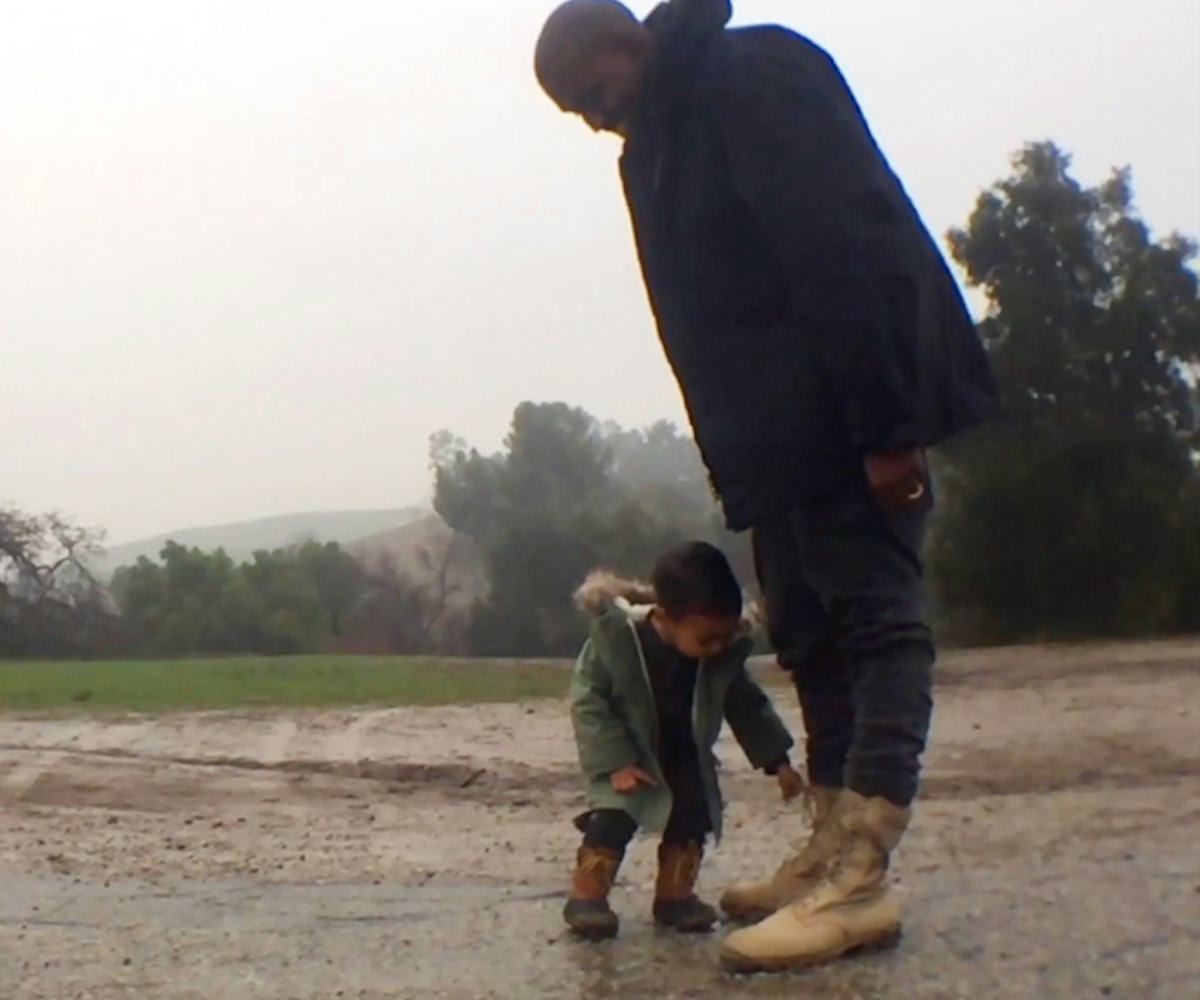
A few weeks after the song dropped, Kanye went on The Ellen DeGeneres Show to premiere the music video. It wasn't a big-budget cinematic production. It was directed by Spike Jonze—the guy behind Being John Malkovich and some of the most iconic videos of the 90s—but it looked like a home movie shot on an iPhone.
It’s just Kanye and North.
They’re in a soggy, foggy field.
Kanye is wearing a heavy brown coat. North is in boots, walking through the mud.
There are no jump cuts. No special effects. It’s just a father and his 18-month-old daughter hanging out in the rain. It matches the song perfectly because it’s raw and unpolished. It feels private, like we’re looking at something we weren't supposed to see. At one point, Kanye just stops and looks at her, and the look on his face is pure, uncomplicated dad energy.
Why "Only One" Was a Career Pivot
Before Kanye West Only One, Kanye was in his "industrial" phase. Yeezus was all about screaming, leather skirts, and middle fingers to the fashion industry. People thought he’d lost his mind.
"Only One" proved he could still write a melody that could make a grown man cry.
It also kicked off the "McCartney Era." Shortly after, we got "FourFiveSeconds" with Rihanna and "All Day." It showed a shift toward a more collaborative, gospel-adjacent sound that would eventually lead to The Life of Pablo. It was the first sign that the "Old Kanye" (the soulful, sample-heavy producer) and the "New Kanye" (the avant-garde artist) were finally starting to merge into something new.
What Most People Get Wrong About the Collaboration
There’s a misconception that McCartney wrote the song and Kanye just sang it. That’s not how they worked. McCartney provided the "vibe" and the chord progression, but the emotional core—the lyrics and the concept of Donda speaking—was all Kanye’s stream-of-consciousness.
Also, some critics at the time complained about the Auto-Tune. They said, "Why would you get a Beatle and then use a computer to fix the vocals?"
But that's missing the point. In Kanye West Only One, the Auto-Tune is an instrument. It represents the "channeling" he was talking about. It’s a distorted transmission from another world. If the vocals were perfectly clean, it wouldn't feel as ghostly. It wouldn't feel like a transmission from the afterlife.
How to Appreciate "Only One" Today
If you haven't listened to it in a while, or if you only know it from the memes, here is how to actually digest it:
- Listen with headphones: The Ty Dolla $ign harmonies in the background are super subtle but they add a lot of warmth to the second half.
- Watch the Spike Jonze video: It changes the context of the lyrics when you see him looking at North while the "Donda" vocals are playing.
- Read the lyrics while you listen: Focus on the transition where he stops being "Kanye" and starts being "Donda." It happens right around the "Hello, my only one" line.
Actionable Insight: If you're a creator or musician, take a page out of this session. Don't try to "write" a hit. Sit down, start a voice memo, and just mumble until the truth comes out. Kanye and McCartney didn't have a plan; they just had a conversation, and that's why the song still feels human ten years later.