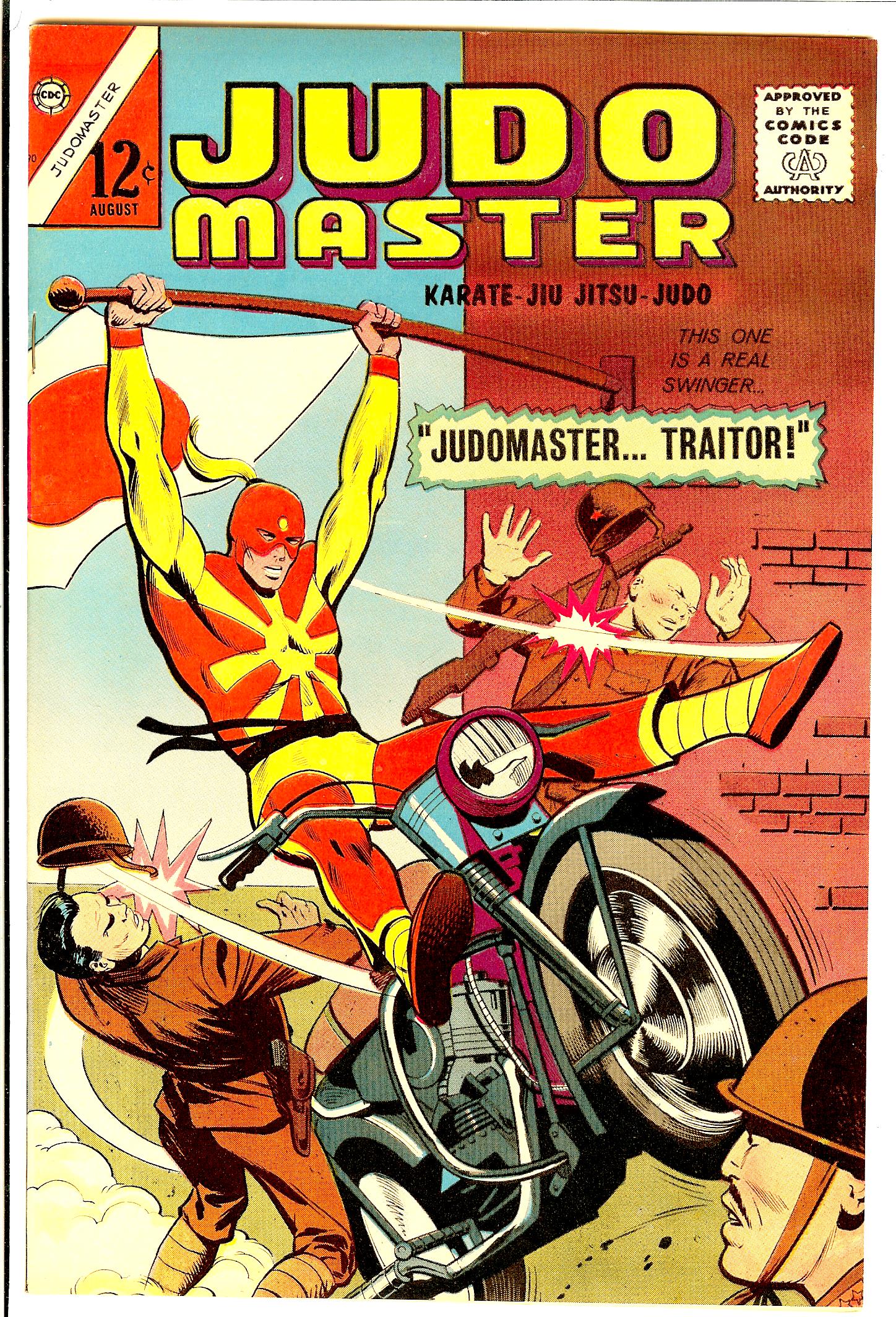
You’ve probably seen the guy in the goofy yellow and green spandex getting mocked in Peacemaker on Max. He’s short, he loves Flamin' Hot Cheetos, and he kicks an incredible amount of ass. But the real story of Judomaster in DC Comics is way weirder than a streaming show cameo. Honestly, he wasn't even a DC character to begin with. He started at Charlton Comics, the same budget-bin publisher that gave us the Blue Beetle and Question, before DC bought the whole lot in the eighties.
Most people think he’s just a generic martial arts trope. He isn't.
The original Judomaster, Hadley "Rip" Jagger, was a World War II sergeant. Think about that for a second. In an era where every comic book hero was carrying a tommy gun or punching Hitler in the face with raw American muscle, Jagger was using specialized leverage and momentum. He was basically the first high-profile pacifist-leaning fighter in a medium defined by violence. It’s a strange legacy.
The Charlton Origins and the Jump to DC Comics
Rip Jagger debuted in Special War Series #4 back in 1965. Joe Gill and Frank McLaughlin created him. The backstory is pure Silver Age grit: Jagger saves a Pacific islander's daughter, and in return, he’s taught the "secret" art of Judo. It sounds cliché now, but back then, Judo was still mystical to Western audiences.
When DC Comics acquired Charlton, they had to figure out what to do with this guy. They didn't just dump him into Gotham City. Instead, they placed him on Earth-Four. Later, after Crisis on Infinite Earths nuked the multiverse, he was folded into the main DC timeline as a member of the All-Star Squadron.
He’s an old-school hero.
The transition wasn't seamless. Unlike Batman, who evolves every decade, Judomaster stayed stuck in his ways. He represented a specific kind of Golden Age morality. He was a man out of time, literally. In the L.A.W. (Living Assault Weapons) miniseries in the late '90s, we saw him trying to fit into a world that had become much more cynical. He was the moral compass in a room full of anti-heroes like Peacemaker and Nightshade.
Why the Second Judomaster Changed Everything
Then things got interesting. Rip Jagger died. It happens to everyone in comics, usually at the hands of a villain like Bane during Infinite Crisis. But his death paved the way for Sonia Sato.
Sonia is the Judomaster DC Comics fans actually remember from the modern era. Introduced in Justice Society of America #11 by Geoff Johns and Dale Eaglesham, she was a total departure. She had a "meta-human" ability that the original lacked: an aversion field. Basically, you cannot hit her. If you try to punch her, your aim just... misses. It’s a passive defensive power that perfectly mirrors the philosophy of Judo, which is about using an opponent's energy against them.
She joined the JSA. She dated Damage (Grant Emerson). She dealt with the heavy baggage of being a legacy hero in a world where her predecessor was a white guy in a culturally specific mask.
The Power Set: It’s Not Just Throwing People
Let's talk about the fighting style. Judo translates to "the gentle way."
In the comics, this is interpreted through "Kuzushi" or unbalancing the opponent. Sonia Sato takes this to a supernatural level. If Superman flies at her, he’s going to end up in the dirt because his own momentum is his undoing. It makes her one of the most difficult characters to write in a fight scene. How do you beat someone you literally cannot touch?
She isn't just a brawler. She's a tactical nightmare.
- Aversion Field: A permanent aura that deflects incoming attacks.
- Expert Technique: Mastery of throws, joint locks, and pins.
- Strategic Mind: Trained to lead teams under high-pressure scenarios.
The Peacemaker Connection and Misconceptions
If you came here because of the TV show, you need to know that the version played by Nhut Le is a massive departure from the source material. In the comics, Judomaster and Peacemaker are teammates. They’re both Charlton alum. They have a mutual, albeit tense, respect.
The show turns him into a villainous (or at least antagonistic) bodyguard. It works for the screen because he's a foil to John Cena's loud, brash violence. But in the Judomaster DC Comics lore, the character is usually a symbol of discipline and restraint.
There's also a third Judomaster, Thomas Jagger, Rip's son. He showed up in Checkmate. He was a spy. He used a more brutal version of the martial art. He’s often overlooked, but he adds a layer of "family business" to the mantle that makes the DC version feel more lived-in than the Charlton original.
The Cultural Impact of a "Niche" Hero
Critics often argue that Judomaster is a relic of "Orientalism" in comics—the 1960s obsession with "exotic" Eastern martial arts. While that's true for Rip Jagger's origin, the character has evolved. Sonia Sato reclaimed the identity. She turned it into a representation of Japanese-American strength rather than a caricature.
He’s never going to be A-list. He’s not getting a solo movie with a $200 million budget. But he represents the "connective tissue" of the DC Universe. Without characters like him, the world feels empty. He’s the guy who shows up in the background of a massive crossover event and saves a civilian while the Flash is busy fighting a god.
How to Collect Judomaster Stories
If you actually want to read this stuff, it’s a bit of a scavenger hunt. DC hasn't always kept his solo runs in print.
First, track down the Charlton Action Heroes archives. It’s the only way to see the 1960s stuff without spending thousands on back issues. It’s campy, sure, but the art by McLaughlin is genuinely great for the era.
Next, look for Justice Society of America (Vol. 3) by Geoff Johns. That’s where Sonia Sato shines. Her character arc during the "Thy Kingdom Come" storyline is some of the best B-list hero writing in the last twenty years. You see her struggle with the JSA's massive legacy and find her own footing.
Finally, check out Checkmate (Vol. 2) for the Thomas Jagger era. It’s a political thriller disguised as a superhero comic. It’s smart, dense, and shows a completely different side of what a "Judomaster" can be when they work for a shadowy government agency.
The Enduring Appeal of the Gentle Way
The reason we’re still talking about Judomaster in DC Comics in 2026 isn't because he’s the strongest. It’s because he’s unique. In a genre that usually solves problems with a bigger explosion or a harder punch, a character dedicated to leverage and defense stands out.
Whether it's Rip Jagger's WWII heroics, Sonia Sato's untouchable grace, or even the Cheeto-eating version on TV, the mantle persists. It’s a reminder that sometimes, the best way to win a fight is to let your opponent defeat themselves.
Your Next Steps for Exploring Judomaster
To truly understand this character's place in comic history, you should start by reading the L.A.W. (Living Assault Weapons) miniseries from 1999. It serves as the definitive bridge between the old Charlton characters and the modern DC Universe. After that, pick up the Justice Society of America: The Next Age trade paperback to see the debut of Sonia Sato. If you're a fan of the Peacemaker series, look for back issues of the 1960s Judomaster #89-98 to see the original dynamic between the two characters before they were reimagined for modern television.