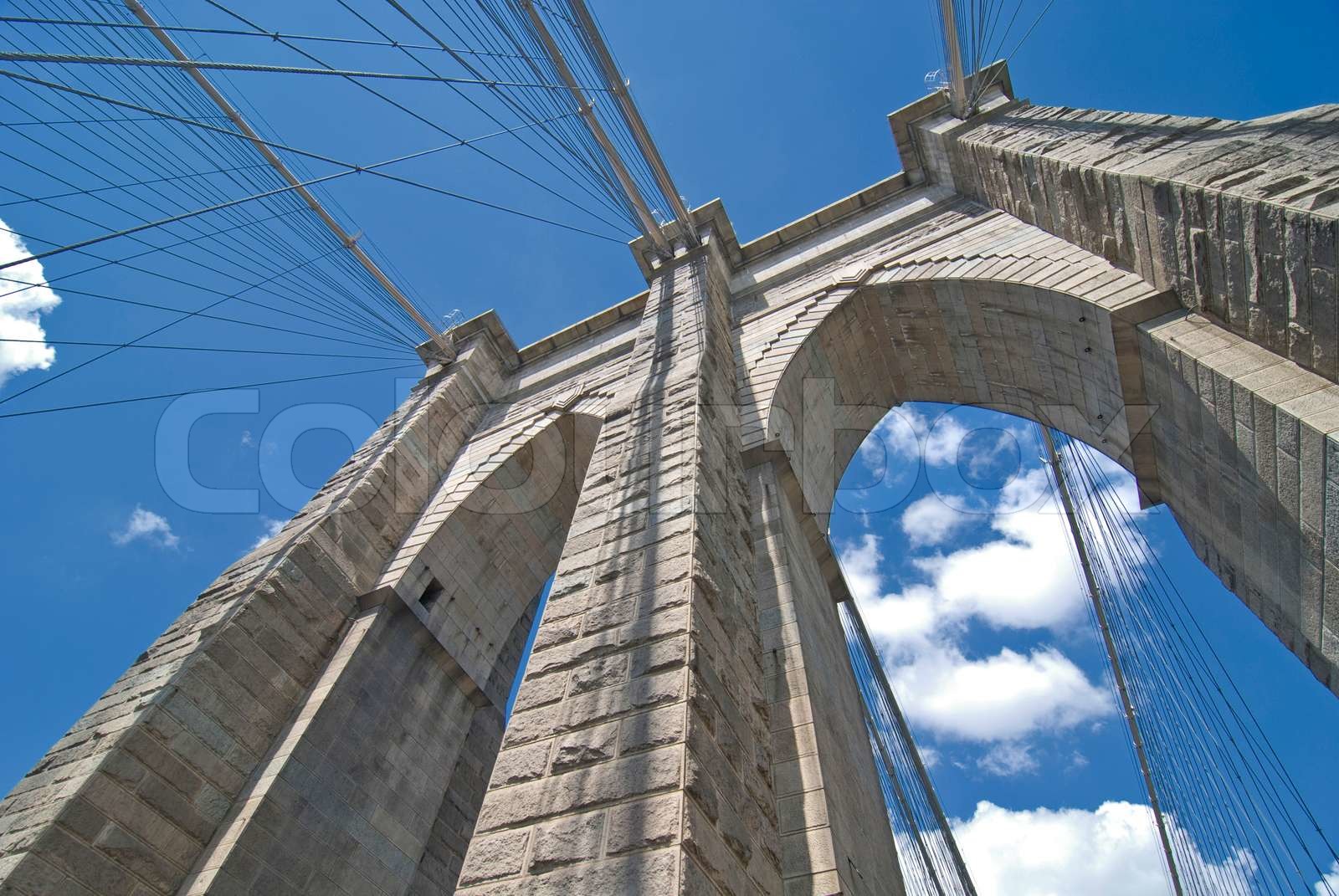
Everyone knows the Brooklyn Bridge. It’s that massive, neo-Gothic hunk of granite and steel that defines the New York skyline, appearing in every cinematic sweep of the city since movies were invented. But if you ask the average tourist who the architect of the Brooklyn Bridge actually was, they’ll probably give you a blank stare or maybe mumble something about a guy named Roebling.
They’re right. Sorta.
The truth is way messier and, honestly, much more tragic than a single name on a plaque. It wasn't just one person. It was a family dynasty defined by "caisson disease," stubborn brilliance, and a woman who basically had to teach herself higher mathematics on the fly to keep the whole thing from collapsing into the East River.
The Man Who Dreamed the Impossible (Then Died)
John Augustus Roebling was a German-born Prussian who studied under the philosopher Hegel. He was intense. He was a vegetarian before it was cool, obsessed with hydropathy (water cures), and had a temper that could probably melt the very wire he manufactured. He didn't just want to build a bridge; he wanted to build a monument to human willpower. Before the Brooklyn Bridge, people thought building a span of 1,595 feet was a literal joke. Critics called it a "castle in the air."
Roebling didn't care. He had already proven the skeptics wrong with his suspension bridge over the Niagara River. He knew steel wire was the future. While everyone else was messing around with iron chains, Roebling was perfecting the "air spinning" method of cable construction.
Then, the fluke happened.
In 1869, while surveying the site at a ferry slip, his foot was crushed by a docking boat. He didn't believe in traditional medicine, so he tried to treat the infection with "water therapy." It didn't work. He died of tetanus less than a month later. He never saw a single stone laid. If you're looking for the original architect of the Brooklyn Bridge, he's the one who gave the project its soul, but he never actually got his hands dirty in the construction.
Washington Roebling and the Terror of the Caissons
With the father dead, the burden fell to the son: Washington Roebling.
Imagine taking over the biggest engineering project in human history at age 32 because your dad died. Talk about pressure. Washington was an engineer, but he was also a Civil War hero who had navigated balloons for the Union Army. He was tough, but even he wasn't prepared for the caissons.
To build those iconic stone towers, they had to sink giant wooden boxes (caissons) to the bottom of the river. Men worked inside them, digging through the muck to reach bedrock. It was a nightmare. It was hot, the air was pumped in from above, and the pressure was immense. Lighting was provided by candles and gas lamps that flickered in the thick, humid air.
Then came the "bends."
Back then, nobody understood why men were coming up from the caissons and collapsing in agony or dying. We know now it was nitrogen bubbles in the blood—decompression sickness. Washington Roebling spent more time in those caissons than almost anyone else. He was a leader who led from the front. In 1872, he stayed down too long helping to fight a fire in the Brooklyn caisson.
He emerged paralyzed, partially blind, and in constant pain.
The Secret Architect: Emily Warren Roebling
This is where the story gets really interesting. For the next decade, the architect of the Brooklyn Bridge was effectively a woman named Emily Warren Roebling.
With Washington confined to his house in Brooklyn Heights—literally watching the construction through binoculars from his bedroom window—Emily became his eyes, ears, and voice. She didn't just carry messages. She studied strength of materials, stress analysis, and complex bridge specifications.
She was basically a 19th-century stealth engineer.
The Assistant Engineers on the project weren't dumb; they knew she was the one calling the shots. She managed the politicians, the contractors, and the grumbling public. If she hadn't stepped in, the Board of Trustees probably would have stripped Washington of his title. She held the whole fragile ego-system together with sheer intellect and diplomacy.
When the bridge finally opened in 1883, Emily was the first person to cross it in a carriage. She carried a rooster as a symbol of victory. It was a weird, triumphant moment for a woman who wasn't allowed to vote but had just finished the greatest engineering feat of the century.
Why the Design Still Works Today
The Brooklyn Bridge is overbuilt. That’s why it’s still standing while modern bridges sometimes struggle. John Roebling didn't trust the math of his era entirely, so he designed the bridge to be six times stronger than he thought it needed to be.
He included a web of diagonal stay cables that look like a giant spiderweb.
- Suspension Cables: These carry the vertical load.
- Stay Cables: These provide stiffness against the wind.
- Granite Towers: These aren't just for show; they are massive anchors that hold the whole tension system in place.
Most suspension bridges don't use those diagonal stays anymore because we have better ways to stiffen decks now. But on the Brooklyn Bridge, they are the reason it survives the vibrations of thousands of cars a day—something the Roeblings couldn't have even imagined. They were designing for horse-drawn carriages and steam engines, yet their "excessive" safety margins saved the bridge for the automotive age.
The Steel Wire Scandal
Nothing in New York gets built without a little corruption. It’s basically tradition. During the construction, a contractor named J. Lloyd Haigh was caught supplying sub-standard steel wire. It was brittle and dangerous.
By the time they caught him, tons of the bad wire had already been spun into the cables.
Washington Roebling had a choice: tear it all down and start over, or find a way to fix it. He calculated that because he had over-engineered the bridge so significantly, they could actually leave the bad wire in place if they just added extra good wire to compensate. He made the call. The bridge is still holding that "bad" wire today, buried deep inside those massive 15-inch thick cables. It's a testament to the Roebling's obsession with safety factors.
How to Experience the Legacy Today
If you want to actually "see" the work of the architect of the Brooklyn Bridge, don't just walk across the wooden slats with the tourists. Look at the details.
- The Gothic Arches: John Roebling wanted the bridge to be a cathedral of commerce. The pointed arches in the stone towers are classic Gothic Revival, meant to make the bridge feel permanent and sacred.
- The Promenade: Roebling insisted on an elevated boardwalk for pedestrians. He believed that people in a crowded city needed a place to breathe fresh air and see the horizon. It was a deeply "lifestyle" choice for an industrial engineer.
- The Anchorage: If you visit the Brooklyn side, the massive stone structures that hold the cable ends are incredible feats of masonry. They are basically artificial mountains.
Real Insights for History and Engineering Buffs
The Roeblings represent a bridge between the old world of stonemasonry and the new world of steel. They were the first to use steel wire in a bridge of this scale. Before this, "wire" usually meant iron. Steel was still a bit of a mystery metal in the 1860s.
If you are researching the Roeblings, David McCullough's book The Great Bridge is the gold standard. It’s long, but it’s the most accurate account of the political infighting and the technical hurdles they faced.
What most people get wrong is thinking of the bridge as a static object. It's a living machine. It breathes, it moves in the wind, and it expands and contracts with the temperature. The Roeblings designed it to be flexible. That’s why it didn't snap during the Great Blizzard of 1888 or any of the hurricanes that have hit the city since.
Actionable Next Steps
To truly understand the impact of the Roebling family and the Brooklyn Bridge, you should move beyond the digital screen and engage with the history physically and intellectually:
- Walk the Bridge at Sunrise: To avoid the crowds and actually see the geometry of the cables without a thousand selfie sticks in the way, get there at 6:00 AM. Look at the "saddles" on top of the towers where the cables rest; they are designed to move to account for thermal expansion.
- Visit the Roebling Museum: Located in Roebling, New Jersey, this museum is built on the site of the old John A. Roebling’s Sons Company. You can see the actual machines used to spin the wire that holds up the bridge (and the Golden Gate, and the George Washington Bridge).
- Check out the "Manifold" at the Transit Museum: If you're in Brooklyn, the New York Transit Museum often has exhibits on the construction of the city's infrastructure, including rare photos of the caisson workers.
- Look for the Plaques: When you walk the bridge, find the plaque dedicated to Emily Warren Roebling. It’s a small acknowledgment of the woman who was the de facto Chief Engineer for over a decade.
- Study the "Stay" Cables: Observe how the diagonal cables intersect with the vertical suspenders. This "diagonal bracing" is the signature of the Roebling style and is what makes the bridge look like a Victorian drawing.
The Brooklyn Bridge isn't just a way to get from Manhattan to Brooklyn. It’s a 140-year-old proof of concept that outlived its creators and their critics. It stands because three people—John, Washington, and Emily—refused to let death, disease, or corruption stop them.