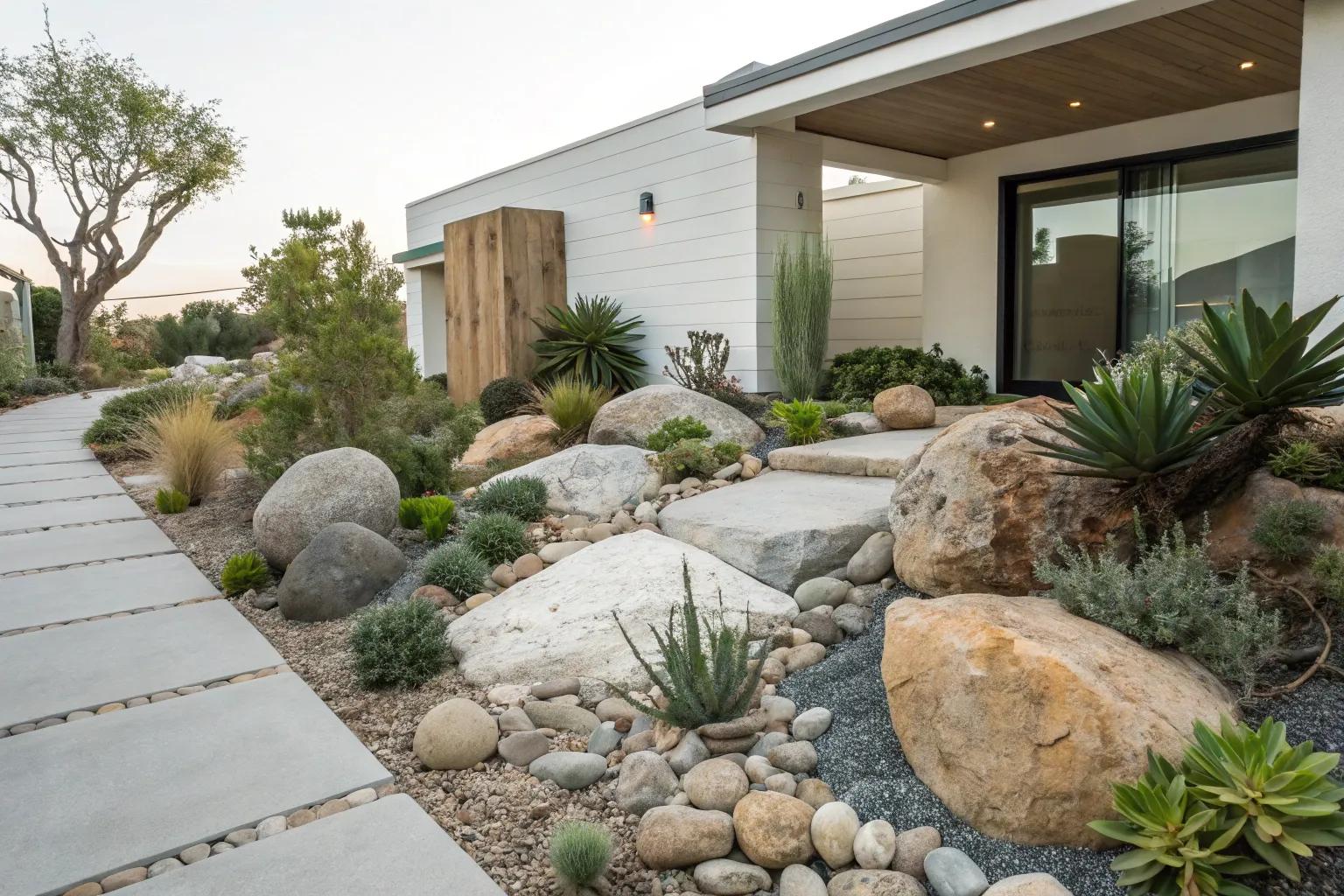
Ever stood in front of a patch of raked gravel and felt... nothing? It happens. Honestly, the biggest misconception about Zen gardens—or karesansui—is that they’re just "pretty" minimalist landscaping. They aren't. They’re actually dry landscapes meant for your mind to chew on. People often think they can just throw some pebbles in a wooden frame, stick a rock in the middle, and call it a day. But if you're looking for genuine japanese rock garden ideas, you have to start with the "dry" philosophy. No water. Just the suggestion of it.
The rocks aren't just rocks. In the 14th century, Zen monks at places like Ryoan-ji in Kyoto weren't trying to win a "Best Yard" award. They were building a physical manifestation of a koan—a riddle used in Zen practice. You look at the gravel, and your brain sees the sea. You look at a jagged boulder, and it becomes a mountain peak piercing through clouds. It’s a trick of the eye that forces the spirit to settle down. If you want to do this right, you’ve got to stop thinking like a gardener and start thinking like a painter who only has three colors to work with.
Why Your Stone Choice Is Failing the Vibe
Let's get real about the stones. Most people go to a big-box hardware store, grab some uniform grey river rocks, and wonder why their garden looks like a construction site. Real karesansui relies on Suiten, or the "character" of the stone. You need rocks that look like they’ve been through some stuff. In Japan, there are actually ancient manuals like the Sakuteiki (the oldest known book on garden design) that warn about the "taboos" of stone placement. For instance, never set a stone in a way that contradicts its natural "spirit"—if it looks like it wants to lie flat, don't stand it up vertically.
The Power of Odd Numbers
Don't go for symmetry. Please.
Nature doesn't do 2x2 grids. You want groupings of three, five, or seven. The "triad" is the classic move. You have one tall, vertical stone (the soul) flanked by two smaller, reclining stones. This creates a visual tension that keeps the eye moving. If you put two identical rocks next to each other, the brain gets bored and stops looking. But when you have a 12-inch tall jagged slate next to a 4-inch rounded granite piece, the contrast creates a "conversation."
You've also got to bury them. This is the secret nobody tells you. A rock shouldn't look like it was dropped onto the gravel from a drone. It should look like it's the tip of an iceberg. Bury the bottom third of your stones. It gives them "weight." It makes them feel like they’ve been there for a thousand years, even if you just bought them last Tuesday.
Raking Is Actually the Hard Part
The sand isn't just a floor; it's the ocean. Or a river. Or a bank of fog. Most japanese rock garden ideas fail because the raking is sloppy. Traditionally, monks used crushed granite, not beach sand. Beach sand is too fine; it blows away in a light breeze and doesn't hold the "comb" marks. You want 2mm to 4mm decomposed granite. It has enough weight to stay put and enough grit to catch the light.
Think about the ripples. If you rake straight lines, you’re looking at a calm sea. If you rake concentric circles around your stones, you’re creating the "splash" effect. It’s visual echoes. It suggests that the rock just fell into the water and the energy is radiating outward.
Honestly, the act of raking is supposed to be a meditation itself. You can't rush it. If your lines are shaky, it shows you were distracted. If the lines are deep and consistent, you’ve reached a state of mushin (no mind). It’s kind of a psychological feedback loop. You rake the garden to calm your mind, and your calm mind makes the garden look better.
Scaling Down: The Tsubo-niwa Concept
Maybe you don't have a giant backyard. Most people in Tokyo don't either. This is where the tsubo-niwa, or courtyard garden, comes in. These are tiny—we’re talking 10 square feet or less. They usually sit in the "dead spaces" of a house, like at the end of a hallway or under a staircase.
In these small spaces, every single leaf matters.
- The Moss Factor: Moss is the "grass" of the Japanese garden. It suggests age and humidity. If you live in a dry climate, don't fake it with plastic. Use low-growing succulents or Scotch Moss (which isn't actually moss but looks the part).
- The Lantern: A Yukimi-gata (snow-viewing lantern) is the go-to for small spaces. It has a wide roof that catches the snow in winter, adding another layer of seasonal beauty.
- The Barrier: Use a simple bamboo fence (shigaki) to block out the "noise" of the rest of the world. It’s about creating a frame. Without a frame, a rock garden is just a pile of dirt. With a frame, it’s a sanctuary.
The "Borrowed Scenery" Hack
Ever heard of Shakkei? It basically means "borrowing" the background. If you have a nice tree in your neighbor's yard or a mountain in the distance, you design your rock garden to lead the eye toward it. You’re essentially stealing their landscaping and making it part of yours. You frame your raked gravel so that it "flows" toward that distant tree. It makes a tiny yard feel like it’s part of a massive landscape.
It’s all about layers. Foreground (your rocks), middle ground (your fence), and background (the neighbor's oak tree). This depth is what makes a garden feel "expensive" and professional rather than DIY.
Maintenance Is the Hidden Lesson
Here is the truth: rock gardens are a pain to maintain. People think "Oh, no plants, no work." Wrong. Leaves fall. Weeds sprout through the landscape fabric. Bird poop happens. But that’s the point.
The maintenance is the practice. Picking out individual pine needles from a bed of white gravel forces you to be present. You can't multitask a Zen garden. You have to be there, in the dirt, noticing the small things. If you aren't prepared to spend twenty minutes every weekend with a rake and a pair of tweezers, you might want to just get a nice succulent arrangement instead.
But if you do it? There’s nothing like it. Sitting on a porch (an engawa) with a cup of tea, looking at a landscape you’ve "quieted" with your own hands—it does something to your blood pressure. It’s an antidote to the digital noise we’re all drowning in.
Common Blunders to Avoid
Don't overcomplicate the color palette. Stick to greys, whites, and the deep green of moss or evergreens. Red lava rocks? No. Neon blue glass pebbles? Definitely no. You’re trying to mimic the natural world, not a mini-golf course.
Also, watch your edges. A rock garden needs a crisp border to keep the gravel from migrating into your lawn. A simple edge of weathered steel or dark wood works wonders. It acts as the "canvas" edge.
Lastly, don't pack it too tight. The concept of Ma (negative space) is vital. The empty space in the gravel is just as important as the rocks themselves. It’s the "silence" between the notes in a song. If you fill every inch with "stuff," the eye has nowhere to rest, and you’ve defeated the entire purpose of the garden.
Actionable Next Steps
- Audit your space: Identify a "low-traffic" area where you won't be tempted to walk across the gravel. Zen gardens are for looking, not walking.
- Source local "character" stones: Skip the big-box stores. Go to a local quarry or a specialty landscape supplier. Look for stones with "skin"—weathering, lichen, or interesting textures.
- Test your grit: Order a small bag of 3/8-inch decomposed granite. See how it holds a rake mark after a light watering. If it slumps, you need a coarser grade.
- Sketch the triad: Before you dig, draw a simple three-stone arrangement. One high, one medium, one low. Focus on the "void" between them.
- Install a proper base: Use a heavy-duty geotextile fabric. Do not skip this. If you don't, you'll be fighting grass and weeds within a month, and your "Zen" will vanish very quickly.