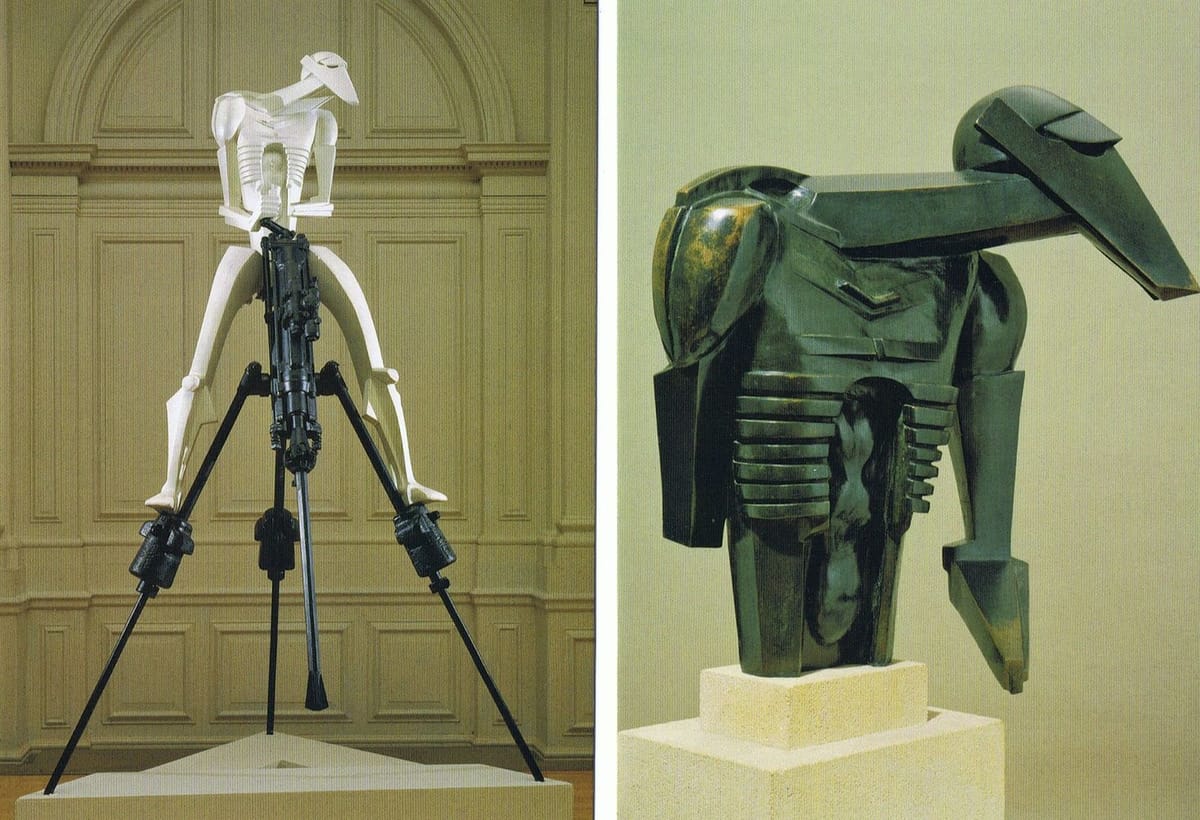
Honestly, if you saw a photo of the original Jacob Epstein Rock Drill without any context, you’d probably assume it was a prop from a 1970s sci-fi flick or maybe some lost concept art for a Star Wars villain. It looks like a robotic praying mantis or a skeletal stormtrooper perched on a massive, industrial tripod. It's weird. It's aggressive. And it's basically the most violent piece of art ever made that doesn't actually depict a drop of blood.
But here is the thing: most people who talk about the Jacob Epstein Rock Drill are actually looking at a ghost. Or a fragment. What you see in the Tate Britain today—that shiny, bronze, limb-less torso—is a total pivot from what the sculpture was meant to be.
The story of how this thing went from a celebration of "man-machine" power to a mutilated symbol of war-time regret is one of the most dramatic "oops" moments in art history. It's about a guy who fell in love with technology right before technology started murdering all of his friends.
The Original Vision: A Real-Life Cyborg
Back in 1913, Jacob Epstein was feeling himself. He was part of this vibe in London called Vorticism. Basically, these guys were obsessed with the "vortex" of modern life—the energy, the noise, the sheer, raw power of the industrial age. While everyone else was busy sculpting pretty naked ladies in marble, Epstein went out and bought a second-hand industrial rock drill from a quarry.
He didn't just sculpt a drill. He used the actual machine.
It was a "ready-made" before Marcel Duchamp made it cool with his urinal. Epstein took this heavy, vibrating, phallic piece of mining equipment and slapped a two-meter-tall plaster robot on top of it. The figure was visored and menacing. It looked like it was birthing the drill. Or maybe the drill was an extension of its own body.
Why the Drill Mattered
- The Phallic Factor: Let’s not beat around the bush; the drill was a massive phallus. It represented masculine virility and the "penetration" of the earth.
- The Fetus: Hidden inside the ribcage of this terrifying robot was a tiny, delicate plaster embryo. It’s this weirdly tender detail in the middle of all that cold machinery.
- The Sound: Epstein originally wanted to hook the thing up to a motor so it would actually vibrate and make a deafening noise in the gallery. Imagine walking into a quiet art show and being blasted by the sound of a jackhammer.
It was supposed to be a hero. A "Frankenstein’s monster" of the future, but in a good way. Epstein saw it as the "armed, sinister figure of to-day and to-morrow." He thought he was predicting a new race of super-men.
Then the Great War Happened
You've got to remember the timing. 1913 was the peak of this "machines are awesome" phase. Then 1914 hits. The First World War kicks off, and suddenly, those cool industrial machines aren't just for mining; they're for mowing down rows of teenagers in the mud.
The "staccato chatter" of the rock drill started sounding exactly like the Maxim machine guns at the front.
Epstein’s friends started dying. Henri Gaudier-Brzeska, a fellow sculptor he deeply admired, was killed in a charge in 1915. T.E. Hulme, the critic who was basically Epstein’s biggest hype-man, got blown up by a shell in Flanders.
Suddenly, the Jacob Epstein Rock Drill didn't look like a heroic vision of the future anymore. It looked like a murderer. It looked like the very thing that was turning his friends into "maimed and mutilated" fragments.
The Mutilation: Creating the Torso
By 1916, Epstein couldn't stand to look at the original sculpture. He didn't just put it in storage. He took a saw to it.
He threw away the actual rock drill—the piece he’d been so proud of buying. He cut off the robot’s legs. He lopped off its arms. He left it as a "castrated," helpless trunk of a body. This new version, which he renamed Torso in Metal from 'The Rock Drill', was cast in bronze (or gunmetal, which is a pretty grim choice of material given the context).
The Difference is Brutal
If the 1913 version was a predator, the 1916 version is a victim. The torso looks like the soldiers returning from the trenches—missing limbs, "withered" shoulders, and a hollowed-out sense of defeat. The fetus is still there, protected by the ribs, but now it looks more like a symbol of a future that’s been stunted before it could even begin.
You can actually see this version at the Tate. It’s haunting because you can feel the absence of the drill. The figure is still hunched over, clutching at a phantom machine that isn't there anymore. It’s the art equivalent of a ghost limb.
What People Get Wrong (And Why It Matters)
There’s a common misconception that the Jacob Epstein Rock Drill was always meant to be a critique of war. It wasn't. It was a fan-boy's tribute to the machine age that turned into a horror story in real-time.
Also, a lot of people think the original is lost forever. Technically, the original is gone—Epstein destroyed the plaster and sold the drill. But in 1974, researchers at the Birmingham Museum and Art Gallery used old photos and Epstein's notes to reconstruct the full 1913 version.
If you want to see what the "heroic" version looked like, you have to go to Birmingham. If you want to see the "traumatized" version, you go to London. Seeing them both tells you everything you need to know about how the 20th century lost its innocence.
The Rock Drill's Weird Pop Culture Afterlife
It's funny how this "failed" experiment by a New York-born sculptor living in London ended up influencing things decades later.
- Star Wars: Take a look at General Grievous or the battle droids in Revenge of the Sith. The visored, elongated heads and skeletal frames are a dead ringer for Epstein’s robot.
- Music: The Sensational Alex Harvey Band used the Torso for their 1978 album cover, titled—you guessed it—Rock Drill.
- The Chemical Brothers: They actually recorded a track called "The Rock Drill" in 2006 specifically to be listened to while standing in front of the sculpture at the Tate.
How to Experience the Jacob Epstein Rock Drill Today
If you're interested in checking this out for yourself, don't just look at a thumbnail on your phone. The scale is what makes it.
- Visit the Tate Britain: Look for the bronze Torso. Pay attention to the space between the arms. That empty space is where the drill used to be. It’s the most important part of the sculpture because it's what's missing.
- Compare it to Vorticism: Look at works by Wyndham Lewis or David Bomberg while you're there. You'll see the same sharp lines, but Epstein is the only one who really brought that energy into the 3D world.
- Head to Birmingham: See the reconstruction. It’s over two meters tall. Standing underneath that massive drill gives you a much better sense of why people in 1915 found it "utterly loathsome" and "menacing."
The Jacob Epstein Rock Drill is basically a diary entry in metal. It's the record of a man watching his optimistic dreams about the future turn into a nightmare of industrial slaughter. It’s one of the few pieces of art that tells the story of World War I without ever showing a battlefield.
Actionable Next Steps
To truly grasp the impact of this work, you should view the 1974 reconstruction and the 1916 Torso side-by-side (digitally or in person). Notice how the removal of the legs and drill shifts the figure's center of gravity from one of "domination" to one of "collapse." For those interested in the technical history, researching the Holman's of Cornwall rock drills used in the reconstruction provides a fascinating look into the specific machinery that defined the era's industrial power.